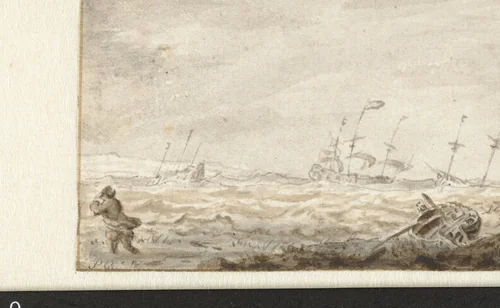
Pieter Coopse
Pieter Coopse, historically documented also as Pieter Jansz. Coops, was a distinguished draughtsman and painter whose specialized marine views defined his contribution to the Dutch Golden Age. Active around 1668, Coopse hailed from Hoorn in the Northern Netherlands, a region deeply reliant on maritime commerce and naval power. His work belongs to the flourishing tradition of seventeenth-century seascape art, a genre that demanded not only technical skill in rendering water and light but also detailed accuracy in depicting the intricate rigging and structure of ships.
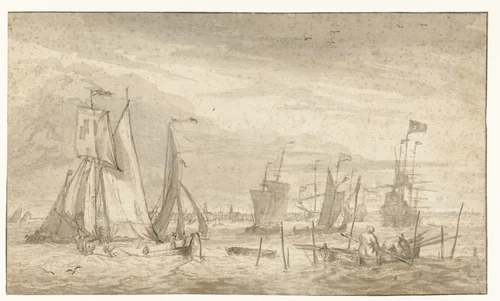
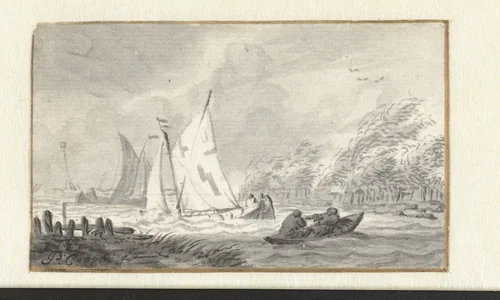
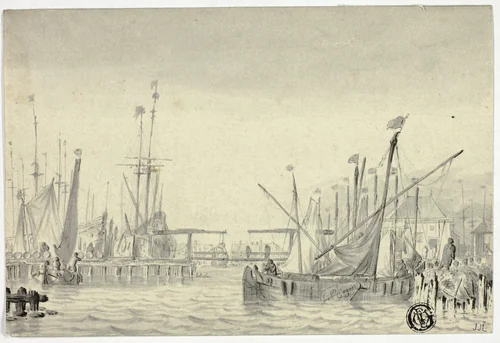
Coopse’s surviving oeuvre, largely concentrated in drawings, demonstrates a versatile engagement with water as both a dramatic force and an economic thoroughfare. He mastered the contrast between open ocean turbulence and the focused activity of harbor life. Compositions like Zeilschepen op ruwe zee capture the elemental, expressive power of rough waters, prioritizing movement and atmosphere. Conversely, the artist’s observational detail shines through in works focusing on commerce, such as Druk bevaren rivier voor een stadsprofiel and Ships in Harbor, where the vessels act as key indicators of the nation’s wealth and urban reach.
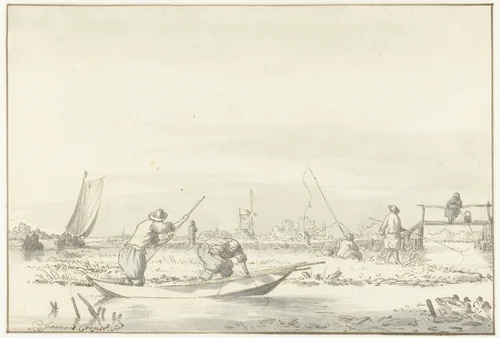
A subtle but defining characteristic of his output is the sheer range of scale and mood he could evoke using minimal materials. While known primarily as a seascape artist, Coopse also demonstrated a quiet facility with the inland environment, exemplified by the tranquil, descriptive details of Polderlandschap met vissers. It is perhaps a minor historical irony that an artist whose documented active period appears so concentrated managed to create works of sufficient enduring gravitas to maintain museum-quality standards centuries later.
The significance of Coopse is ratified by the inclusion of key works like Riviergezicht in prestigious international institutions, including the Rijksmuseum in Amsterdam and the Art Institute of Chicago. Today, scholars and enthusiasts seeking access to these compelling seventeenth-century views benefit from the fact that much of his known work resides in the public domain. Numerous collections facilitate the sharing of his images, allowing fine examples of Pieter Coopse prints to be distributed globally, thereby ensuring his sophisticated grasp of the maritime environment remains accessible through high-quality prints.
Source: Wikipedia · CC BY-SA 4.0