Pieter Bout
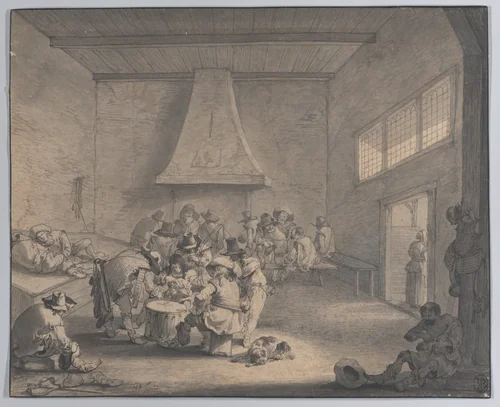
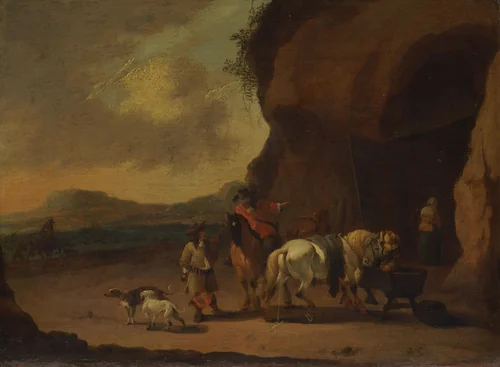
Pieter Bout (c. 1630-c. 1700) holds a significant position among the later Flemish masters, recognized for his expansive work as a painter, draughtsman, and printmaker. Active prominently during the years 1658 to 1670, Bout specialized in highly detailed landscapes, evocative architectural fantasies, and topographical views that documented both urban and coastal life. His works, including the dramatic Horsemen Halted on a Mountain Pass and the detailed Guardroom Scene, attest to a mastery of composition and narrative detail, securing his placement in major international collections such as the Rijksmuseum and the Metropolitan Museum of Art. His enduring legacy ensures the museum-quality standard of his surviving pieces.
Bout’s style is often assessed through its relationship to earlier Flemish traditions, particularly in its dense detail and ambitious scope, which recall the output of artists like Jan Brueghel the Elder. However, Bout was a transitional figure whose approach subtly forecast the changing aesthetics of the coming century. He utilized a notably clear and soft palette, avoiding the deep chiaroscuro favored by many of his contemporaries. This luminosity, coupled with his attention to atmospheric effects, signals a shift toward the lighter tonalities characteristic of 18th-century painting.
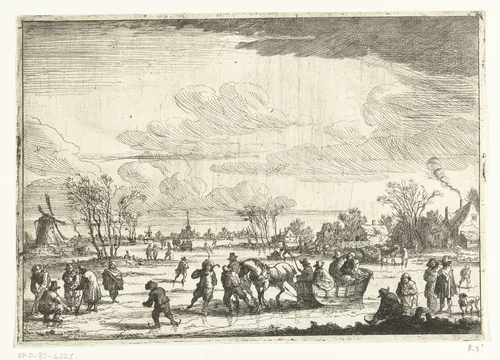
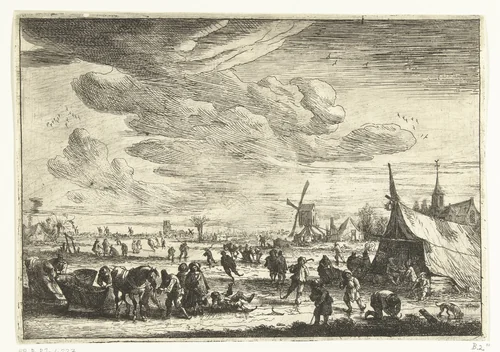
His versatile output encompassed both grand oil paintings and delicate graphic works. He frequently depicted communal leisure, transforming frozen waterways into vibrant centers of activity, as seen in Arrenslee op het ijs and Schaatsers op het ijs. Indeed, it is clear from the breadth of his graphic output that Bout maintained a particular fondness for depicting winter sports, often rendering the Dutch ice as a stage for miniature dramas of human interaction.
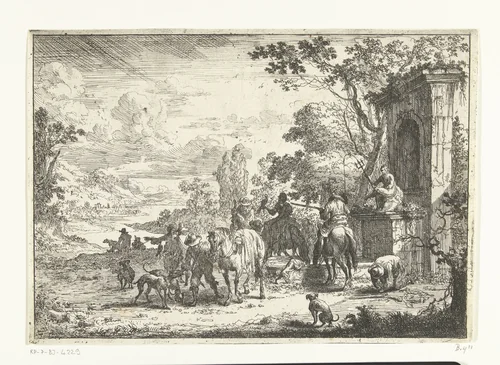
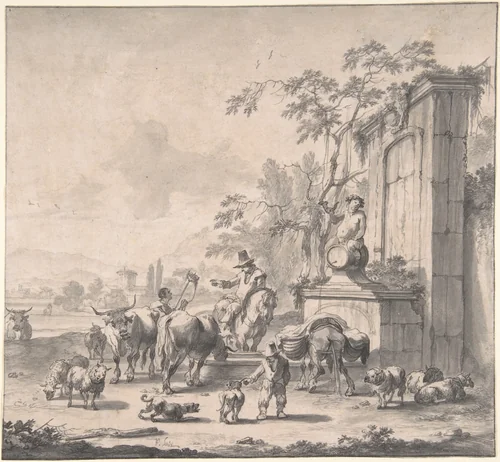
Whether executing complex architectural studies or detailed genre scenes like Rustende jagers bij een Neptunusfontein, Bout’s ability to imbue everyday life with dignity and precise observation remained constant. His commitment to printmaking ensured his vision reached a broad audience. Today, many Pieter Bout prints and etchings have entered the public domain, making his nuanced observations of 17th-century life highly accessible as downloadable artwork for researchers and enthusiasts worldwide.
Source: Wikipedia · CC BY-SA 4.0