Pierre Puget
Pierre Puget (1620-1694) was a singular force in French art during the seventeenth century, a polymath who successfully navigated the diverse roles of painter, architect, engineer, and sculptor. While the French court of Louis XIV increasingly favored the measured classicism of the Style Louis XIV, Puget brought an often raw and overwhelming emotional energy to his work, channeling the dramatic intensity of the Italian high Baroque.
Puget’s stylistic divergence allowed him to explore subjects of pathos and profound feeling, setting his output distinctly apart from the academic restraint prevailing in Paris. This powerful expressive vocabulary became his hallmark, establishing him as a crucial, if sometimes contentious, figure in the official hierarchy of French art.
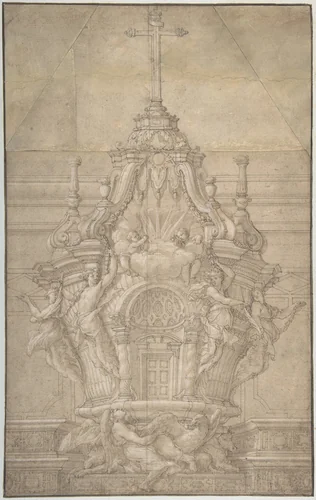
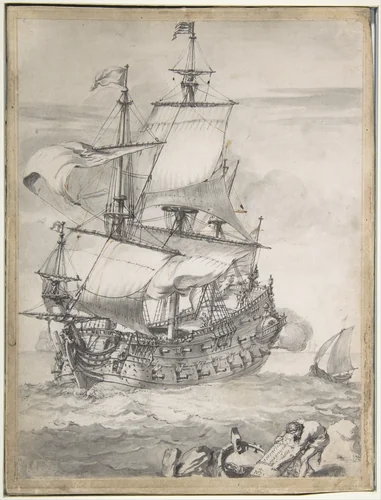
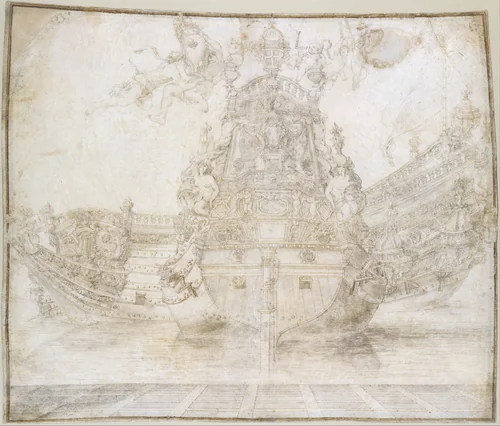
A significant portion of Puget’s career involved naval work in Toulon, where his skills as an engineer and designer were crucial for supervising maritime construction and ornamentation. This foundational experience informed his approach to structure and detail, visible even in his graphic works. Collections internationally, including the Metropolitan Museum of Art and the Rijksmuseum, maintain critical holdings of his highly detailed preparatory drawings. These range from grand architectural proposals, such as Design for a Tabernacle, to precise documentation of naval architecture, exemplified by Design for the decoration of a Warship.
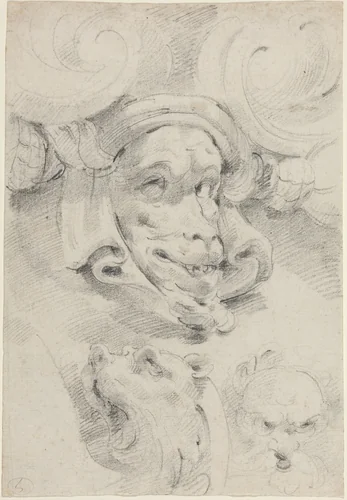
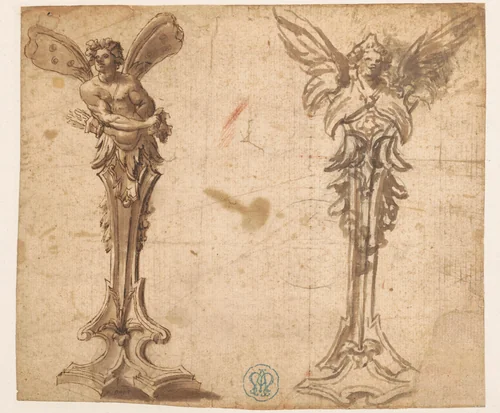
His versatility extended to decorative arts and ornament, demonstrated in works like Ornamental Sketches with Grotesque Masks and Twee ontwerpen voor gevleugelde hermen. These sketches reveal the fertile ground of his imagination, proving that his technical competence was matched by an exuberant creativity. Many of these important Baroque designs are now available as downloadable artwork through major institutional archives, ensuring the accessibility of his visual language to scholars and designers globally.
Although original Pierre Puget paintings are scarce, his extensive graphic output and monumental sculpture define his reputation. By embracing emotion and theatrical dynamics over cool intellectualism, Puget left behind a potent artistic legacy. These museum-quality works, often available today as high-quality prints, confirm his status not just as a master craftsman, but as one of the most compelling dramatic voices of the French Baroque.
Source: Wikipedia · CC BY-SA 4.0