Pierre Millet
Pierre Millet, whose documented artistic activity spanned the productive two decades between 1854 and 1874, occupies a specialized but compelling position within the history of mid-nineteenth-century European graphic arts. His known extant body of work is notably concise, comprised of just five distinct prints, four of which center on a singular, recurring motif: the laboring woman.
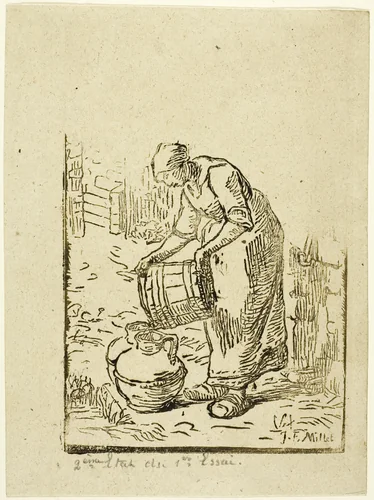
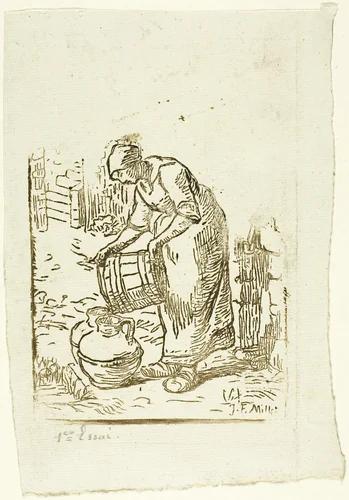
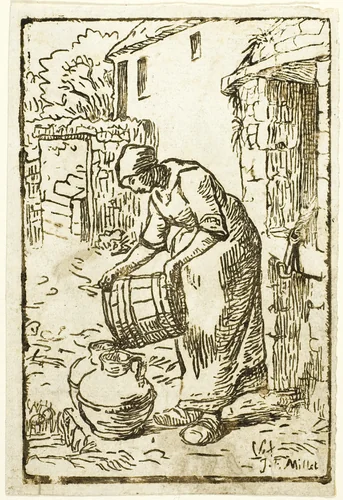
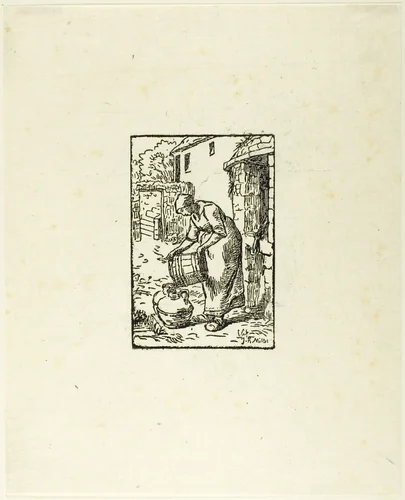
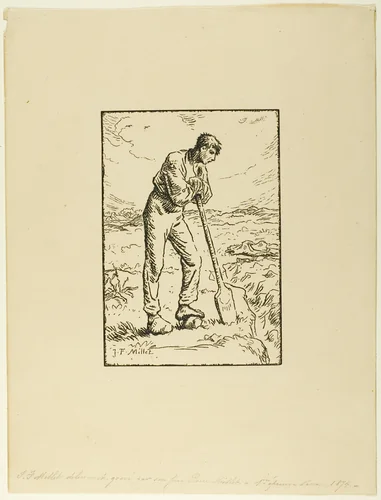
Millet’s technical precision and engagement with quotidian subjects mark him as a practitioner aligned with the rising tide of Realism. His key works, such as Digger Leaning on His Spade, provide a stark, unromanticized depiction of manual labor. However, it is his iterative focus on the composition Woman Filling Water-Cans, repeated four times in the surviving database records, that offers a subtle glimpse into his artistic process. Such deliberate repetition suggests an intense focus on refining line, shadow, and atmospheric effect, utilizing the reproducibility of the print medium to achieve nuanced variations on a powerful, humble theme. This dedication to the domestic struggle, rendered with such consistency, demonstrates Millet’s commitment to capturing the dignity inherent in routine work.
Despite his limited output, the significance of his work is confirmed by its inclusion in major institutional holdings, notably the Art Institute of Chicago, a clear indicator of its enduring museum-quality value. The scarcity of biographical detail surrounding Millet the printmaker, coupled with the profound historical weight of his compositions, only enhances the intrigue surrounding his period of activity.
Adding a fascinating layer of historical ambiguity, records for the name Pierre Millet (Milet) also identify a French Jesuit missionary active centuries earlier who traveled to the Iroquois people in what is now upstate New York. While the temporal gap prevents conflating the two figures, the historical echo creates a subtle narrative tension, suggesting that the name is associated with both spiritual exploration in the 17th century and the exacting exploration of physical labor in the 19th.
Today, thanks to digital archives, these images remain accessible to contemporary audiences. The detailed line work and strong tonal contrasts translate exceptionally well to modern viewing platforms, allowing enthusiasts worldwide to study Millet’s technique. Many of his works are now available as high-quality prints and royalty-free downloads, ensuring his precise observations on mid-century rural life continue to resonate far beyond their initial print runs.