Pierre Lepautre
Pierre Lepautre (1648–1716), the influential French engraver, occupies a crucial, transitional position in the history of European decorative arts. Active during the close of the grand Siècle de Louis XIV, Lepautre served as a foundational force in steering French taste away from severe Baroque classicism toward the intimacy and playful elegance of the nascent Rococo style.
His artistic contributions were centered on disseminating new design vocabulary through the medium of the printed plate. Unlike painters who worked for private or court patrons, Lepautre’s influence was widespread and industrial; his patterns and ornament prints circulated among architects, joiners, and interior designers across the continent. This mechanism allowed the emerging French aesthetic, characterized by its reliance on C- and S-scrolls, shell motifs (rocaille), and fluid asymmetry, to take root rapidly across the major European courts.
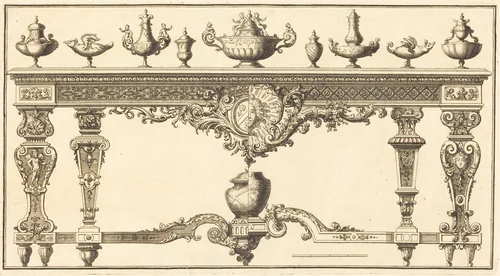
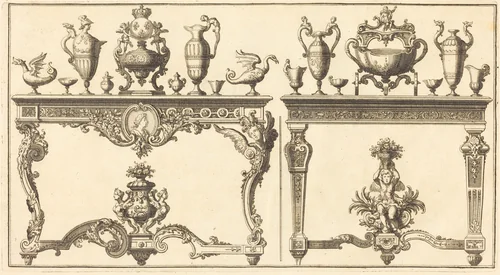
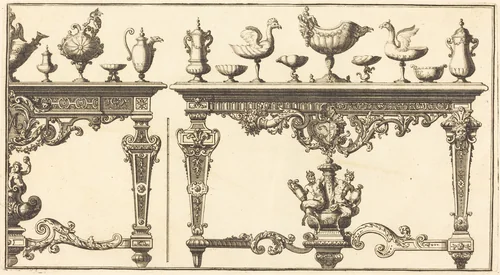
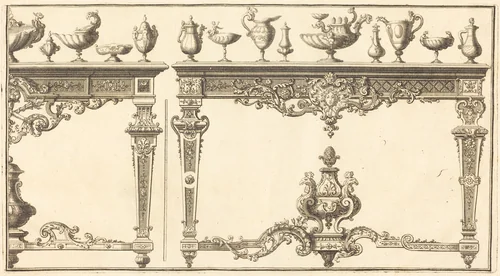
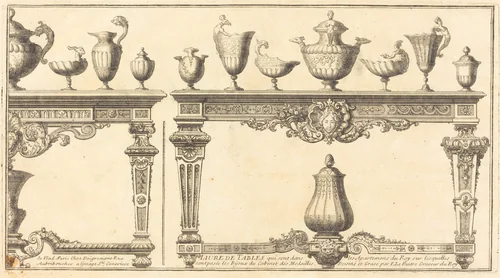
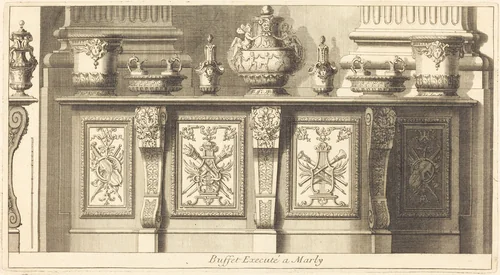
Lepautre is specifically credited with furthering the development of the Rococo movement, articulating its earliest formal characteristics well before 1715. His designs offered a decisive break from the heavy symmetry dictated by designers like Jean Bérain, introducing lighter compositions that anticipated the Regency period. His commitment to ornament is evident in his prolific output, including the definitive series of engravings known as Livre de Tables. These collections of detailed, museum-quality patterns provided comprehensive blueprints for elaborate console tables and architectural fixtures, fundamentally shaping the material culture of the 18th century.
It is a minor, yet persistent, complication in art history that Lepautre shares both a name and a near-identical active period with the celebrated French sculptor Pierre Lepautre (1659–1744). While the sculptor’s legacy resides in powerful marble figures defining the period’s sculptural standards, the engraver’s impact lies in his widely distributed design books. These pattern compilations of high-quality prints provided the sophisticated underpinnings for the century’s new interior sensibility. Today, his works are often found in institutional collections, making many of these pioneering designs available as public domain and free art prints for study and appreciation.
Source: Wikipedia · CC BY-SA 4.0