Pierre Audouin
Pierre Audouin (1768–1822) was an accomplished French engraver whose active professional career, spanning roughly 1788 to 1801, placed him at the crucial intersection of Neoclassical influence and the turbulent early Republican era in France. A trained academician, he studied under the established master Beauvarlet, adopting the meticulous technique necessary for translating complex oil paintings into reproducible media. Audouin’s enduring importance is underscored by the continued presence of his work in major international institutions, including the Rijksmuseum, the Metropolitan Museum of Art, and the Cleveland Museum of Art, where his high-quality prints are preserved for study.
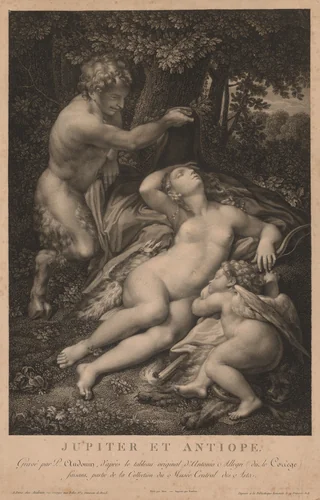
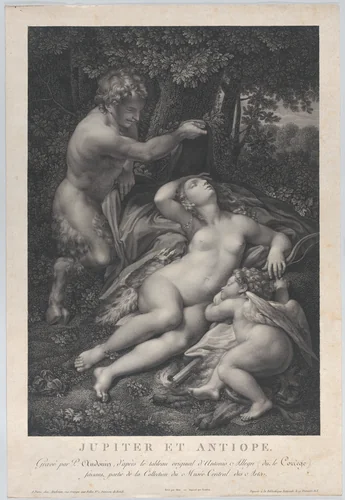
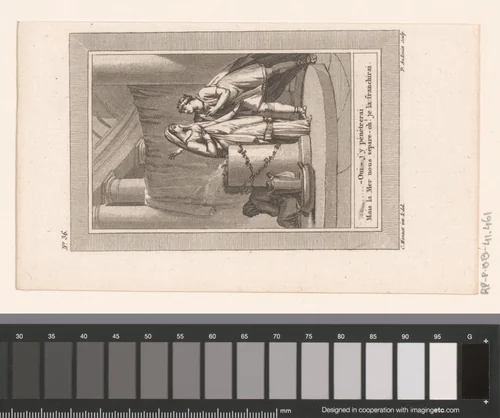
Audouin specialized almost entirely in reproductive works based on classical mythology, history, and the European canon, demonstrating a sophisticated command of line and shadow required for rendering paint into intricate intaglio. His portfolio reflects the period’s taste for heroic and sensual narratives, including dramatic mythological scenes such as Jupiter and Antiope, the tender exchange depicted in A satyr discovering the sleeping Venus, with Cupid lying at her side, and the tragic romance of Hero en Leander.
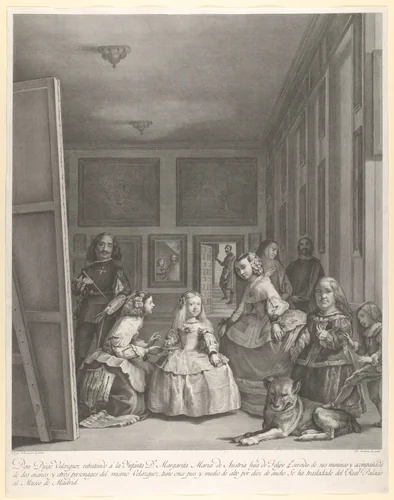
Beyond the classical repertoire, he engaged directly with Baroque masters. Arguably his most ambitious surviving work is the exacting transcription of Velázquez's masterpiece, titled Las Meninas: the family of Philip IV in the foreground with the Infanta Margarita in the centre, Velázquez standing painting at left, the King and Queen reflected in the mirror in the background. These detailed works reveal his mastery of rendering intricate compositions for distribution among collectors and art academies.
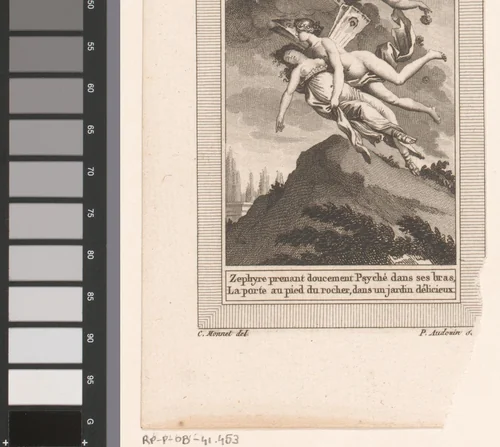
Printmaking in the late 18th century served an essential dual purpose: preserving the visual lineage of great paintings and making them culturally accessible to a wider European audience through affordable media. Audouin’s professional focus facilitated this cultural exchange, disseminating both contemporary tastes, evident in pieces like Zephyrus redt Psyche, and canonical history painting. It is perhaps telling that, like many of his cohort, his renown rests primarily on his exacting ability to translate the genius of others; few engravers captured the specific gravity of the masters with such unwavering discipline and clarity. Today, many surviving examples of his craftsmanship reside in the public domain, ensuring that these historically significant downloadable artwork remain available to scholars and enthusiasts worldwide, cementing Audouin's role as a vital link in the historical chain of artistic dissemination.
Source: Wikipedia · CC BY-SA 4.0