Pierre Andrieu
Pierre-Paulin Andrieu (1798-1855) holds a unique position in the history of nineteenth-century French culture. Though primarily known through historical records as a highly decorated cleric, serving as the Archbishop of Bordeaux et Bazes before achieving the rank of Cardinal, Andrieu maintained a rigorous, focused practice as a visual artist. His output, though concentrated and limited to five known major works, exhibits a technical mastery and thematic intensity that elevates his artistic production far beyond the status of mere avocation.
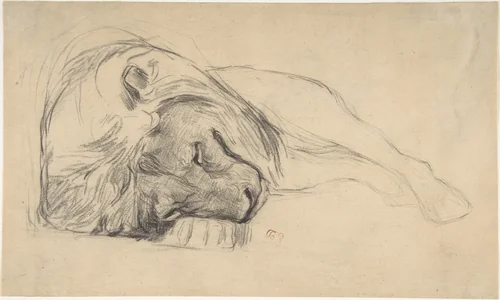
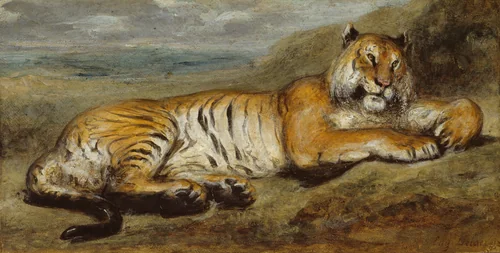
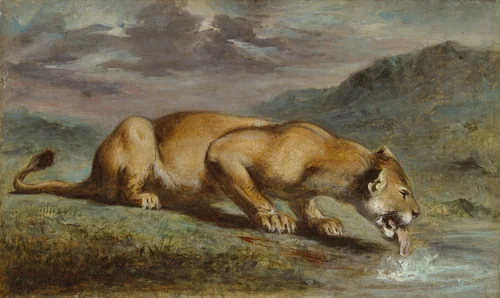
Active roughly between 1798 and 1855, Andrieu dedicated a significant portion of his known oeuvre to the study of the animal subject, particularly large, powerful predators. This focus aligns him loosely with the Romantic animalier painters, though his compositions possess an acute dramatic tension that separates them from straightforward naturalism. Works such as Tiger Resting and the starkly emotional drawing Wounded Lioness are defined by an academic precision in anatomy combined with an expressive use of line, suggesting an artist who sought to capture not just form, but the inherent psychological state of the subject.
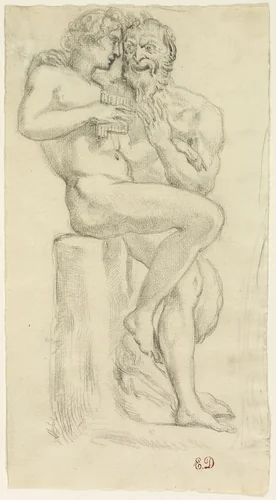
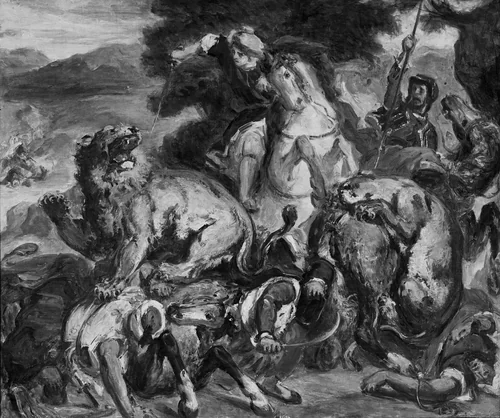
The power of these studies ensured that his work quickly entered significant public holdings. Today, these pieces are recognized as museum-quality examples of early Romantic draftsmanship, found in institutions like the Art Institute of Chicago and the Metropolitan Museum of Art. The most ambitious piece, The Lion Hunt, reveals his command of complex figure grouping and narrative momentum, a classical skill that he also applied to studies of the human form, demonstrated by Study of a Nude Figure and a Faun.
The inherent tension between Andrieu’s demanding ecclesiastical duties and his artistic fascination with the wild, often violent energy of the animal world provides a compelling point of historical contrast. His disciplined output ensures that collectors frequently seek high-quality prints and archival documents related to these compelling compositions. Due to the era of their creation, the visual legacy of Pierre Andrieu paintings and drawings is increasingly entering the public domain, making authentic digital reproductions and Pierre Andrieu prints accessible globally.