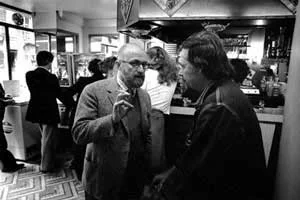
Pierre Alechinsky
Pierre Alechinsky, the celebrated Belgian master, holds a crucial and dynamic position in the history of postwar European abstraction. Born in 1927, Alechinsky established his primary working base in France starting in 1951, a strategic move that placed him at the epicenter of evolving artistic dialogue between continental Europe and the United States.
His prolific output demonstrates a powerful synthesis of gestural freedom and conceptual rigor, defining his critical active period between 1969 and 1985. Alechinsky’s visual language is deeply affiliated with the spontaneous, often explosive brushwork characterizing both tachisme and American Abstract Expressionism. However, his alignment with Lyrical Abstraction granted his work a unique emotional fluidity, favoring direct expression over strict theoretical adherence. He did not merely participate in these movements; he utilized them as launching pads for a distinct, highly sophisticated graphic vocabulary.
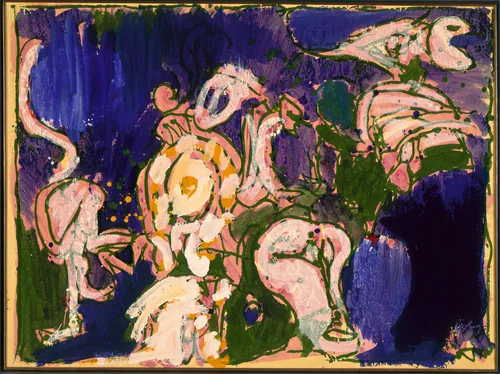
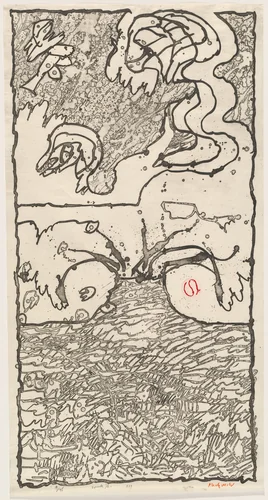
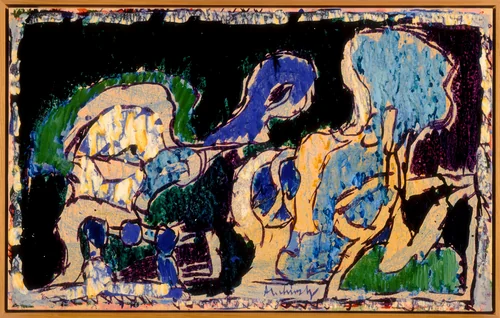
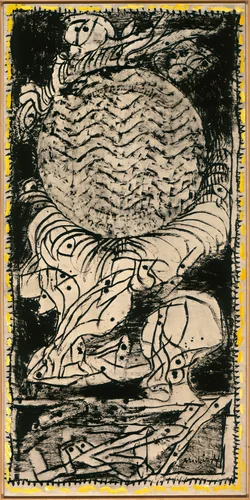
Works such as the energetic painting Astres et Desastres and the conceptual Colloque écologique reveal Alechinsky’s signature approach. His compositions frequently employ highly detailed, calligraphic borders that frame a central, often riotous field of color and incident. This technique, the ‘remarques’ border, is one of the most subtly engaging elements of his practice: a frame that refuses to merely contain the painting, instead insisting on a parallel visual narrative that annotates the creation mid-process.
Alechinsky’s foundational contributions ensured his work became a cornerstone of major institutions globally, including the National Gallery of Art. His persistent exploration across media—evidenced by the inclusion of vibrant Pierre Alechinsky paintings like Nouvelle île alongside complex Pierre Alechinsky prints such as Pont à Mousson and Verrerie allégorique—highlights an artist who consistently prioritized the immediate energy of the line. While these museum-quality originals remain essential objects of study, many of his earlier graphic studies have entered the public domain, ensuring that downloadable artwork and free art prints are widely accessible for scholarship and appreciation. His enduring legacy rests on his ability to maintain visual complexity while embracing the speed and urgency of improvisation.
Source: Wikipedia · CC BY-SA 4.0