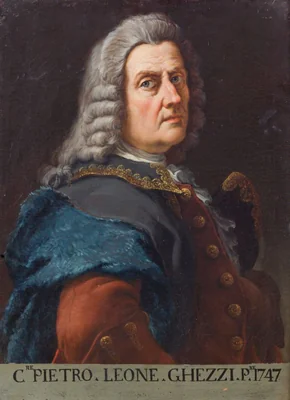
Pier Leone Ghezzi
Pier Leone Ghezzi was a central figure in the Roman Rococo, distinguished not only as a painter, draughtsman, and printmaker but primarily as the period's foremost satirist. Active chiefly in Rome, Ghezzi is widely regarded as the first professional caricaturist, transforming the casual sketch into a sophisticated and often biting form of social commentary. While his oeuvre included traditional decorative frescoes and the development of an innovative style of anecdotal, realistic history painting, his enduring significance lies in his masterful portrait drawings.
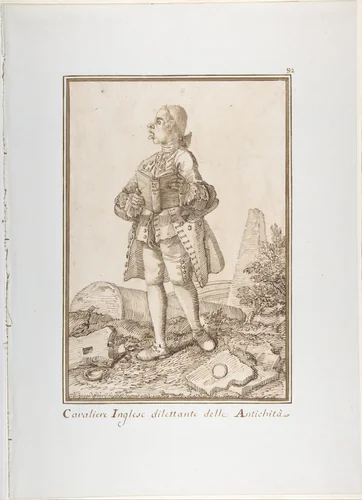
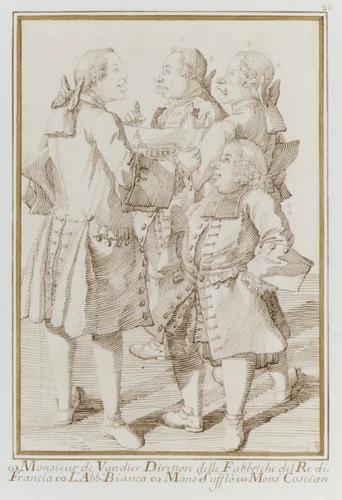
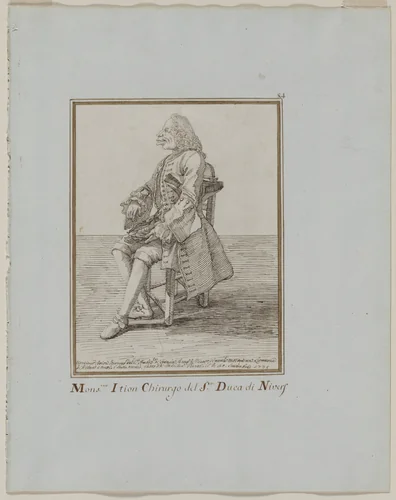
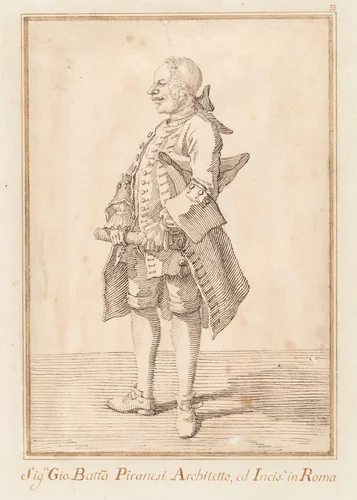
Ghezzi possessed an exceptional facility for capturing the psychological and physical essence of his sitters—who ranged from cardinals and high society figures to visiting scholars like Luigi Vanvitelli—with remarkable economy. In his countless portrait studies, he required only a few swift, decisive strokes to achieve a profound likeness. This approach moved the portrait beyond traditional flattery, focusing instead on observable eccentricities of posture, clothing, and expression.
His technique amplified flaws or singularities for comic effect. In renderings of single figures, Ghezzi emphasized exaggerated anatomy or peculiar details of costume. When producing group scenes, such as A Monk with a Carrot and a Woman with a Chamber Pot, he maximized humor by repeating strange attitudes or fixed expressions across multiple participants. The longevity of his wit is attested to by the continuing appeal of works like A Caricature of L'Abbate Folinghi, which distills a personality to its defining peculiarity with disarming clarity.
Ghezzi's innovative application of caricature provided an invaluable, informal record of the intellectual and social life of eighteenth-century Rome. His works, including sketches like Angels Supporting a Frame, are held in major collections, including the Metropolitan Museum of Art and the Art Institute of Chicago. The influence of his influential drawing style ensures that Pier Leone Ghezzi prints remain a cornerstone of graphic art history. Furthermore, as much of his catalogue is now in the public domain, high-quality prints and downloadable artwork are increasingly accessible, allowing scholars to study the foundational stages of this critically important satirical tradition.
Source: Wikipedia · CC BY-SA 4.0