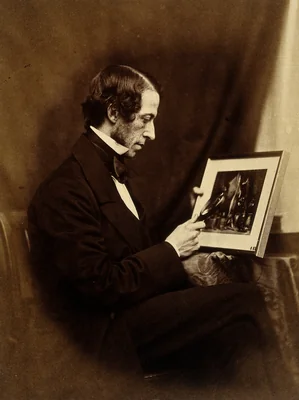
Philip Henry Delamotte
Philip Henry Delamotte (active 1851-1857) was a pivotal British photographer and illustrator whose compact, yet highly influential, body of work provides perhaps the definitive visual record of mid-Victorian architectural ambition and engineering complexity. Though his professional career spanned barely six years, his photographic contributions are preserved today in major institutional collections, including the National Gallery of Art and the Metropolitan Museum of Art, establishing his status as a museum-quality chronicler of the era.
Delamotte’s significance rests primarily on his systematic documentation of the relocation and re-erection of Joseph Paxton's monumental Crystal Palace, moved from Hyde Park to Sydenham Hill between 1852 and 1854. This massive undertaking formed the basis of one of his two known publications, resulting in a crucial visual archive of early industrial logistics and construction methods. Unlike many contemporaries who focused on portraiture or landscape, Delamotte specialized in recording the overwhelming scale of infrastructure. His works, such as Steam Engine near the Grand Transept, Crystal Palace, capture the interplay between emerging technology and temporary structures, often balancing the raw materiality of iron and glass with the human element.
He masterfully composed these difficult indoor scenes, treating the vast, repeating geometries of the Palace not merely as a subject, but as a complex visual challenge demanding patience and structural awareness. Works like Storeroom with Artisans and Plaster Casts, Crystal Palace offer rare glimpses into the organized chaos behind such immense projects, often capturing the fascinating transitional spaces where art preparation met heavy engineering. Delamotte’s observation of scale is subtly witty; the tiny figures of the artisans frequently serve to emphasize the almost limitless height and breadth of the exhibition hall.
Delamotte operated during a pivotal moment in the development of photography, utilizing the medium not just for pictorial effect but as a robust tool for visual history. His precise compositions, evidenced in plates such as Evening and The Upper Gallery, display a sophisticated handling of light within the massive glass structures. Today, Delamotte’s limited but potent output, constituting definitive Philip Henry Delamotte prints, is highly valued for its historical clarity. Many of the original plates reside in the public domain, allowing institutions and enthusiasts easy access to high-quality prints of his seminal Victorian-era documentation.
Source: Wikipedia · CC BY-SA 4.0
![[Exterior View of Facade and Fountains; Exterior View of Side Pavilion; Exterior Side View of Central Transept; Exterior Side View of Central Trancept with Reclining Figure in Foreground] by Philip Henry Delamotte, photograph, 1857-1861](https://img.artbee.org/69e4f69a-10a3-4f30-9ad4-2e07c2ac0dee/small.webp)
![[Façade, Views, and Entrance Loggia of the Renaissance Court] by Philip Henry Delamotte, photograph, 1857-1861](https://img.artbee.org/dfe5d7fa-a45f-4a51-bdcf-93fb0878b957/small.webp)
![[Greek Court with Farnese Torso of a Youth; View of a Classical Fountain and Pool; Roman Gallery with Apollo Belvedere and Model of the Roman Forum; Roman Sculpture Court] by Philip Henry Delamotte, photograph, 1857-1861](https://img.artbee.org/373214c3-1c52-41ab-8259-29c6d9131ebb/small.webp)
![[Greek Court with Sculpture of Discobolus; Roman Court with Sculptures of Gladiator, Mercury and Fauns; Italian Sculpture near the Great Transept] by Philip Henry Delamotte, photograph, 1857-1861](https://img.artbee.org/08904b62-fcff-4159-abd7-eeb8b932e193/small.webp)
![[Greek Court; Statue of Minerva; Ludovisi Mars; Iris, Hecate, or Lucifera] by Philip Henry Delamotte, photograph, 1857-1861](https://img.artbee.org/9aff31cc-b4ee-4d3d-a1eb-de9070d97bf3/small.webp)
![[Interior of Egyptian Court; Classical Sculpture Gallery with Discus-Thrower; View of Egyptian Court from Classical Sculpture Gallery; Foliage in the Egyptian Court] by Philip Henry Delamotte, photograph, 1857-1861](https://img.artbee.org/1e3ae678-d1a2-46e2-bee4-750680667bcb/small.webp)
![[Mammoth Tree; General View of Nave, Looking South; View from North Gallery; Classical Fountain] by Philip Henry Delamotte, photograph, 1857-1861](https://img.artbee.org/0b3b6ec0-7de0-43bd-80d7-a675dc77fa01/small.webp)
![[Medieval Court; Entryway to Byzantine Court; Sheffield Court; French and Italian Mediaeval Vestibule] by Philip Henry Delamotte, photograph, 1857-1861](https://img.artbee.org/302bab83-be31-4cdc-963e-4f6593d76713/small.webp)
![[Medieval Court; Statue of Coleoni; Equestrian Statue of Gattamelata by Donatello, from the Court of Monuments of Christian Art; Equestrian Statue of Colleone] by Philip Henry Delamotte, photograph, 1857-1861](https://img.artbee.org/530ae897-4ffc-4de7-a208-ece87a201923/small.webp)
![[Medieval Court; The Walsingham Font; Entrance to English Medieval Court] by Philip Henry Delamotte, photograph, 1857-1861](https://img.artbee.org/a658efe9-b0eb-47c7-9486-567a58f98d6f/small.webp)
![[Roman Court with Sculptures of Posidonius and Wounded Gladiator; Sculpture of Geoffrey Chaucer by Marshall; Sculpture of Shakespeare by Roubilliac] by Philip Henry Delamotte, photograph, 1857-1861](https://img.artbee.org/41c4ec8c-5fb5-4f9d-bc89-7dd6fe7bd561/small.webp)
![[Sculpture Court Flanked by Torso of Marsyas and Sacrificial Altar; Sculpture Court with Bust of Caracalla; Greek Court with Sculptures of Mercury, Faun, and Ariadne; Roman Court with Three Sculptures of Venus] by Philip Henry Delamotte, photograph, 1857-1861](https://img.artbee.org/abb6499f-fd20-4fea-853e-e1f41cb066d5/small.webp)
![[Sculptures in Roman Court; Sacrificial Altar; Greek Sculpture Gallery; Statues in Greek and Roman Sculpture Court] by Philip Henry Delamotte, photograph, 1857-1861](https://img.artbee.org/29927a94-2f10-4b03-b2bf-2e15f4b7ccaa/small.webp)
![[Sculptures of Abraham Duquesne; an Ancient Briton; David with his Slingshot; a Hunter] by Philip Henry Delamotte, photograph, 1857-1861](https://img.artbee.org/e8ea242b-ab05-4dcd-8ad8-65fb63563969/small.webp)
![[Sculptures of Andromeda, the Toilet of Atalanta, Corinna, and a Naiad] by Philip Henry Delamotte, photograph, 1857-1861](https://img.artbee.org/54ab2d43-a55b-4a68-9720-263e468974ae/small.webp)
![[Sculptures of Cain, a Hunter Defending his Family, the Massacre of the Innocents, and Allegorical Figures of the First Whisper of Love] by Philip Henry Delamotte, photograph, 1857-1861](https://img.artbee.org/d9f81a96-afa7-4a30-a03a-556313d4c0f0/small.webp)
![[Sculptures of Hylas and the Nymphs, Allegorical Figures of the Three Fates, Zephyr wooing Flora, and Michelangelo's Bacchus and Donatello's St. George] by Philip Henry Delamotte, photograph, 1857-1861](https://img.artbee.org/a84ac9c6-f96d-40f1-86ff-6a560474a004/small.webp)
![[Sculptures of Minerva Protecting a Warrior, Una and the Lion, Children with a Pony and a Hound, and Child Play] by Philip Henry Delamotte, photograph, 1857-1861](https://img.artbee.org/fd923054-4428-4504-bfc0-79caf34fd77a/small.webp)
![[Sculptures of Sabrina, an Allegorical Figure of Morning, a Nereide, and Eve Listening] by Philip Henry Delamotte, photograph, 1857-1861](https://img.artbee.org/f93d888e-aa28-4db3-9654-2b029244d312/small.webp)
![[Sculptures of a Dancing Faun, a Neapolitan Improvisatore, Homer, and Thucydides] by Philip Henry Delamotte, photograph, 1857-1861](https://img.artbee.org/b6ff89cb-f53f-46bd-bd13-58ad3fc1e67d/small.webp)