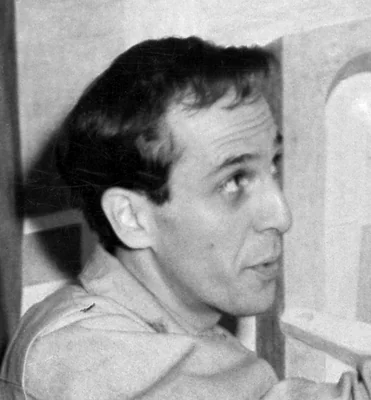
Philip Guston
Philip Guston (1913-1980) stands as one of the most important, powerful, and influential American painters of the last century. A Canadian-American artist active as a painter, draftsman, printmaker, and muralist, Guston’s career is defined by a rigorous willingness to abandon established successes, moving abruptly through distinct artistic modes. He is lauded for achieving mastery across these shifts, from the grand, public scale of Renaissance-inspired figuration, often associated with muralism, to the formally accomplished intensity of Abstract Expressionism.
Throughout his stylistic explorations, Guston maintained a deep thematic engagement with social and moral concerns. Even as an abstract painter, his canvases subtly grappled with serious political issues, frequently addressing the pervasive nature of racism, antisemitism, fascism, and the complex dimensions of American identity. This underlying thematic consistency highlights a core tension in his oeuvre: the struggle to balance formal innovation with moral responsibility.
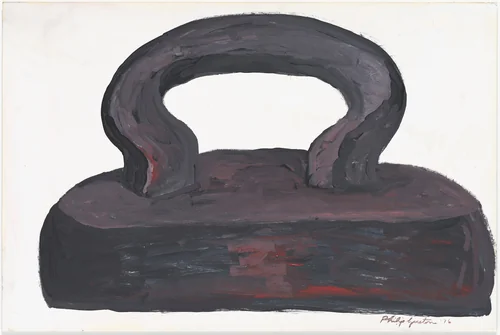
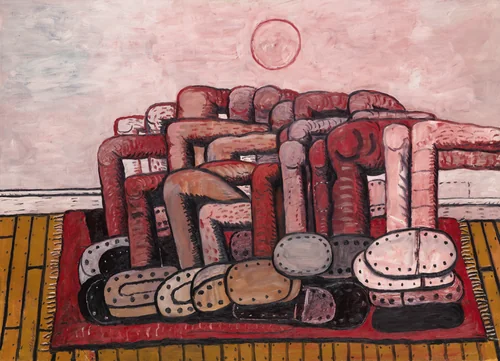
The most provocative and defining phase of Guston’s career began in the late 1960s when he executed a dramatic, self-imposed return to figuration. This late style employed a deliberately crude and often humorous cartoonish vocabulary, populated by isolated objects, clocks, shoes, and hooded figures. This radical stylistic change, initially met with shock and bewilderment by critics who preferred his abstraction, allowed him to confront what he termed the "banality of evil" through satire and mock-pity. Guston’s willingness to abandon the aesthetic comfort of the prevailing abstract style cemented his reputation as a visionary unafraid to sacrifice beauty for raw truth.
Guston's monumental impact is reflected in the market recognition his work now commands; in 2013, his painting To Fellini achieved an auction record for the artist, selling for US$25.8 million at Christie's. His drawings and paintings are essential holdings in major institutions, including the National Gallery of Art, where researchers can study the breadth of his output from 1948 to 1969. For collectors and academics, high-quality prints of his lesser-known early works and mid-career lithographs remain widely available, showcasing the impressive technical range Guston brought to his comprehensive body of work.
Source: Wikipedia · CC BY-SA 4.0
![Agean [special proof] by Philip Guston, print, 1979-1981](https://img.artbee.org/aa9ddec6-8bef-4350-a258-30125d0926c7/small.webp)
![Car [special proof] by Philip Guston, print, 1979-1980](https://img.artbee.org/1bcdd48f-42fd-4cf0-8363-71131193651b/small.webp)
![Coat [special proof] by Philip Guston, print, 1979-1980](https://img.artbee.org/cfea9840-9dcd-4ed3-9b8b-bd8e07baa02b/small.webp)
![Curtain [special proof] by Philip Guston, print, 1979-1980](https://img.artbee.org/821336ee-4c82-4ac9-a9af-d97ebf6096f3/small.webp)
![Easel [special proof] by Philip Guston, print, 1979-1981](https://img.artbee.org/757496a4-09ed-4728-b0d3-f00e946ddb39/small.webp)
![East Side [special proof] by Philip Guston, print, 1979-1980](https://img.artbee.org/81386ff7-4363-449d-9abd-63b8003148da/small.webp)
![Elements [special proof] by Philip Guston, print, 1979-1980](https://img.artbee.org/d73d7231-1bb1-4fc9-b100-35aeb06df6df/small.webp)
![Gulf [special proof] by Philip Guston, print, 1979-1983](https://img.artbee.org/c59563a6-e8bb-41e9-b3b6-4847252bda90/small.webp)
![Objects [special proof] by Philip Guston, print, 1979-1981](https://img.artbee.org/c4026381-0319-45a6-bfca-1b8c2b8432db/small.webp)
![Painter [special proof] by Philip Guston, print, 1979-1981](https://img.artbee.org/ef0ba5ce-975b-4ef8-ad21-397b2a22067c/small.webp)
![Pile Up [special proof] by Philip Guston, print, 1979-1981](https://img.artbee.org/548a61a2-40a2-4cf8-9e01-28f08bc612b8/small.webp)
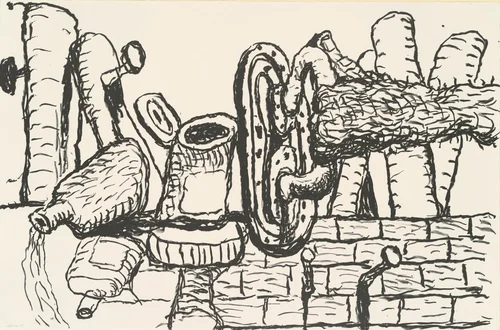
![Room [special proof] by Philip Guston, print, 1979-1980](https://img.artbee.org/68f4cbc1-1cb4-41d5-adcb-605d00aa5a21/small.webp)
![Rug [special proof] by Philip Guston, print, 1979-1981](https://img.artbee.org/da666a48-fff8-4525-a6f9-13556effffbf/small.webp)
![Scene [special proof] by Philip Guston, print, 1979-1981](https://img.artbee.org/24beb25e-d7c5-4523-b35c-bd7bb0d8e819/small.webp)
![Sea Group [special proof] by Philip Guston, print, 1979-1983](https://img.artbee.org/557de72e-9235-44fd-af2e-c3bd28c34ee2/small.webp)
![Sea [special proof] by Philip Guston, print, 1979-1980](https://img.artbee.org/6be21b40-4e77-4b1f-a658-1c57990f7169/small.webp)
![Sky [special proof] by Philip Guston, print, 1979-1983](https://img.artbee.org/b285c05c-64c2-453c-832e-d05421284c52/small.webp)