Petrus Christus
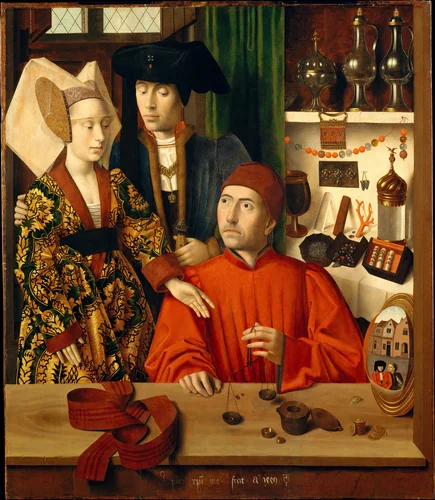
Petrus Christus (active c. 1440-1455) holds a foundational position within the second generation of Early Netherlandish painting, defining the artistic trajectory of Bruges following the death of its greatest master. Arriving in 1444, Christus, alongside Hans Memling, quickly assumed leadership in the city’s thriving artistic ecosystem, effectively stepping into the vacuum left by Jan van Eyck. Although profoundly influenced by Van Eyck’s meticulous oil technique and mastery of light, Christus was simultaneously indebted to the dramatic narrative style of Rogier van der Weyden, synthesizing these disparate approaches into a uniquely coherent style.
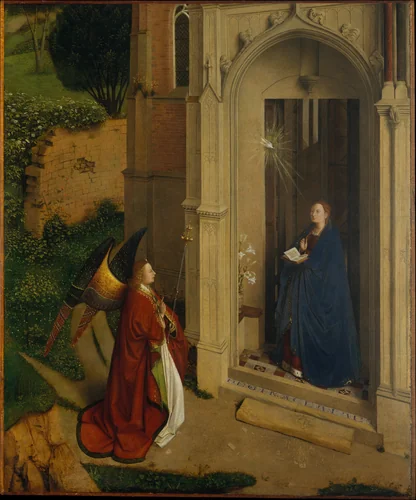
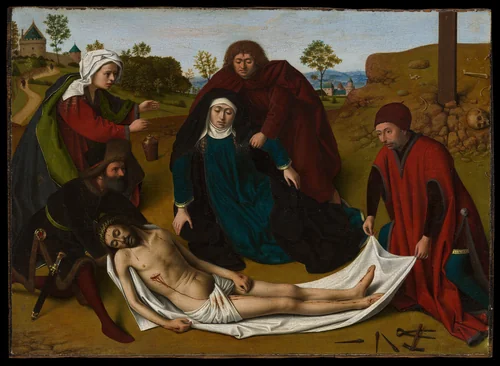
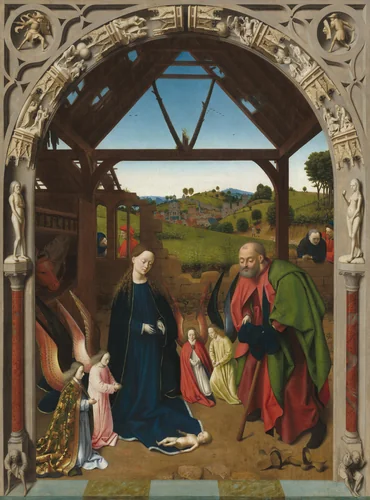
Christus’s primary contribution to the history of art lies in his systematic incorporation of mathematical principles into composition. While other Netherlandish masters achieved a sense of depth through empirical observation, Christus was one of the first in the North to deploy sophisticated linear perspective, lending his compositions, such as The Annunciation and The Lamentation, a calculated sense of spatial clarity and order. This technical precision, derived in part from the delicate execution associated with contemporary miniature painting and manuscript illumination, resulted in works of jewel-like exactitude.
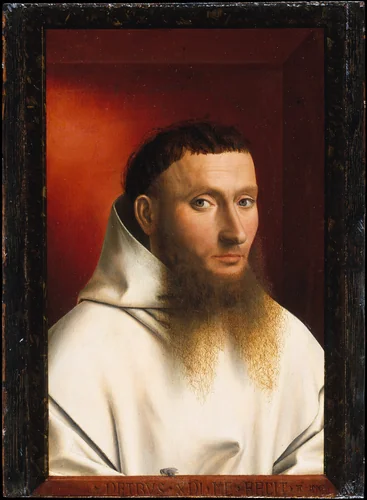
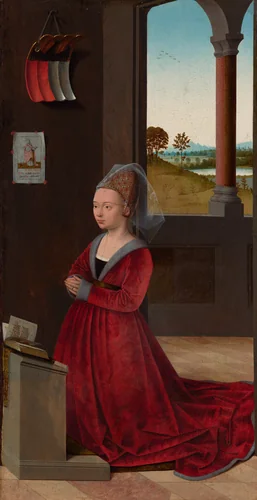
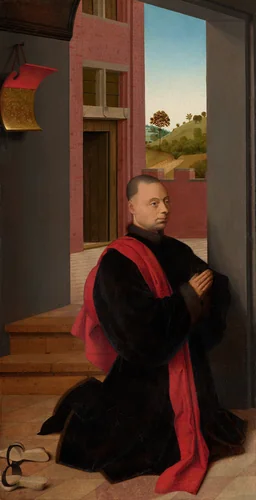
His innovation is most pronounced in his approach to portraiture. Works like the celebrated Portrait of a Carthusian (1446) and the Portrait of a Young Girl are noteworthy for discarding the neutral or flat backgrounds favored by earlier masters. Instead, Christus began setting his figures against detailed, three-dimensional architectural spaces, effectively integrating the sitter into a tangible environment. This subtle architectural framing turned the painted panel into something closer to an open window, offering the viewer a quiet, domestic peek at the sitter’s world.
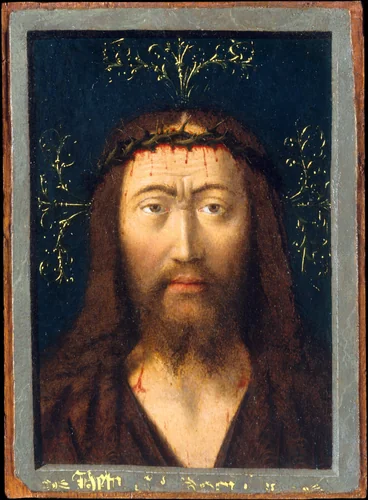
Although only around thirty works are securely attributed to him, Christus’s systematic methods profoundly impacted his successors. His commitment to clear volumetric space and luminous surfaces ensured that Petrus Christus paintings served as a vital transitional link between the foundational generation of the 1430s and later Renaissance developments. Today, many of his finest panels, including the Head of Christ (Ecce Homo), are held in leading global collections. Since much of his production has entered the public domain, a wide selection of museum-quality high-quality prints and downloadable artwork is available, testifying to the enduring clarity of his vision.
Source: Wikipedia · CC BY-SA 4.0