Peter de Wint
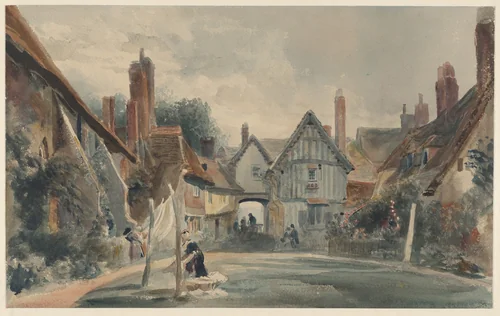
Peter de Wint (1784-1828) established himself as one of the most prolific and technically adept English landscape painters of the early 19th century. Although he worked successfully in oil, his enduring reputation rests firmly on his mastery of watercolour, a medium he handled with extraordinary freedom and confidence, marking him as a pivotal figure in the development of British topographical art.
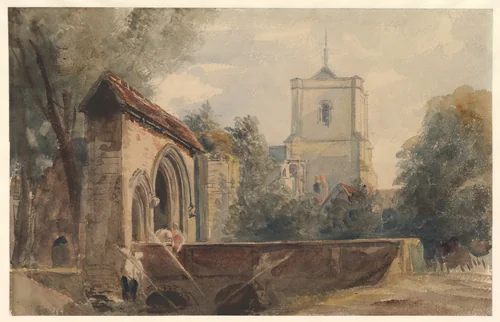
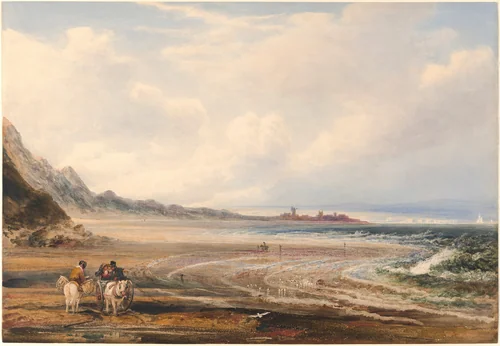
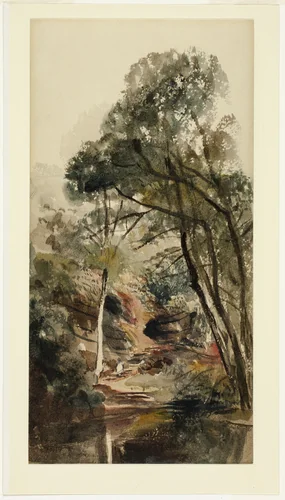
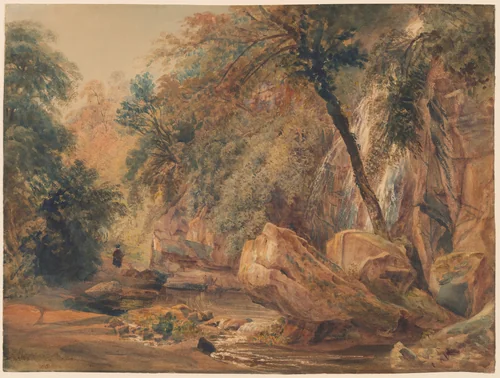
De Wint’s approach often favored immediate, expansive compositions that captured the specific atmospheric conditions of the English countryside, particularly around his adopted home in Lincoln. Unlike some contemporaries who relied on meticulous detail, De Wint employed broad washes and vigorous handling, allowing the luminosity of the paper to interact directly with rich pigments. This technique lent a robust, often monumental quality to pieces like Evening on the Foss Dyke near Lincoln and A View near Lowther, elevating simple rural scenes into powerful expressions of Romantic naturalism.
His dedication to the English terrain was nearly absolute. The breadth of his output was remarkable, encompassing over a thousand known works during his relatively short active period. Interestingly, despite his surname, De Wint, suggesting Continental origins, his artistic eye was almost exclusively focused on the sincere portrayal of domestic British topography. This steadfast devotion to local scenes is evidenced by works such as Avondlandschap met de ruïne van Kirkstall Abbey, Yorkshire, held in the Rijksmuseum collection.
Today, his dedicated output ensures that outstanding examples of Peter de Wint paintings are maintained in the permanent collections of major institutions worldwide, including Tate Britain, the Victoria and Albert Museum, and the National Gallery of Art. The accessibility and technical excellence of his vision mean that his work is widely studied, and many of his most important compositions are available to the public as high-quality prints, allowing modern viewers to appreciate the foundational role De Wint played in defining the English landscape tradition. His legacy confirms him as a preeminent painter who defined the natural, unvarnished beauty of early 19th-century England.
Source: Wikipedia · CC BY-SA 4.0