Peter Candid
Peter Candid, born Peter de Witte in Flanders and known in Italy as Pietro Candido, stands as a crucial figure in the dissemination of late sixteenth-century style across Europe. His career, spanning from 1550 to 1601, seamlessly bridged the sophisticated intensity of Italian court art with the established precision of Northern European draftsmanship, making him instrumental in defining German Renaissance decoration.
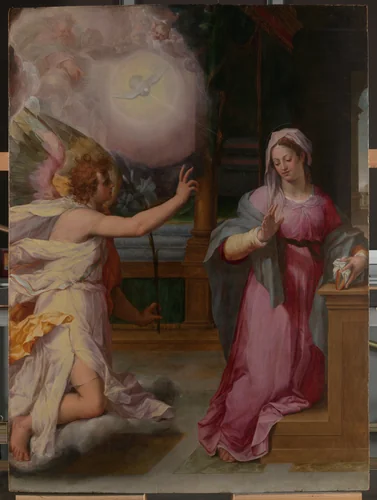
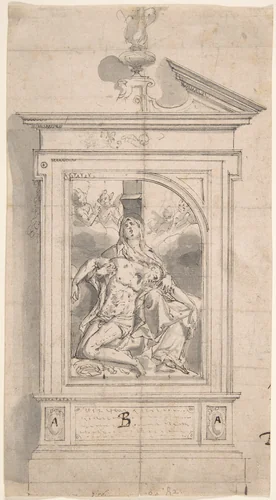
Candid first achieved prominence during his extended residence in Florence, serving the illustrious Medici court. Here, he functioned as a prolific painter, but critically, also as a master designer for frescoes and tapestries. This Italian period honed his skills in executing complex multi-figure compositions and imbued his technique with the elegant elongated forms of Florentine Mannerism. Works such as the solemn preparatory study Pietà (Design for an Altar) and the deeply spiritual The Annunciation attest to the highly refined devotional imagery he produced under the influence of his adopted city.
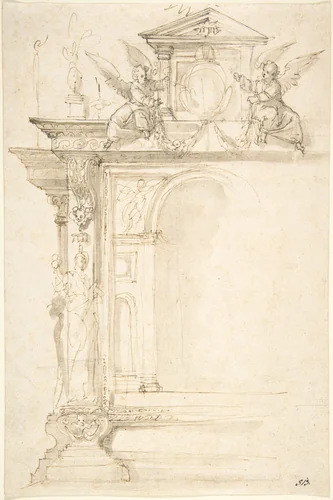
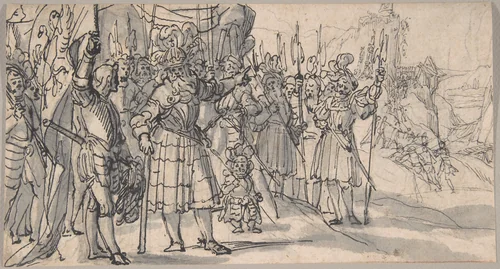
His reputation grew sufficiently to secure a pivotal appointment in Munich, where he joined the Bavarian court of Duke William V and his successor Maximilian I. Candid successfully transported his refined Italian vocabulary north, applying it to vast decorative cycles and the designs for stucco work that characterized the new court style. His later works reveal a continuing commitment to meticulous preparation and theatrical clarity, whether designing grand monuments, as seen in Design for an Altar or Monument with Angels and Other Figures, or historical narrative scenes like Otto von Wittelsbach Liberates the Army from a Mountain Pass near Verona.
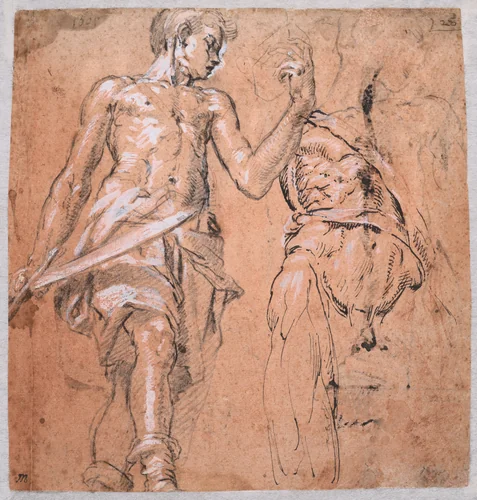
Candid’s enduring legacy resides largely in his meticulous production of museum-quality drawings. These sheets functioned as both finished works and preparatory studies, providing insight into the construction of late Mannerism. The studies, such as Two studies of a Standing Man with a Sword (Alexander the Great), reveal his analytical yet dynamic approach to the human form. Interestingly, while his Italian name, Candido, implies purity, his figures frequently engage in the twisting contrapposto that reveals the delightful complexity of the era.
Today, important examples of Peter Candid paintings and drawings are held in major global institutions, including the Metropolitan Museum of Art. As a testament to his continued significance, much of the artist's graphic output is now in the public domain and available as high-quality prints and downloadable artwork for scholars and enthusiasts alike, ensuring the accessibility of this pivotal transitional master.
Source: Wikipedia · CC BY-SA 4.0