Peter Behrens
Peter Behrens (1868-1940) stands as a pivotal figure in early modernism, recognized equally as a formidable architect, graphic designer, and industrial designer. His historical significance is rooted in his pioneering role in establishing the first comprehensive corporate identity, a systematic fusion of branding and architecture that defined the modern corporation. Behrens’s early fame rests upon his monumental AEG Turbine Hall in Berlin (1909), which cemented his international reputation and provided a definitive statement on the aesthetic potential of functional industrial architecture.
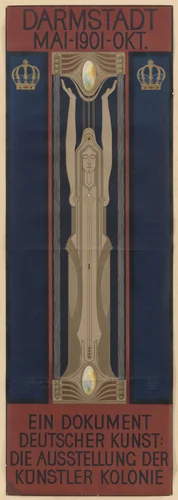
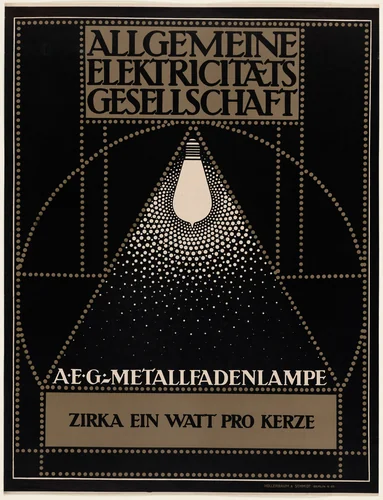
Behrens was a founding member of the influential Deutscher Werkbund in 1907, the same year he began his transformative association with the Allgemeine Elektricitäts-Gesellschaft (AEG). For AEG, he established a complete corporate language, designing everything from the company logo and typefaces to factory buildings and consumer products like the A.E.G.- Metallfadenlampe. This comprehensive, unified approach effectively invented the field of corporate design. Behrens’s output from this period, including posters like Darmstadt Kunstler Kolonie, demonstrates the high standard he set for graphic communication; his iconic work is frequently sought after as museum-quality material, available as Peter Behrens prints for collectors today.
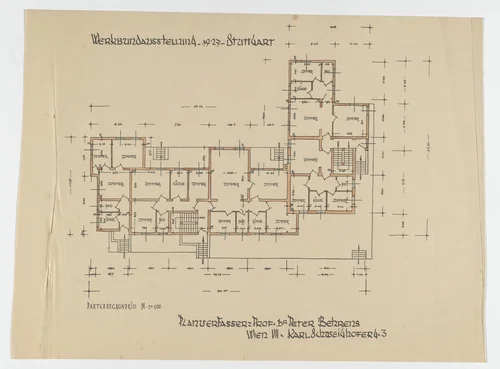
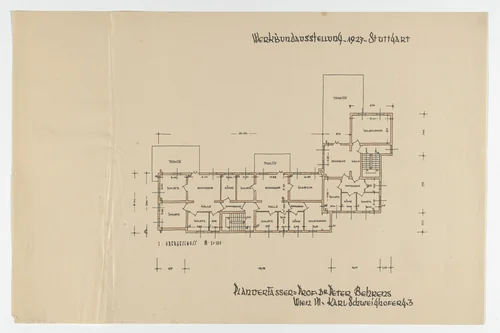
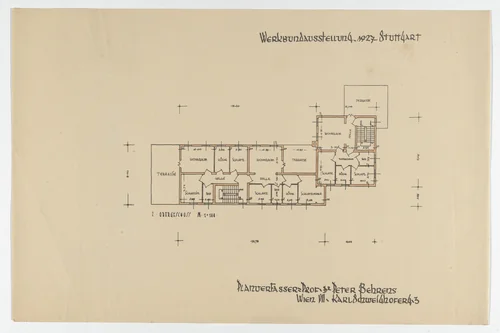
Maintaining a long and varied architectural career spanning the 1900s through the 1930s, Behrens led the rationalist, classical German Reform Movement in the 1910s. Following World War I, he embraced the expressive angularity of Brick Expressionism, exemplified by the remarkable Hoechst Administration Building outside Frankfurt. By the mid-1920s, his work aligned increasingly with New Objectivity, visible in projects such as the Stuttgart Weissenhof Apartment House, documented extensively through his detailed ground floor plan and subsequent floor plans. He served as an influential educator, heading the architecture school at the Academy of Fine Arts Vienna from 1922 to 1936, and his projects spanned Russia, England, and Germany.
Perhaps his greatest, albeit indirect, contribution to the century was his studio’s role as an unprecedented laboratory for emerging talent. In the 1910s, the offices of Behrens served as the starting point for three future giants of European modernism: Ludwig Mies van der Rohe, Le Corbusier, and Walter Gropius. To have trained the founders of the Bauhaus, the master of concrete, and the father of minimalism simultaneously is a singular feat unmatched in architectural history.
Source: Wikipedia · CC BY-SA 4.0