Paul Ranson
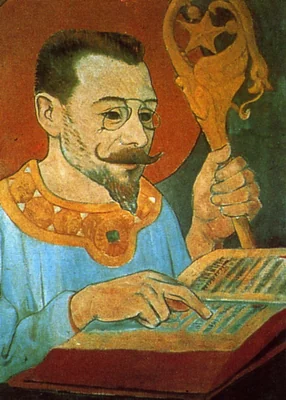
Paul-Élie Ranson (1861-1909) holds a crucial, if contained, position within the history of French Post-Impressionism and the early trajectory of modern decorative arts. As a painter, writer, and organizational figure, Ranson was fundamentally embedded in the Symbolist and Aesthetic movements that defined the fin de siècle. He is recognized primarily as an integral member of Les Nabis (The Prophets), a collective founded in 1888 that sought to imbue visual art with spiritual depth and radical decorative synthesis. Ranson's studio in Paris, known affectionately as La Roulotte (The Caravan), often served as the primary gathering place for the group, making him a quiet, yet central, organizational force.
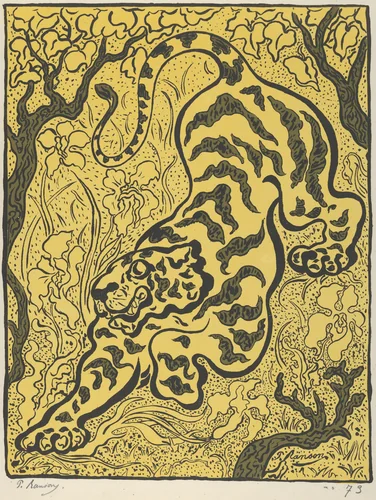
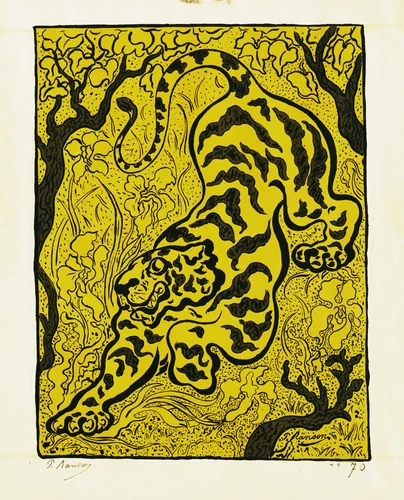
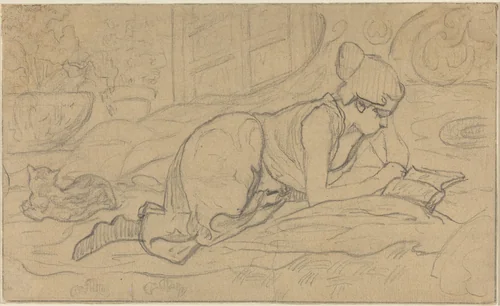
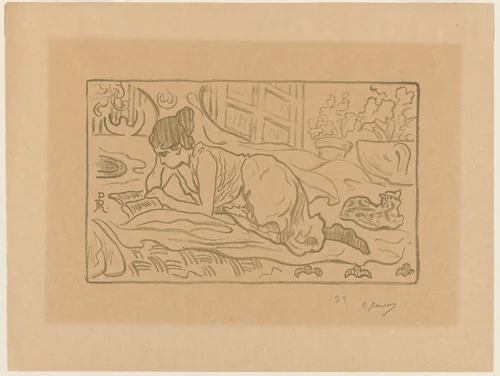
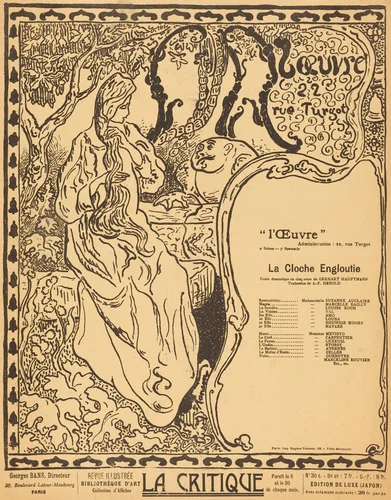
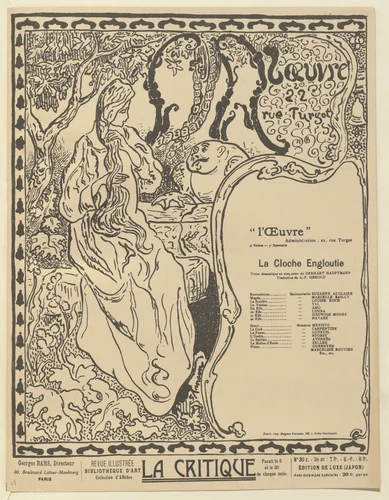
While Ranson’s active period of exhibition and graphic output was notably short, spanning roughly 1893 to 1897, his contribution to graphic arts was immediate and innovative. His extant production, focused primarily on a limited number of Paul Ranson prints, one drawing, and a single significant painting, nonetheless displays the characteristic Nabi focus on flattened planes, expressive color, and rhythmic, stylized contours. Embracing the Symbolist belief that art should evoke idea rather than simply depict reality, his work explored both intimate domestic scenes, such as the focused study in La Liseuse couchée, and dramatic exotic themes, like the print Tiger in the Jungle. This latter work, featured in the prestigious L’Estampe Originale, showcases his commitment to color lithography as a medium capable of conveying strong emotional impact and formal synthesis.
Ranson’s relatively sparse oeuvre ensures that the surviving pieces carry substantial historical weight. That fact that his works are held in premier North American institutions, including the Museum of Modern Art, the Metropolitan Museum of Art, and the National Gallery of Art, confirms his lasting significance beyond the collective fame of Les Nabis. It is a charming historical footnote that while the majority of his cohort pursued grand mural projects for public spaces, Ranson, the group's unofficial host, often specialized in smaller, more intimate studies of textile design and refined decorative panels, perhaps reflecting the domestic nature of his leadership role. Today, many of Ranson's influential pieces are now entering the public domain, allowing institutions to make high-quality prints available for broader study.
Source: Wikipedia · CC BY-SA 4.0