Paul Delaroche
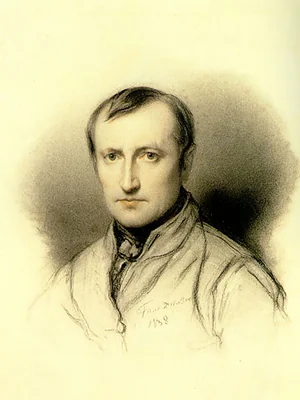
Hippolyte-Paul Delaroche (1807-1855) was a cornerstone figure in mid-nineteenth century French painting, achieving enormous fame throughout Europe for his expertly crafted historical narratives. Operating during a period of intense stylistic transition, Delaroche forged a successful path by strategically blending the heightened emotionality of Romanticism with the compositional discipline and exacting detail characteristic of Academicism and Neoclassicism. This synthesized approach allowed his large-scale Paul Delaroche paintings to capture public attention and dominate the official Paris Salons.
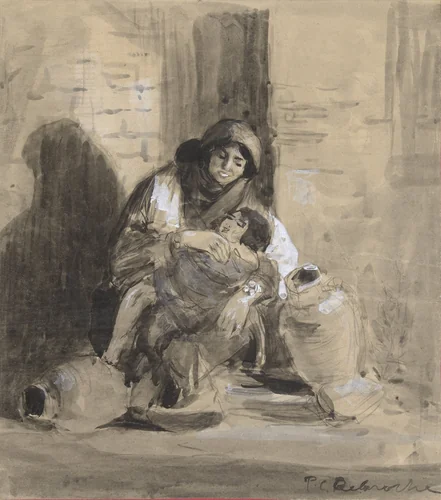
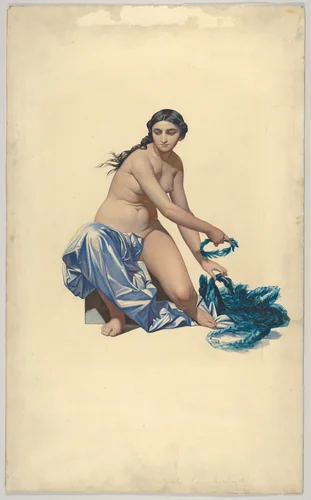
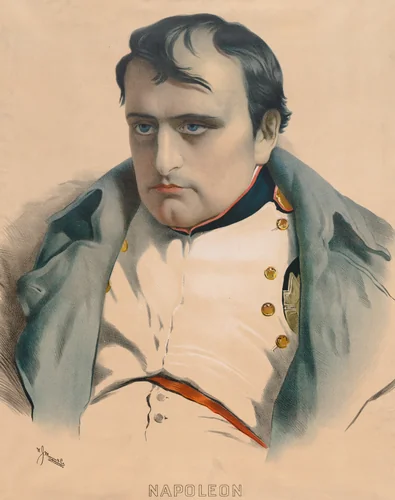
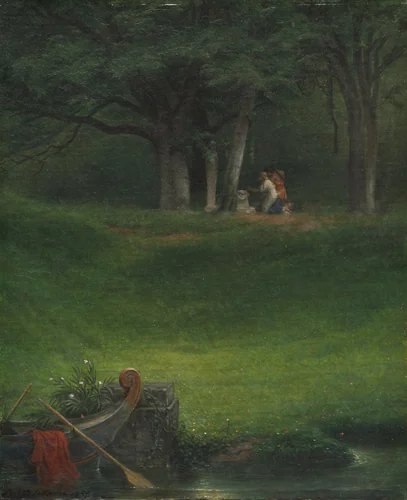
Delaroche’s primary innovation lay in his commitment to "pragmatic realism." While his themes were often deeply dramatic, sourced heavily from English and French history, he consciously stripped his historical figures of traditional heroic idealization. He aimed to depict the past and his subjects, such as in the celebrated Zittende Joodse vrouw uit Gaza, met haar kind en twee grote kruiken, with an objective, deglorified plausibility. Notably, he treated all subjects, whether historical figures like Marie-Antoinette, major figures of Christianity, or his contemporaries like Napoleon Bonaparte, with the same analytical gaze, refusing to bend his style toward popular ideals or norms. This careful balance between dramatic subject matter and objective realism generated widespread appeal.
A leading student of Antoine-Jean Gros, Delaroche’s influence extended far beyond his own easel. He cultivated a highly successful studio, serving as a pivotal mentor to a generation of artists who would define the later nineteenth century, including Thomas Couture, Jean-François Millet, and the renowned Academician Jean-Léon Gérôme. This powerful pedagogical legacy confirms his importance as a central, transitional authority in French art practice.
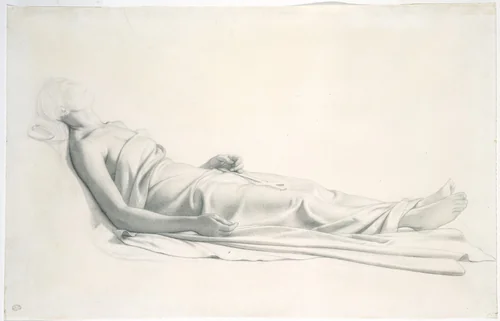
Today, while his monumental historical works remain fixtures in major institutions like the Rijksmuseum and the Metropolitan Museum of Art, his process remains highly accessible. Preparatory works, such as the meticulous Drapery Study for the Figure of the Dying Mary Magdalen, are widely available as downloadable artwork, offering rich insight into his exacting standards. This robust presence of his high-quality prints ensures that Delaroche’s distinct blend of detail and drama continues to inform scholarly study.
Source: Wikipedia · CC BY-SA 4.0