Paul Berthon
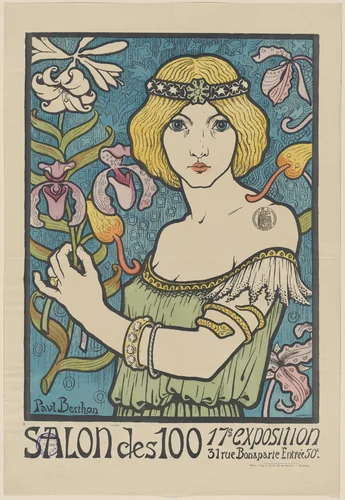
Paul Berthon (1872-1909) was a pivotal French graphic artist whose brief but highly focused career established him as a master of color lithography during the peak of the Art Nouveau movement. Active primarily between 1895 and 1901, Berthon specialized in producing sophisticated posters and decorative panels that captured the era’s fascination with stylized natural forms and the idealized female figure. His work, characterized by its flowing contours and jewel-toned palette, secured early inclusion in permanent collections, including the Museum of Modern Art, the National Gallery of Art, and the Cleveland Museum of Art.
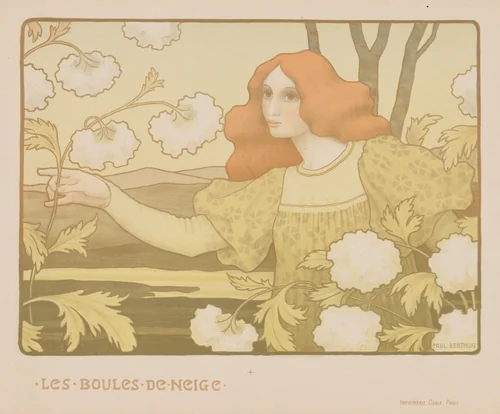
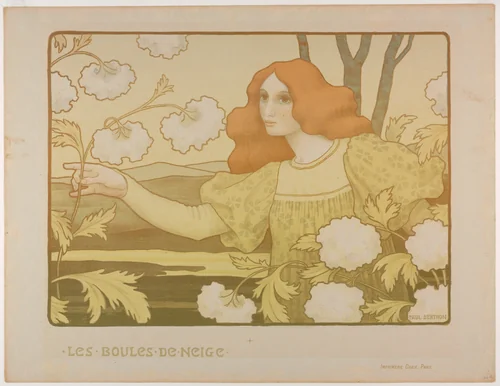
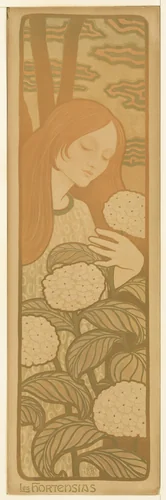
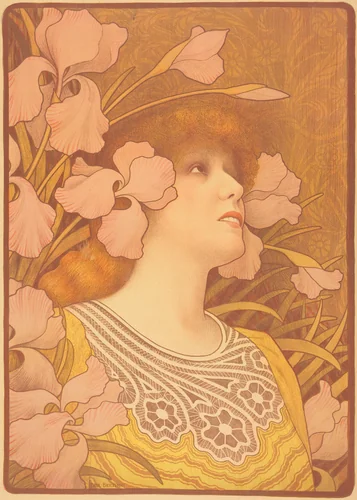
Berthon’s artistic achievements lay in his technical command of the challenging chromolithographic process. Unlike many contemporaries who relied on simple line work, Berthon achieved a remarkable richness of texture and depth, often applying colors in layers that gave his finished prints a luminous, almost enamel-like finish. This approach is evident in the striking botanical study The Hydrangeas and the decorative panels known as Snowballs. While his style undeniably aligns with the wider Parisian aesthetic championed by figures like Mucha, Berthon often favored a slightly cooler, more reserved graphic style, emphasizing decorative geometry over purely romantic sensuality.
One interesting element of his legacy is the intense brevity of his output. Recording only five prints and a single recorded design in the database over six years, Berthon achieved institutional recognition almost instantly, suggesting a rapid, high-impact trajectory in the competitive Parisian poster scene rather than sustained, long-term production. His works were clearly recognized as premium art objects from the outset; the clarity and precision of his printing elevate them to museum-quality artifacts.
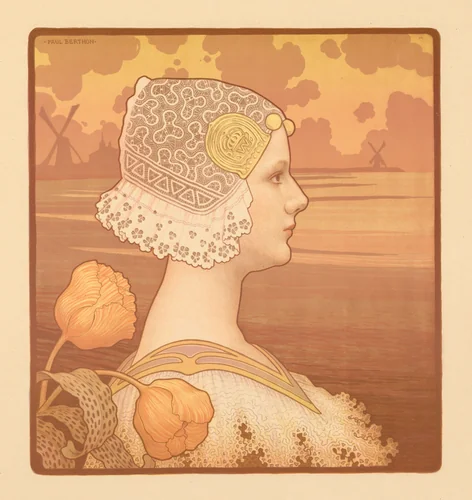
Berthon’s talent extended beyond decorative advertisement, as demonstrated by his formal royal portrait, Her Most Gracious Majesty Queen Wilhelmina (Sa Très Gracieuse Majesté La Reine Wilhelmine), a piece confirming his versatility within the lithographic medium. Today, original Paul Berthon prints remain highly prized, yet due to the timing of their creation, many of his compelling images have entered the public domain, making high-quality prints and royalty-free downloadable artwork widely available for contemporary study and appreciation. His enduring appeal rests firmly on the intrinsic quality and defining aesthetic of his graphic work.
Source: Wikipedia · CC BY-SA 4.0