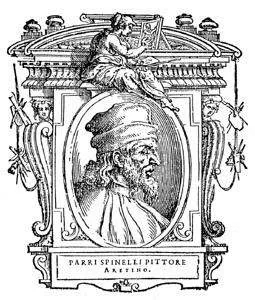
Parri Spinelli
Parri Spinelli (c. 1387-1453) was a pivotal Italian master whose career bridged the late Gothic and early Renaissance periods in Tuscany. Born in the Province of Arezzo, Spinelli’s rigorous artistic education began under the tutelage of his father, the established Tuscan painter Spinello Aretino. Though active throughout the region from 1387 to his death, the crucial period of his professional development occurred outside of his native city, profoundly shaping his innovative visual language.
From approximately 1411 to 1419, Spinelli resided in Florence. These pivotal years saw him embedded within the dynamic intellectual environment of the Florentine workshops, specifically as a documented member of Lorenzo Ghiberti’s highly influential atelier. This exposure to leading figures of the nascent Renaissance was transformative, equipping him with advanced techniques in composition and form. Upon his eventual return to Arezzo, he quickly established himself as the city’s undisputed preeminent painter.
However, his maturing style departed dramatically from strict academic conformity. Unlike the grounded figures favored by his immediate predecessors, Parri Spinelli paintings are characterized by audacious, bold color use and profoundly elongated, often serpentine figures. It is tempting to imagine the subtle tension between his rigorous Florentine training and his dedication to this stylistic Mannerist prefiguration in figure structure, suggesting an artist who prioritized dramatic flair and emotional impact over strict classical orthodoxy.
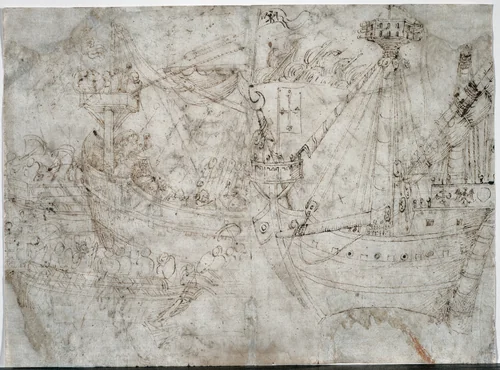
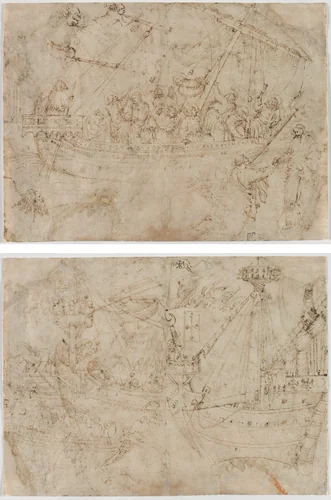
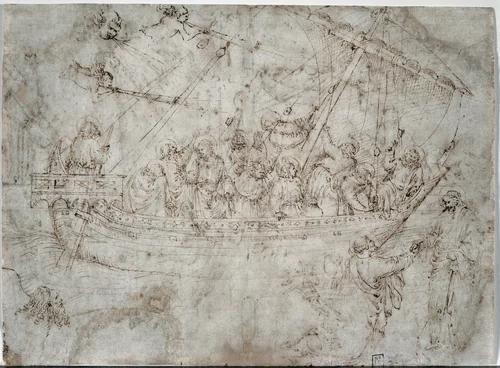
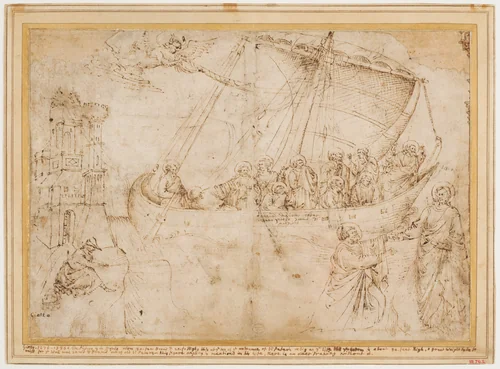
Although the quantity of his extant works is limited, his output includes sophisticated preparatory sketches crucial for understanding his working method, such as Hercules Leaning on His Club [recto] and the structural study Gothic Vault [verso]. His commitment to draughtsmanship is further evident in detailed compositional studies like the various versions of Navicella and Two Drawings of Ships. Today, the significance of Spinelli’s visual legacy is affirmed by his representation in major American institutions, residing in the Metropolitan Museum of Art, the National Gallery of Art, and the Cleveland Museum of Art, offering scholars museum-quality access. Fortunately, many of his key studies are preserved and available as high-quality prints and downloadable artwork through the public domain.
Source: Wikipedia · CC BY-SA 4.0
![Gothic Vault [verso] by Parri Spinelli, drawing, 1387-1453](https://img.artbee.org/10d13010-18e7-43f1-b1ac-b02a924f3eed/small.webp)
![Hercules Leaning on His Club [recto] by Parri Spinelli, drawing, 1387-1453](https://img.artbee.org/6b68e55e-d70a-4293-8239-0b3d44aec0f9/small.webp)