Pancrace Bessa
Pancrace Bessa (active 1806-1836) stands as a pivotal figure in French natural history illustration, distinguished by his fusion of scientific rigor and aesthetic refinement. Operating in the early nineteenth century, a golden age for botanical art, Bessa established his reputation through masterful detail, cementing his place alongside the era’s most revered illustrators.
Bessa’s formal training under the eminent engraver Gérard van Spaendonck provided the foundational discipline necessary for exacting scientific rendering. Crucially, he also worked closely with Pierre-Joseph Redouté, whose influence is perceptible in Bessa's delicate touch and comprehensive treatment of botanical subjects. This collaboration placed him squarely at the apex of the botanical illustration field, balancing the accurate morphology demanded by natural science with the vibrant artistry expected by aristocratic patrons and burgeoning print collectors.
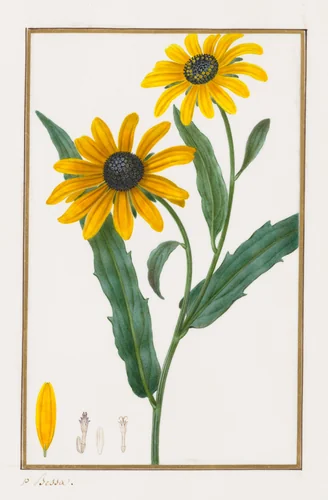
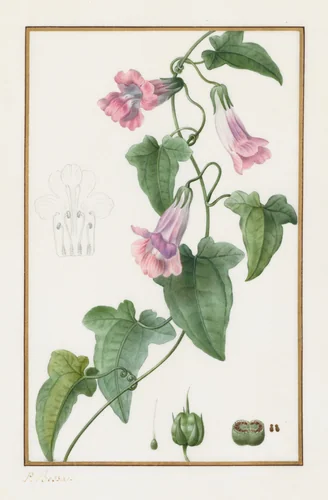
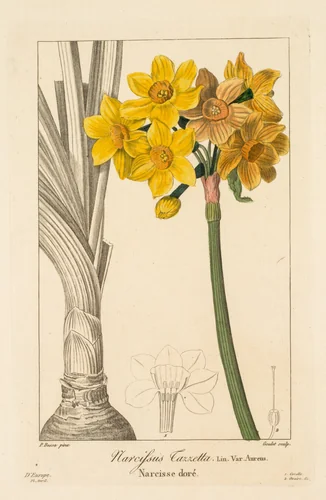
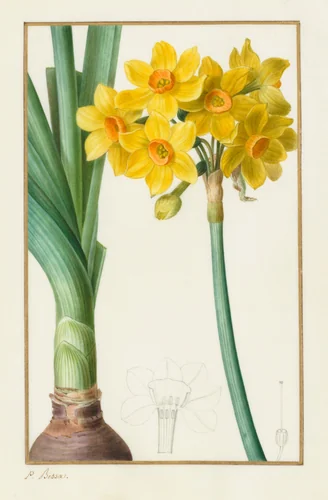
His consistent presence at the Paris Salons, where he exhibited regularly between 1806 and 1831, underscores his sustained relevance in the Parisian art world. While known for focused, intimate studies like Black-eyed Susan and (Botanical: Maurándia semperflorens), his contributions extended to major collaborative publications, including Flore des Jardiniers, Amateurs et Manufacturiers, featuring works such as the Polyanthus or Cluster Narcissus. His specialization was such that the standard botanical author abbreviation, Bessa, is still used today when citing a plant he formally described or illustrated.
A subtle but defining characteristic of Bessa’s output is his ability to imbue strictly scientific diagrams with life, an attribute that elevates his work to museum-quality status. Today, examples of his meticulous drawings and high-quality prints are held in major institutions worldwide, including the Cleveland Museum of Art. His legacy, preserved through collections, often sees his finest works enter the public domain, making downloadable artwork widely accessible. These precise, royalty-free renderings continue to serve both scientific study and decorative appreciation, affirming Bessa’s lasting impact far beyond the Salon walls of the nineteenth century.
Source: Wikipedia · CC BY-SA 4.0