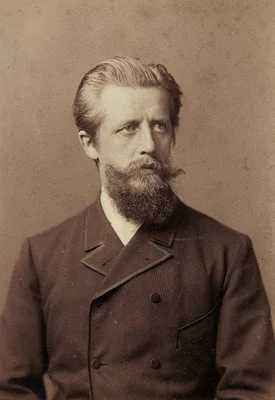
Ottomar Anschütz
Ottomar Anschütz (1846–1907) stands as a foundational figure at the crucial juncture where late 19th-century invention met visual documentation. This German inventor, photographer, and chronophotographer played a decisive role in transforming the understanding and depiction of motion, establishing precedents that would prove critical for the development of cinema. His period of major activity, spanning approximately 1884 to 1889, yielded images that remain cornerstones in the study of early photographic history.
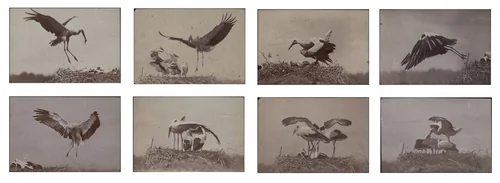
Anschütz’s primary contribution lay in the technical realm, particularly through his advancements in camera mechanics and shutter technology. He is widely credited with developing the highly efficient focal-plane shutter, an innovation allowing for unprecedentedly fast exposure times. This technical capability enabled him to freeze action that had previously appeared blurred or indistinct, capturing phases of movement with scientific precision. His photographic output, often created using his own specialized sequence cameras, thus demonstrated a mastery that elevated what began as rigorous scientific observation into a unique, compelling visual aesthetic.
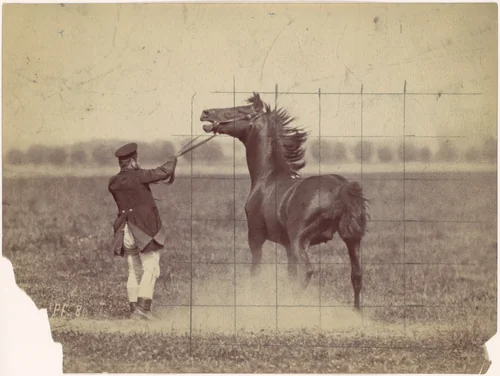
The artist frequently focused his lens on the kinetics of the natural world, documenting the complex gait and movements of animals rarely captured with such clarity outside their natural or controlled habitats. Works such as Horse, the striking study [Two Cheetahs], and the powerful documentation of [Two Bears] reveal not only the physics of locomotion but also an inherent graphic elegance. These images are rigorously factual yet possess a dynamic sophistication that distinguishes them from purely mechanical records. It is perhaps a minor irony that the man who helped invent the technical infrastructure for cinema—the great illusionist medium—did so by relentlessly chasing photographic truth.
Anschütz’s work was foundational to subsequent technical developments, notably the invention of the projector-like instruments necessary to display moving pictures. His photographs, widely circulated in their time, influenced artists and scientists alike, providing empirical data on how the world truly moves. Today, his historical significance is cemented by the inclusion of key works in major international institutions, including the Museum of Modern Art and the Metropolitan Museum of Art. These museum-quality works, reflecting the pioneering years of photography, are often sought after. Many of these early Ottomar Anschütz prints are now available in the public domain, making them highly accessible as downloadable artwork for scholars and enthusiasts globally.
Source: Wikipedia · CC BY-SA 4.0
![[Fox] by Ottomar Anschütz, photograph, 1886](https://img.artbee.org/e0fa5897-06bb-4785-bcfe-1817073546b0/small.webp)
![[Two Cheetahs] by Ottomar Anschütz, photograph, 1888](https://img.artbee.org/8f759d19-d49c-4e76-90e1-1d31d080a646/small.webp)
![[Two Bears] by Ottomar Anschütz, photograph, 1889](https://img.artbee.org/101b2ff9-3cdf-48f4-97d8-fc3203677415/small.webp)
![[Two Bears] by Ottomar Anschütz, photograph, 1889](https://img.artbee.org/ec227d76-e3a6-49a5-b85e-2de971d145e5/small.webp)