Otto Umbehr
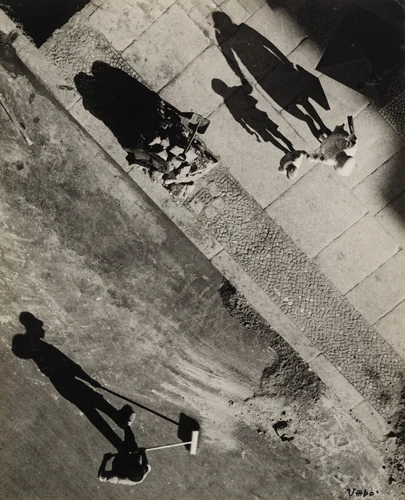
Otto Umbehr, known professionally as Umbo, holds a decisive position in the history of German modernist photography, emerging directly from the radical environment of the Bauhaus. Though his period of intensely focused artistic output was remarkably brief, spanning only 1926 to 1928, the visual grammar he established during this time irrevocably shaped the "New Vision" of the interwar years.
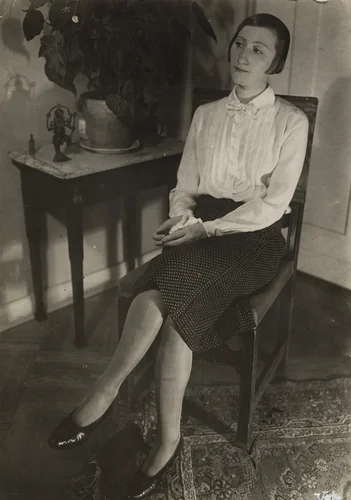
Trained initially under Johannes Itten, Umbo was heavily influenced by the experimental aesthetic and compositional theories promoted by László Moholy-Nagy. His photographic signature utilized high-contrast printing, sharp angles, and unconventional compositions that treated the camera not merely as a recording device, but as an instrument of psychological interpretation. His early work successfully blended the immediacy of street reportage with the psychological depth of studio portraiture.
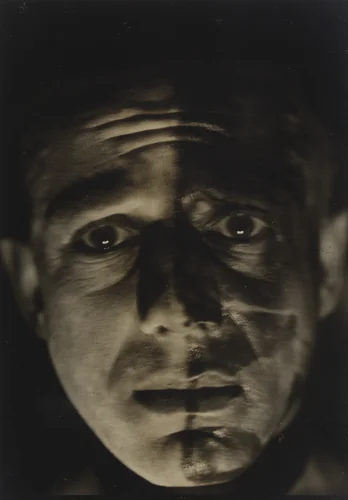
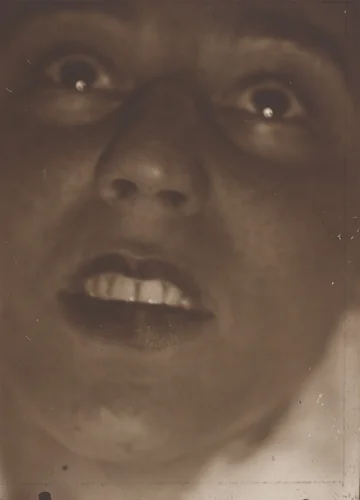
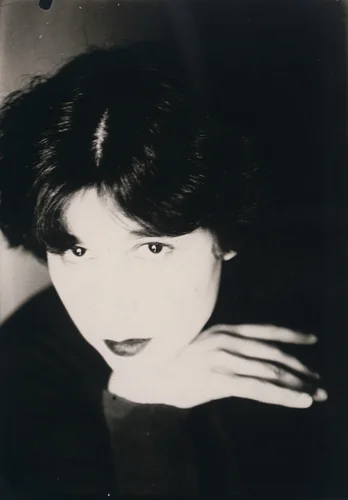
Umbo’s approach to portraiture often transcended simple likeness, transforming his subjects through dramatic lighting and tight cropping. Works such as Ruth Landshoff and Margo Lion demonstrate a remarkable psychological insight into the artistic circle of the Weimar Republic. Conceptual pieces like Warriorlike Face use extreme shadow and light to transform the subject into an unsettling, yet deeply modern, mask. Umbo’s work often suggests that the greatest mysteries of the modern city are not hidden in the shadows, but exposed under the blinding flash of the camera.
Following his dynamic early period, Umbo worked primarily as a photojournalist, serving with the Wehrmacht during the Second World War. The immediate post-war years brought significant financial hardship. His historical status changed dramatically only after 1975, when photography gained broader acceptance as a distinct, museum-quality discipline of art. This belated recognition secured his place in history, allowing for major exhibitions and a renewed critical assessment of his legacy. Today, many seminal works, including the street scene Mystery of the Street, are available as high-quality prints through major institutional collections.
The five photographs dating from his key active period remain concise, powerful summations of German photographic modernism. His importance is validated by major acquisitions, most notably the inclusion of his works in the permanent collection of the Museum of Modern Art.
Source: Wikipedia · CC BY-SA 4.0