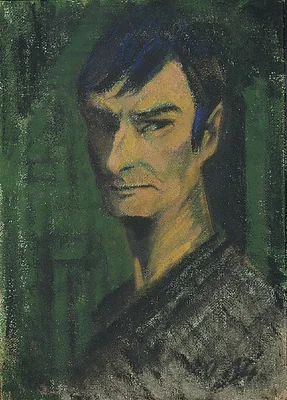
Otto Mueller
Otto Mueller (1874-1930) secures his historical significance as a seminal German painter and printmaker, integral to the transformative Die Brücke Expressionist movement. Active during the critical years between 1912 and 1920, Mueller’s work often deviated sharply from the agitated, urban aesthetics favored by many of his contemporaries. While other Brücke artists focused on the jarring energy of the modern metropolis, Mueller retreated into a distinct, lyric vision focused on the harmonious relationship between the human figure and the natural environment.
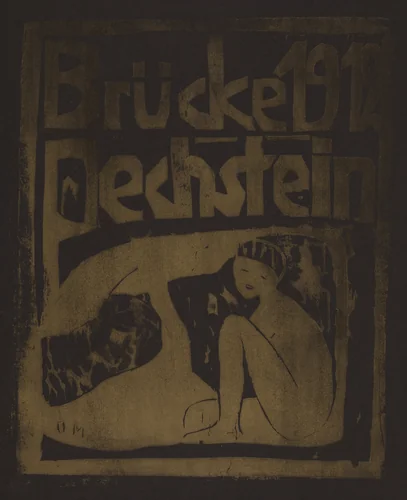
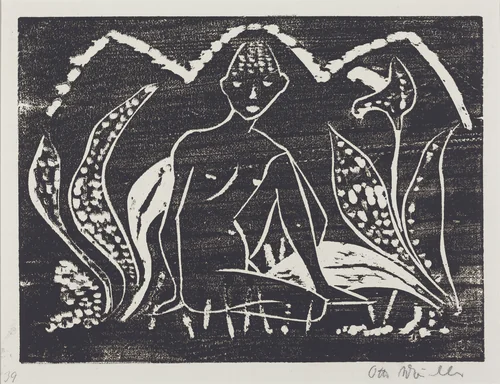
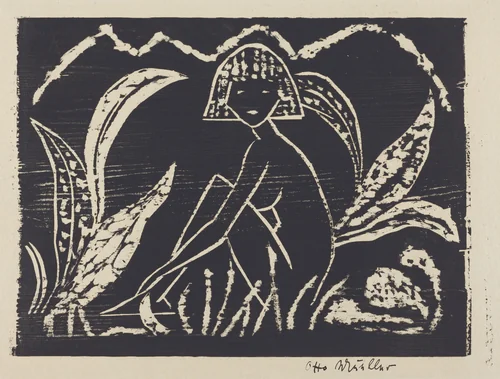
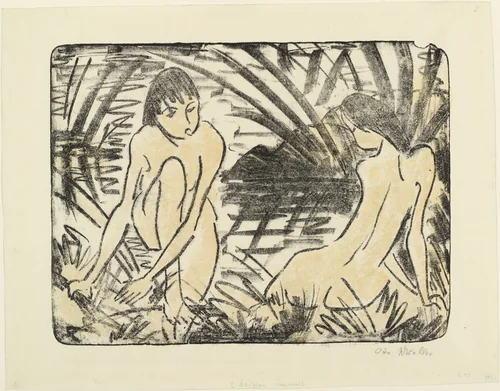
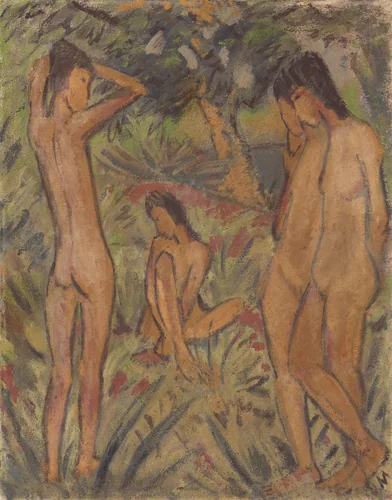
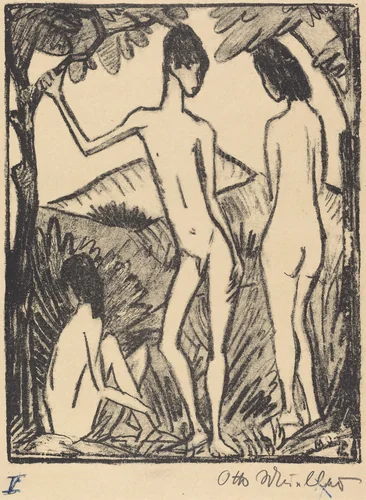
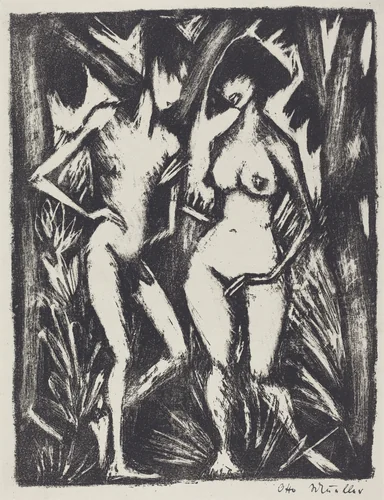
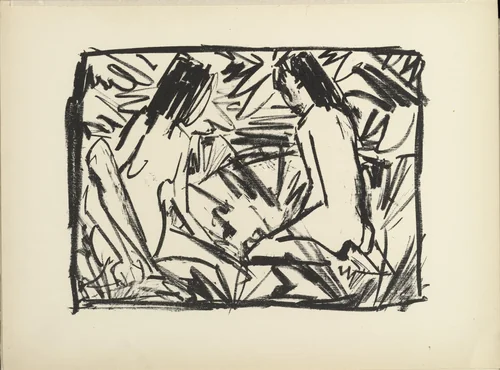
Mueller’s aesthetic identity is inextricably linked to his mastery of printmaking, particularly lithography. He developed a highly recognizable style characterized by soft, matte surfaces and a deliberately limited palette of earth tones, ochres, and dusky greens. These muted hues gave his figures a unique presence that stood apart from the more aggressively chromatic experiments typical of the period. His subject matter was consistently focused on the unadorned nude, often depicted bathing or resting among reeds and foliage, as seen in works like Boy among Leaves and Nude Figure of a Girl in a Landscape.
This persistent preoccupation with the arcadian nude, portraying figures in moments of unvarnished leisure, provides a surprisingly tranquil counterpart to the revolutionary zeal that often defined early German Expressionism. Mueller sought not to shock, but to synthesize, creating a mythology of integration where the body melts seamlessly into its pastoral setting.
Although his active period was focused, yielding a compelling corpus of approximately eleven prints and a few key Otto Mueller paintings, his legacy remains robust. His sensitive and formally elegant approach proved essential to expanding the aesthetic boundaries of Die Brücke, moving its expressive goals beyond the confines of the city and into a more private, introspective landscape. Today, his output is preserved in major institutions including the Museum of Modern Art and the National Gallery of Art. The enduring appeal of his expressive figures ensures that many of his later works, now in the public domain, are available globally as high-quality prints, sustaining interest in his uniquely gentle contribution to Modernism.
Source: Wikipedia · CC BY-SA 4.0
![Boy among Leaves (Boy in Reeds) (Knabe zwischen Blattpflanzen [Knabe im Schilf]) by Otto Mueller, print, 1912](https://img.artbee.org/fbc8eb97-2a91-4683-8330-075023e57b6f/small.webp)
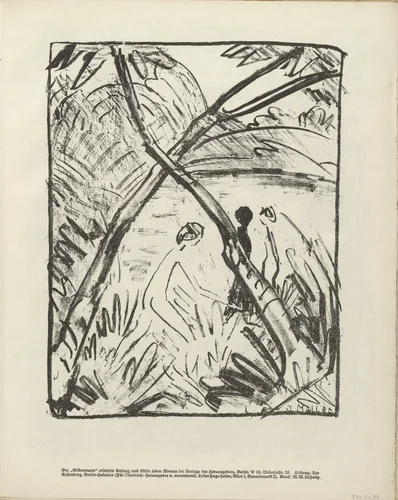
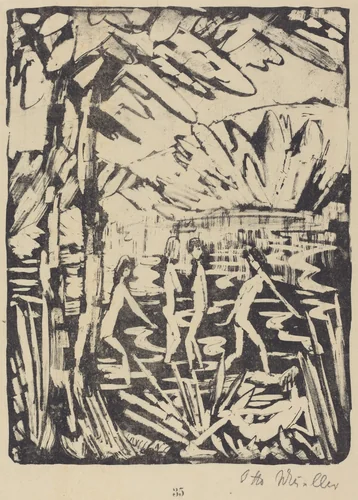
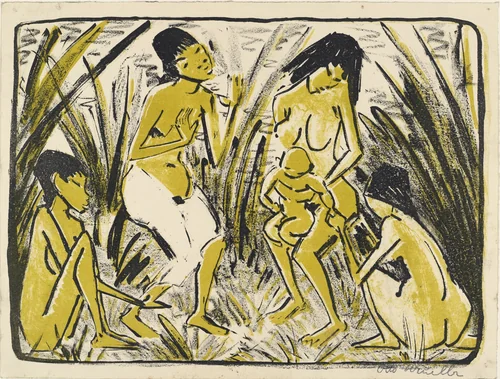
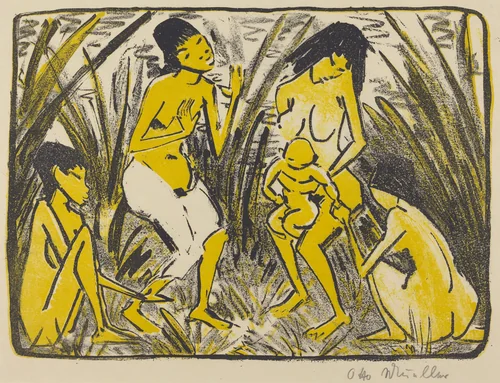
![Five Girls by a Pond in the Woods (1) [Fünf Mädchen am Waldteich (2)] by Otto Mueller, print, 1919](https://img.artbee.org/13c5ffdb-38d1-42e6-a410-612d7d204c65/small.webp)
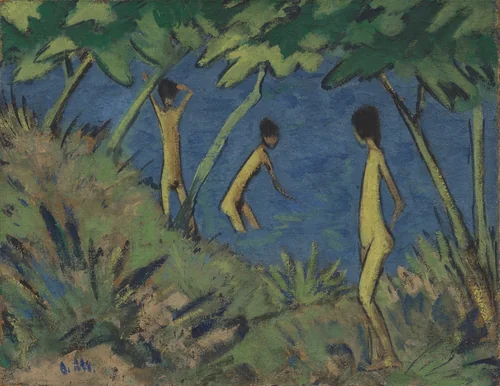
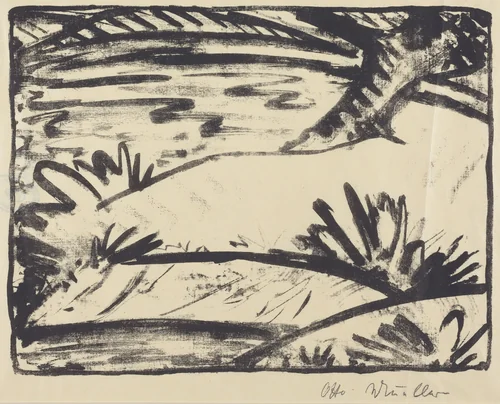
![One Girl Bathing and the Other Sitting on the Shore (2) [Badendes und am Ufer sitzendes Mädchen (2)] by Otto Mueller, print, 1919](https://img.artbee.org/fd0fb8a6-2f97-4b39-a879-8f7a4d8b6496/small.webp)
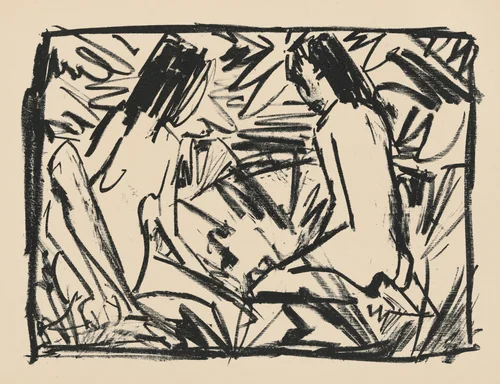
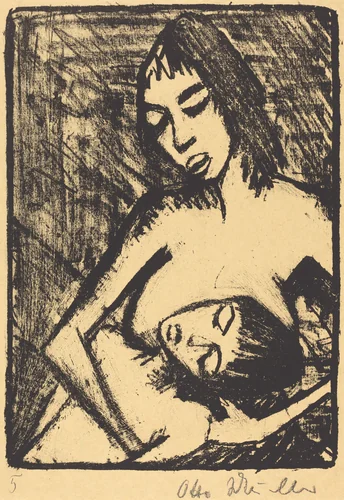
![Mother and Child 2 (Small Version) (Mutter und Kind 2 [kleine Fassung]) by Otto Mueller, print, 1920](https://img.artbee.org/37444410-2723-4b6b-a3a2-15ee41232f82/small.webp)