Okada Hankō
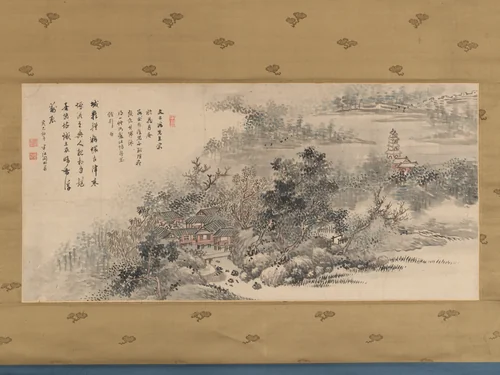
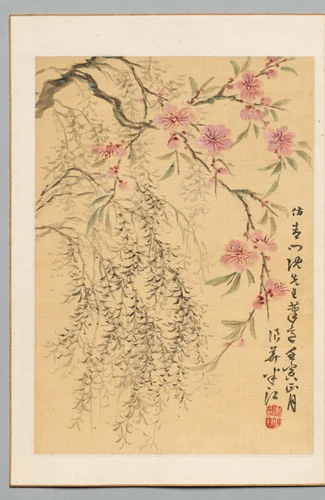
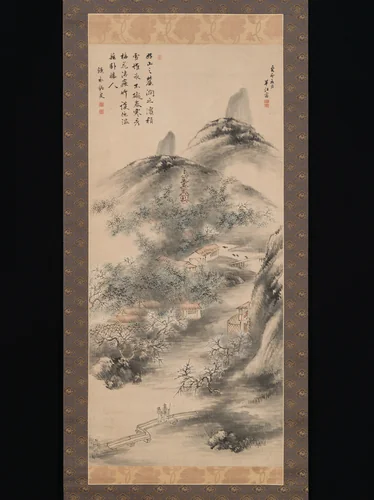
Okada Hankō (1800-1843) was a pivotal practitioner of the Nanga style, or Japanese literati painting, active during the later Edo period. The son of the respected literati painter and successful rice merchant, Okada Beisanjin, Hankō inherited a rigorous aesthetic foundation. He represents the third generation of Bunjinga masters in Japan, an era marked by a critical evolution in the movement’s relationship with its Chinese origins.
This generation enjoyed unprecedented scholarly access to original Chinese paintings, allowing artists like Hankō to move beyond the rote reliance on painting handbooks and secondary copies that had previously constrained earlier literati artists. This freedom led to a distinct maturity in his technique and composition, enabling him to develop a sophisticated personal style untethered from direct imitation.
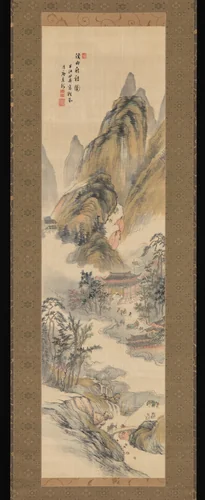
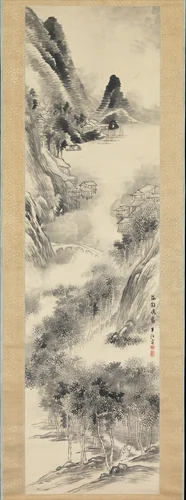
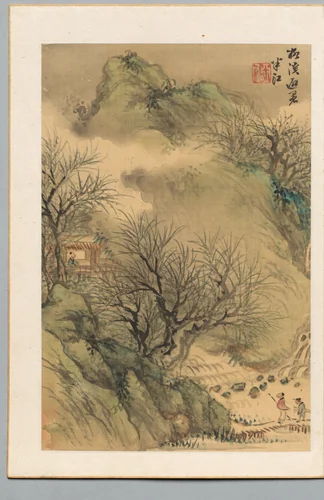
Hankō’s mastery is notable for its versatility; he possessed an unusual command over both refined and robust applications of ink. Many of his compositions employ highly sophisticated brushwork to create complex, layered scenes. In these works, subtle, complementary colors are meticulously added to the predominant black ink wash, achieving depth and atmosphere, as seen in works like Autumn Festival in the Mountains and Misty Dawn at the Seashore. Yet, equally compelling are his pieces executed solely in ink with vigorous, rapid brushstrokes, confirming his status as an accomplished calligrapher alongside his painting practice. This technical duality, encompassing both delicate refinement and energetic assertion, gives his oeuvre a dynamic range often overlooked in his contemporaries.
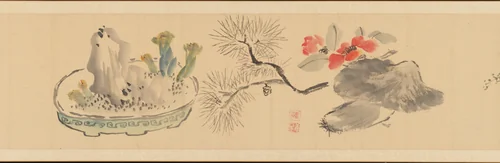
His recorded works, including the intimate Letter Enclosing Flowers and the formal Farewell Gift to Tani Bunji, confirm his position as an authoritative artist of his time. Today, the enduring quality of his production ensures that museum-quality examples of Okada Hankō paintings are held in major international collections, notably the Metropolitan Museum of Art and the Cleveland Museum of Art. For scholars and enthusiasts, many high-quality prints and downloadable artwork derived from his originals are now widely available for study.
Source: Wikipedia · CC BY-SA 4.0