Ogata Kenzan
Ogata Kenzan, originally known as Ogata Shinsei, stands as one of the definitive figures in Japanese aesthetic history, active throughout the Edo period (1663-1743). His significance rests upon a rare mastery that fused three distinct disciplines: he was a consummate potter, an accomplished painter, and a respected calligrapher. His work is critically associated with the refined traditions of Kyō ware and Kiyomizu ware, though his innovative approach ultimately transcended regional classification.
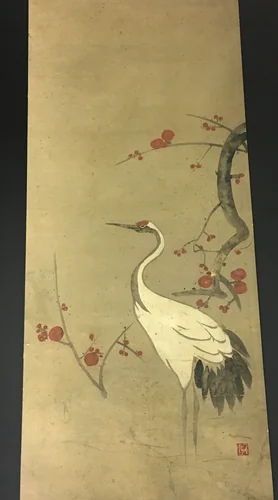
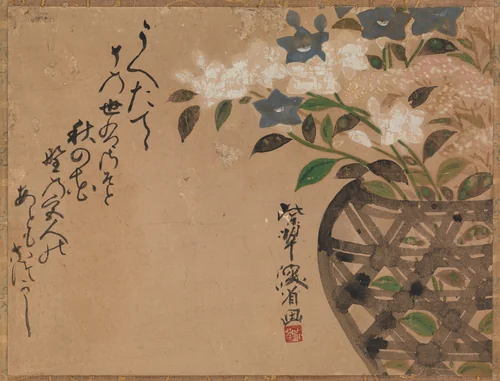
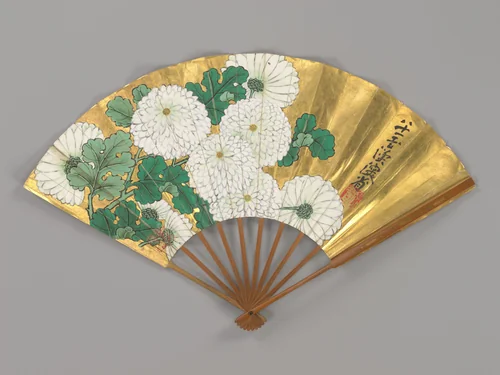
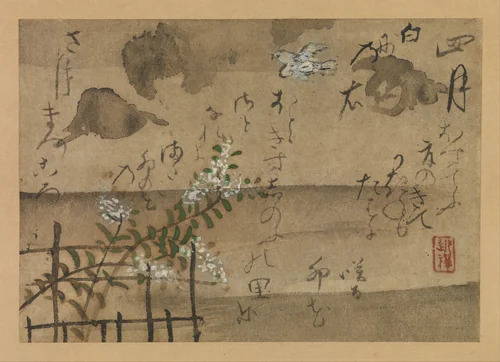
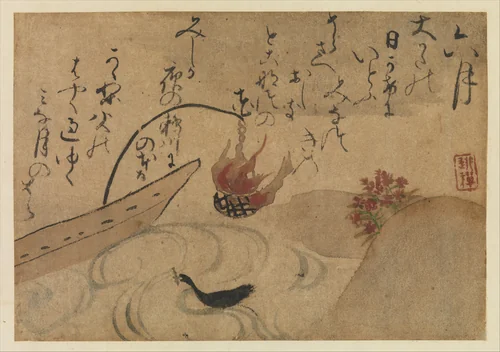
Kenzan elevated ceramic artistry by integrating his superb talents as a painter directly into the functional object. His ceramics were rarely monochromatic or purely textural; instead, he treated the surface of the clay as a three-dimensional canvas. This allowed for the execution of designs that were both dynamic and deeply lyrical, often drawn from the natural world with a sophisticated sense of graphic composition and negative space. His painterly hand is evident in masterpieces such as Red Plum Branch and a Crane and Bellflowers in Basket, which showcase his characteristic blend of bold asymmetry and delicate brushwork. It is a subtle observation that Kenzan employed a remarkable breadth of pseudonyms during his long career, including Shisui, Shōkosai, and Tōin, suggesting an active intellectual life dedicated to defining and redefining his artistic identity throughout changing eras.
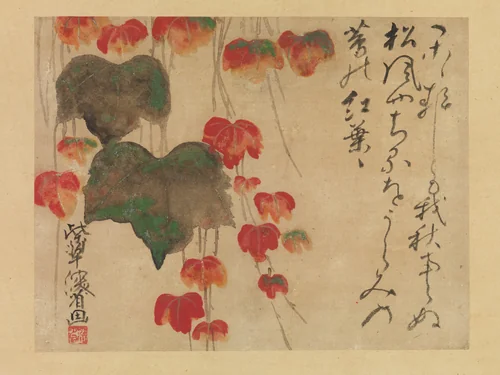
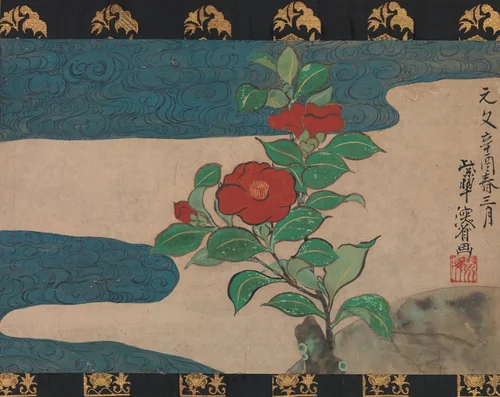
His contributions fundamentally shaped the trajectory of Japanese decorative arts. Kenzan’s enduring legacy is rooted in his establishment of a tradition where the applied arts achieved parity with fine arts. He ensured that pottery was viewed not merely as craftsmanship but as a medium for high-level artistic expression. Works such as Autumn Ivy and the evocative Camellia by Water affirm the museum-quality status of his output and are central to numerous international collections. Fortunately, the historical importance of his production means that many examples of Ogata Kenzan prints and paintings are accessible today. They are frequently made available as royalty-free downloadable artwork through institutional archives, ensuring the accessibility of Kenzan’s aesthetic genius to the global public domain.
Source: Wikipedia · CC BY-SA 4.0