Odoardo Fialetti
Odoardo Fialetti (active 1600-1617) was an Italian painter and prolific printmaker whose graphic output provides a crucial study in the transition from late Renaissance training into the dynamism of the early Baroque era. His works, held today in significant collections including the Metropolitan Museum of Art and the National Gallery of Art, offer valuable insight into Venetian-school aesthetics at the turn of the century, affirming the lasting importance of the Odoardo Fialetti prints.
Fialetti’s artistic trajectory is marked by distinct stylistic shifts. Beginning his training in the foundational structures of the late Renaissance, he soon developed a highly individualized style centered on Mannerist principles. These mid-career pieces utilized the signature elongation and psychological complexity characteristic of that movement, yet avoided the extreme rigidity sometimes seen in his contemporaries.
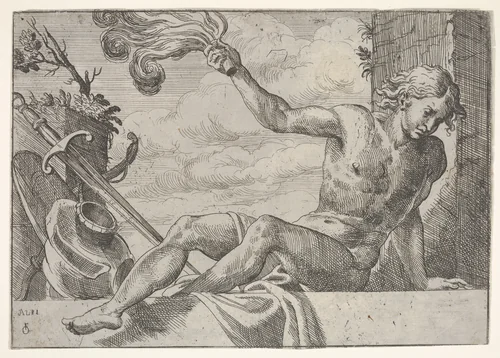
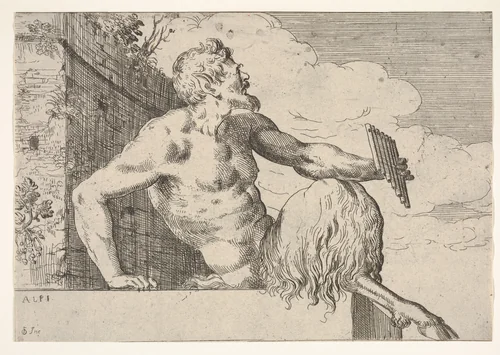
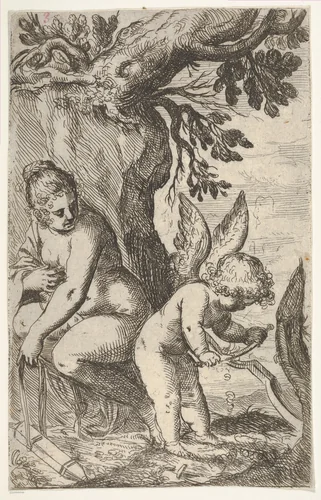
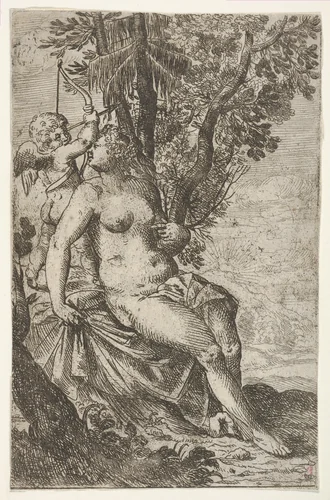
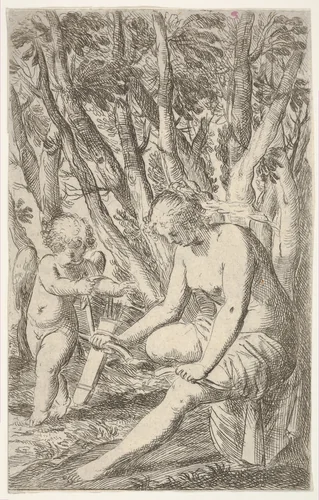
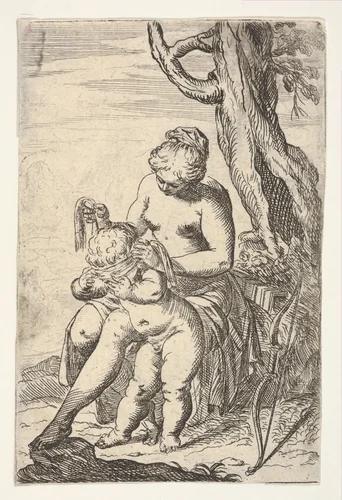
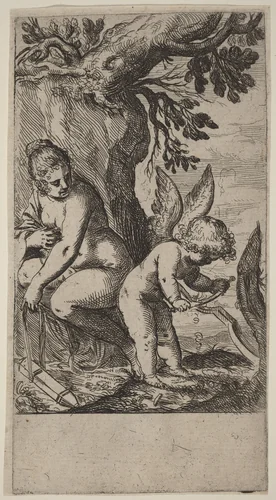
His greatest artistic legacy rests upon the vitality and immediate appeal of his engravings. His skill as a printmaker allowed for wide dissemination of his figures, often drawn from classical mythology and allegory. The short series Sport of Love (Scherzi d'amore) showcases a compelling combination of technical precision and narrative charm. These small-scale depictions explore the complex relationship between Venus and Cupid with remarkable intimacy, whether showing Cupid prepares to shoot an arrow as Venus looks over her right shoulder, or the slightly domestic drama of Venus breaking Cupid's bow over her knee. Even figures such as Seated Pan holding a pipe or the muscular Mars, seated on a wall, are rendered with a powerful, personalized immediacy.
Interestingly, Fialetti did not remain anchored to the intellectual tension of high Mannerism. In the later years of his known activity, he adopted a noticeably looser, more dynamic execution, anticipating the expressive freedom of the burgeoning Baroque style. This willingness to embrace fluidity suggests an artist keenly receptive to the changing demands of the visual market, preferring immediacy over structural formalism. Consequently, many of his striking images are now widely accessible via the public domain, allowing scholars and enthusiasts access to museum-quality representations. These high-quality prints ensure that Fialetti’s subtle wit and technical prowess continue to be appreciated well beyond his brief period of recorded activity.
Source: Wikipedia · CC BY-SA 4.0