Norman Lewis
Norman Lewis (1909-1979) holds a distinguished position within the New York School, recognized internationally as an innovative painter, committed scholar, and influential teacher. Active primarily between 1943 and 1967, Lewis was one of the very few African-American artists to gain acceptance and critical recognition within the sphere of Abstract Expressionism during its peak influence. His works, including notable drawings, prints, and paintings, are held in prestigious institutional collections, such as the National Gallery of Art.
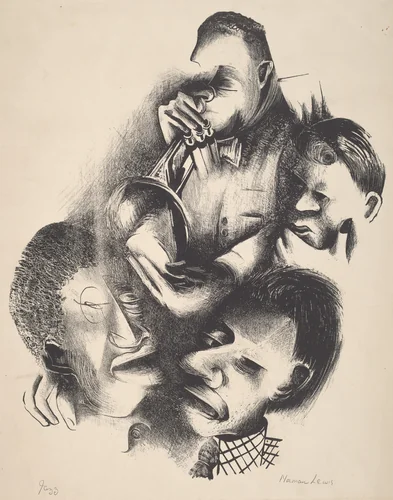
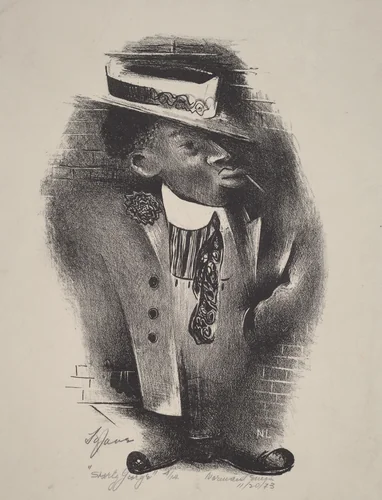
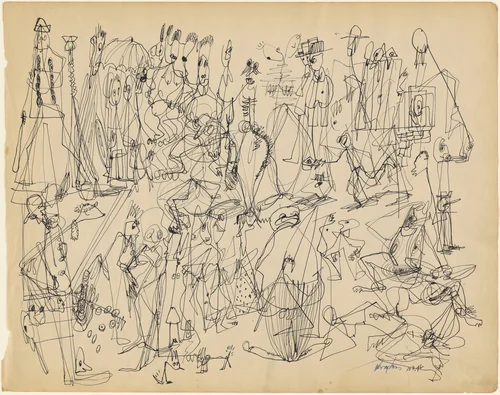
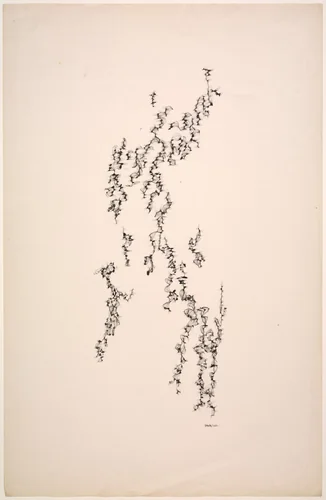
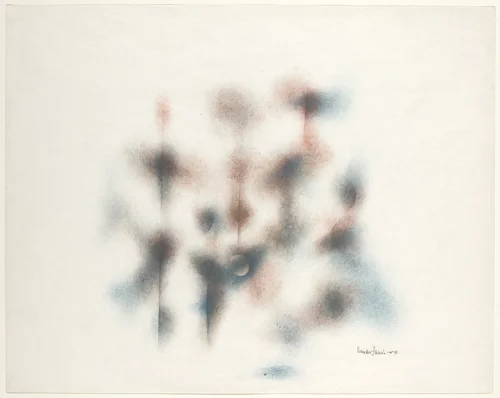
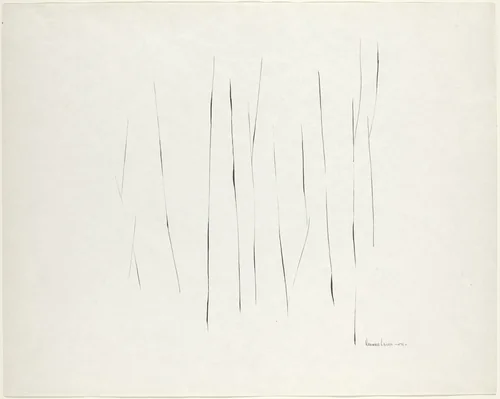
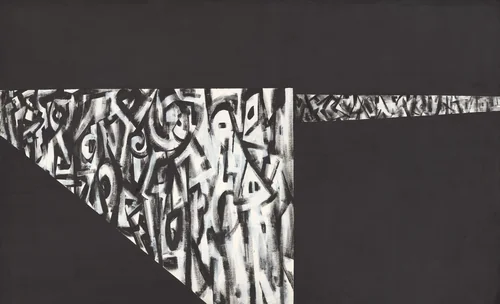
Lewis fundamentally refined the language of post-war abstraction. Unlike the aggressive, expressionistic gestures favored by some contemporaries, Lewis developed a distinctive style characterized by intricate networks of linear design and atmospheric fields of color. His visual methodology was one of structure and rhythm, often synthesizing social observations with non-objective form. Early works like the drawing Jazz and the print Shorty George capture the kinetic energy of performance and urban gathering, using delicate yet decisive brushwork and composition to evoke syncopation and communal activity. His capacity to find abstract poetry in the observed world is also evident in pieces like Leaf Forms #4, where natural structures are distilled into elegant, almost calligraphic patterns.
Lewis's intellectual contributions were as significant as his artistic output. He was a dedicated advocate for equality, helping to establish the Spiral group in the 1960s to discuss the role of the African-American artist in society. His sustained commitment to both formal innovation and social justice provided a crucial counterpoint to the often Eurocentric narrative of American abstraction.
It is perhaps a minor but telling irony that while countless other individuals named Norman Lewis pursued success in fields ranging from fencing and football to literature and politics, this specific Norman Lewis defined his legacy by creating works that transcended mere representation, seeking a universal emotional truth. The technical proficiency and enduring graphic quality of Norman Lewis prints mean that images from his catalogue, including those currently in the public domain, are highly sought after as museum-quality reproductions. His rigorous and sensitive compositions continue to resonate, securing his place among the foremost figures of 20th-century American art.
Source: Wikipedia · CC BY-SA 4.0