Niles Spencer
Niles Spencer (1893-1955) stands as a foundational figure within the American Precisionist movement. Active primarily between the two World Wars, Spencer specialized in the rigorous, often stark depiction of the modern urban and industrial environment. His commitment to structural clarity and simplified geometry quickly earned him critical recognition, placing him alongside influential peers like Charles Sheeler and Charles Demuth. A limited but critically important body of work resides today in the permanent collections of major institutions, including the Metropolitan Museum of Art, the Museum of Modern Art, and the Whitney Museum of American Art.
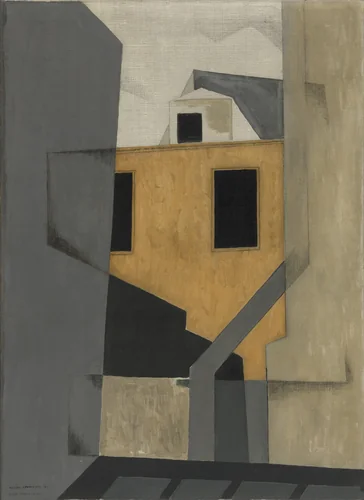
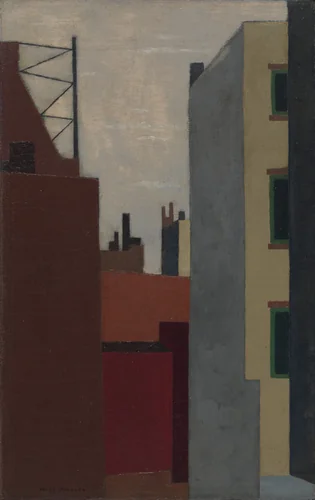
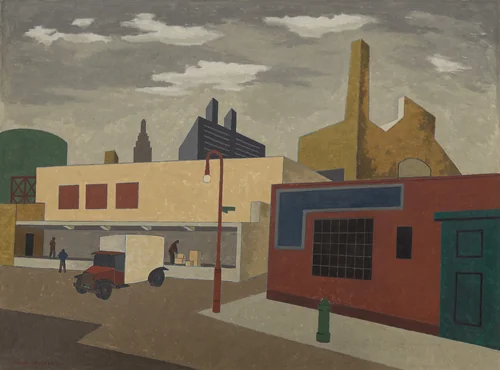
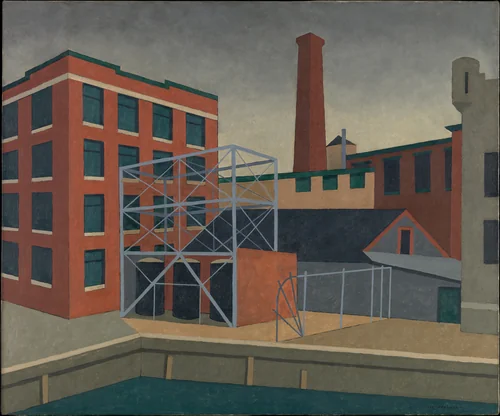
Spencer’s formal innovation centered on transforming the often-chaotic reality of American city structures into harmonious, ordered arrangements. His approach was coolly analytical, standing in sharp contrast to the documentary style of earlier realists. Works such as White Factory and Waterfront Mill showcase the characteristic Precisionist dedication to sharp outlines, immaculate surfaces, and meticulously controlled lighting. The paintings deliberately exclude human figures, compelling the viewer to confront the architecture as monumental, almost eternal forms.
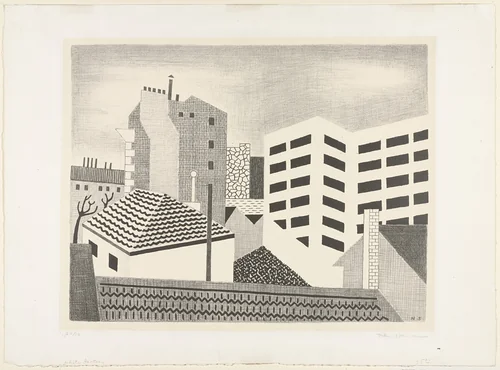
His compositions often employ tightly cropped and complex perspectives, utilizing planar shifts and a sophisticated, deliberately muted color palette. This method creates a powerful dialogue between the geometric stability of the finished composition and the inherent dynamism of the industrial subjects themselves. Canvases such as City Walls or Near Washington Square demonstrate his mastery of rendering complex urban density through simplified planes. Though his career was tragically curtailed by chronic illness, Spencer’s vision remains crucial for understanding the aesthetic response to modernization in 20th-century America.
While his relentless focus was on steel and concrete, his Niles Spencer paintings maintain a surprising visual warmth; the inherent austerity of the subject matter is consistently softened by subtle atmospheric depth and precise tonal gradation. His relatively small production ensures that each surviving canvas, whether Near Avenue A or one of his few documented Niles Spencer prints, is regarded today as a primary historical document. The accessibility of his artistry has widened in recent years, with many key works now in the public domain, allowing institutions to offer high-quality prints and downloadable artwork for study, reinforcing his stature as a master chronicler of the machine age.
Source: Wikipedia · CC BY-SA 4.0