Niccolò dell' Abate
Niccolò dell'Abate (active 1512-1550), sometimes indexed as Nicolò, was a pivotal Italian Mannerist painter whose career decisively bridged the aesthetic innovations of the Emilian school with the burgeoning cultural requirements of the French court. Working extensively in both fresco and oils, he secured his place as a foundational member of the First School of Fontainebleau, an initiative critical to the spread of Renaissance styles across Northern Europe.
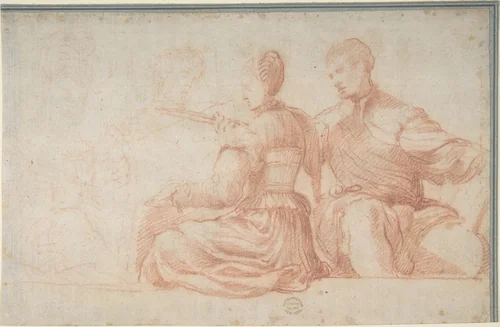
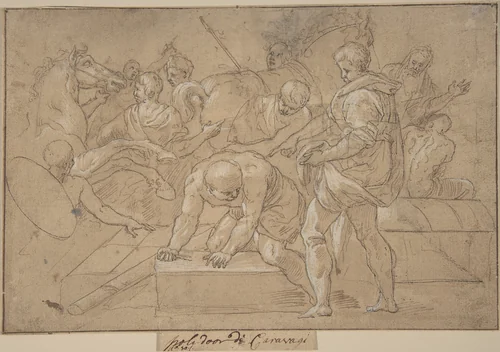
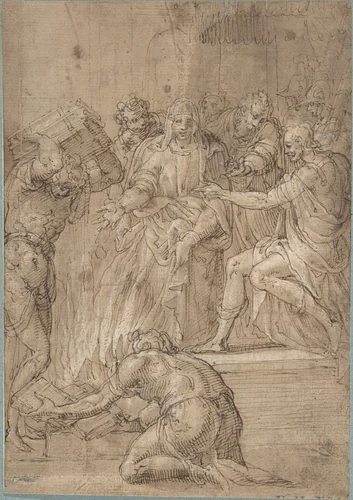
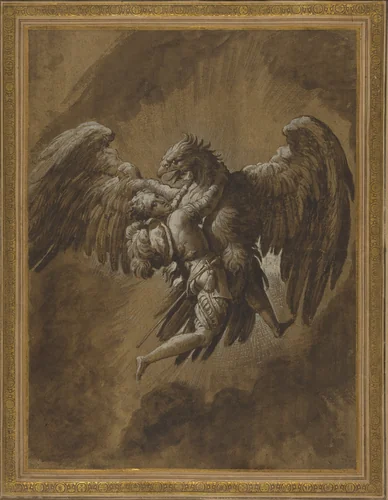
Dell'Abate’s compositions are characterized by the fluid elegance and visual sophistication typical of high Mannerism. His surviving drawings and paintings, held in major collections such as the Metropolitan Museum of Art, demonstrate a keen interest in both classical history and contemporary courtly life. Works such as The Rape of Ganymede reveal his mastery of mythological subjects, employing elongated, graceful forms that define the period's taste for artifice and intellectual complexity. Simultaneously, his ability to handle large narrative compositions is evident in commissions like the Historical Scene (Composition Study for Chapelle de Guise), a preparatory work reflecting his activities in France.
Central to his legacy was his role in the group of artists who established the School of Fontainebleau. Following his move north, Dell'Abate became instrumental in executing decorative schemes for the royal châteaux. This collective enterprise introduced Italianate decorative programs, fusing stucco work with fresco painting, thereby shaping French visual culture for generations.
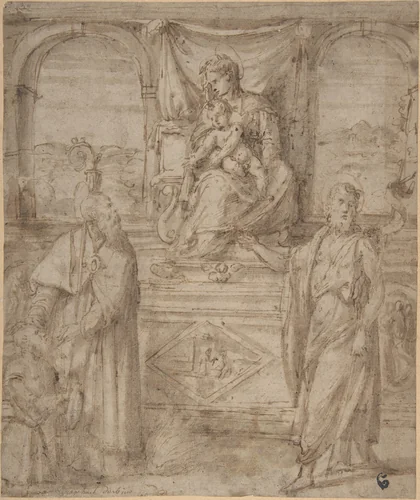
The relatively small number of authentic Niccolò dell' Abate paintings and executed works available today, including the ambitious Madonna and Child Enthroned with Saint Basil the Great and Saint John the Baptist and Donor, belies the true extent of his influence across Europe. Interestingly, while his output was prodigious, much of his legacy rests upon detailed drawings and copies made by followers, giving the impression of an artist whose designs were perhaps more influential than his individual paintings. For contemporary audiences and scholars, many of his key works are now in the public domain, ensuring that high-quality prints and downloadable artwork of his celebrated compositions remain accessible for study and appreciation, sustaining the intellectual tradition of sixteenth-century Mannerism.
Source: Wikipedia · CC BY-SA 4.0