Nazca
The Nazca culture developed across a crucial system of valleys on the southern coast of modern Peru, flourishing prominently between 100 BC and AD 800. Deriving its name from the present-day city and province, the Nazca civilization is globally recognized for its monumental achievements in engineering, urban planning, and symbolic art, particularly those works that redefine the relationship between humanity and the environment.
Their most famous contribution, the eponymous Nazca Lines, constitutes one of the largest and most enigmatic artistic endeavors in antiquity. These geoglyphs, visible only from elevated positions, depict complex biomorphic forms and geometric shapes etched across the desert floor. Beyond this vast scale drawing board, the culture established the major ceremonial center of Cahuachi, demonstrating a mastery of architectural organization essential to their spiritual and political cohesion.
Crucially, the Nazca ensured their survival in an arid environment through brilliant hydraulic engineering. They constructed a network of sophisticated underground aqueducts, known as puquios, designed to tap subterranean water sources. Remarkably, this regional system of puquios remains functional in parts today, a silent testament not only to their ingenuity but to the longevity of sustainable infrastructure. The technical foundations for these systems are believed to have been laid by the preceding Paracas culture, illustrating the Nazca’s practical adoption and refinement of inherited technical knowledge.
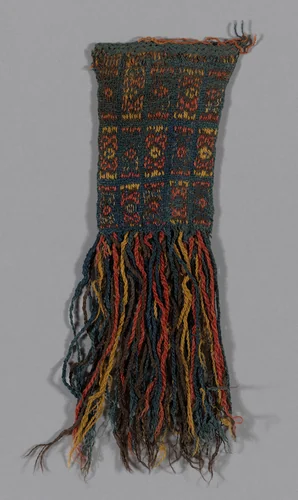
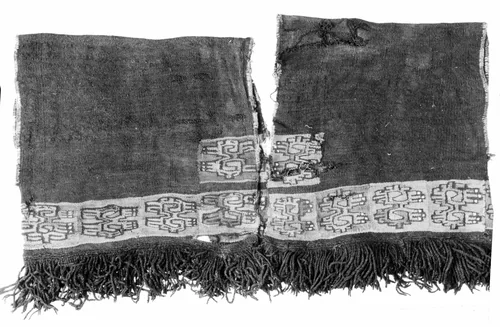
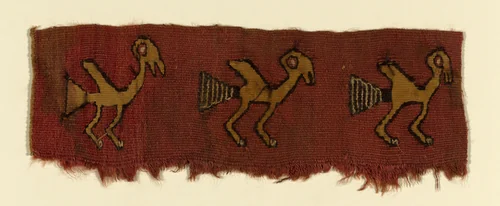
While the Lines define their public profile, the Nazca were also prolific producers of detailed, finely crafted material objects, often utilizing polychrome textiles and distinctive metalwork. These objects offer insight into their cosmology and daily life. Notable surviving examples held in major international collections, such as the Art Institute of Chicago, include fourteen expertly woven textiles and delicate metal pieces like the Nose and Mouth Ornament. Today, the distinct visual vocabulary embedded in their pottery and weaving has made many of the available image resources frequently sought as museum-quality, downloadable artwork for scholars and enthusiasts alike, ensuring their artistic legacy continues to be studied as a primary example of pre-Columbian South American artistry.
Source: Wikipedia · CC BY-SA 4.0