Navajo
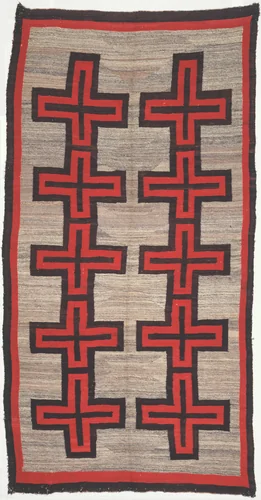
The Navajo people, an Indigenous community rooted in the American Southwest, stand as one of the most historically significant groups in North American textile history. Their language, Navajo, belongs to the Southern Athabascan family. From approximately 1800 to 1880, Navajo weavers defined an era, transforming practical garments into powerful, abstract statements that hold institutional relevance worldwide, with key examples housed in collections such as the Art Institute of Chicago.
This eighty-year span marks the height of the Classic and Early Transitional Periods in weaving. Initially utilizing hand-spun Churro sheep wool dyed with natural pigments, weavers evolved their practice from simple banded designs found in functional items, like the everyday Blanket or Rug, toward increasingly complex compositions. The evolution is starkly evident in the progression of the highly valued dich’osh (Chief Blanket), moving from early banding to the centralized, geometric focus seen in the Chief Blanket (Third Phase). These works demonstrate a sophisticated application of symmetry and visual weight, transforming the act of wearing into a declaration of status and mastery.
The late 19th century ushered in a new chapter of innovation driven by commercial materials. The introduction of refined, brightly dyed wool yarns, often sourced from Germantown, Pennsylvania, dramatically expanded the available color spectrum and technical complexity. This shift enabled weavers to achieve unprecedented visual density, developing the so-called "eye-dazzler" style. Works like the Germantown Eye-Dazzler Rug exemplify this high-frequency aesthetic, where dizzying arrangements of serrated diamonds and jagged motifs create an optical vibration. It is perhaps the most honest critique an artwork can receive, denoting pure, overwhelming visual force.
Today, these works from the active period remain vital subjects of study. Pieces recognized for their exceptional design and execution form the core of museum-quality textile collections. For those researching the historic dye processes or complex geometry, many images of classic Navajo prints are available as downloadable artwork, providing invaluable, royalty-free access to these foundational pieces of Indigenous American art history.
Source: Wikipedia · CC BY-SA 4.0