Michael Heizer
Michael Heizer is one of the most significant American artists to emerge in the late 1960s, widely recognized as a foundational pioneer of the Land Art or Earthworks movement. By working largely outside the traditional confines of galleries and museums, Heizer fundamentally redefined the parameters of sculpture in terms of size, mass, gesture, and process. Beginning in the American West in 1967, his practice shifted the focus from the pedestal to the environment itself, deploying industrial equipment to effect radical, site-specific alterations upon the earth.
Heizer’s innovation lies in his conception of art not merely as an object to be placed, but as an experience integrated into the vast scale of the continent. His large-scale sculptures are characterized by an extreme dedication to scale and permanence, utilizing heavy earth-moving machinery to sculpt enormous trenches, displacements, and monumental geometric depressions directly into remote desert locations. This approach allows him to challenge conventional notions of artistic production, where the magnitude of the work often precludes easy physical access. His major efforts, such as the two monumental cuts forming Double Negative (1969-70), are perhaps best apprehended via aerial photography or specialized documentation.
The conceptual tension inherent in Heizer’s work is reflected in his own life: an artist whose primary medium is geology and landscape maintains active residences in both the metropolitan intensity of New York City and the stark isolation of Hiko, Nevada, perpetually mediating between the culture he critiques and the environment he shapes.
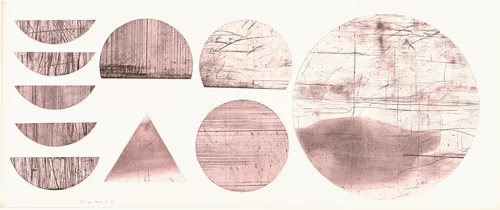
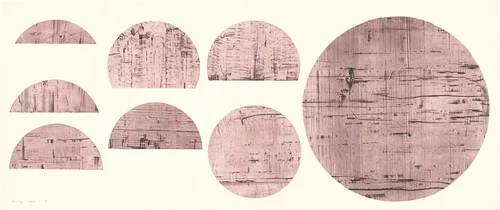
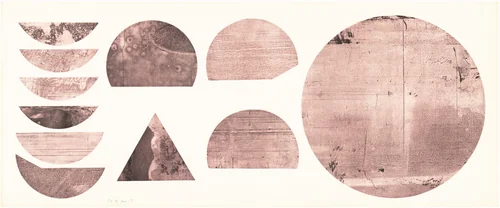
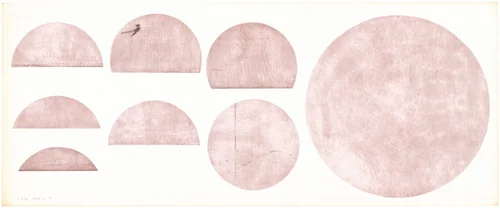
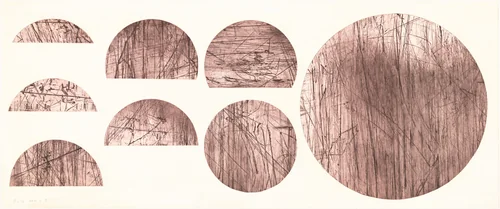
While Heizer is primarily known for these immense environmental structures, his engagement with drawing and printmaking provides essential insight into the conceptual underpinnings of his large-scale vision. His limited edition series from 1978, for example, including the sequence Scrap Metal Drypoint #2 through Scrap Metal Drypoint #6, offers a rare glimpse into the material and formal concerns translated onto a manageable scale. These studies, often dealing with negative space and industrial materiality, distill the massive gesture of the Earthworks movement into graphic form. As works held in major repositories like the National Gallery of Art, Heizer’s output ensures its legacy through high-quality prints and documentation, providing crucial museum-quality accessibility to the core ideas of this pioneering sculptor. His contributions continue to influence contemporary practice, demonstrating that art can be measured in cubic yards as easily as in inches.
Source: Wikipedia · CC BY-SA 4.0