McKim, Mead and White
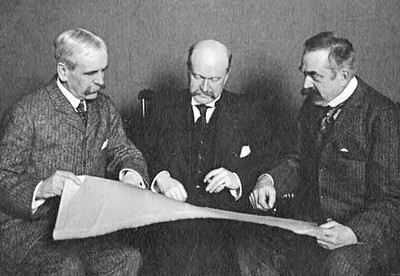
McKim, Mead and White, the New York-based architectural powerhouse, decisively shaped the visual character and urban ideals of America’s Gilded Age. Active primarily from the 1880s through the early 20th century, the firm virtually defined the aesthetic, practice, and aspirations of the American Renaissance movement during fin de siècle New York. Their rigorous work was instrumental in elevating American architecture to a level of classical grandeur previously associated only with major European capitals.
The partnership, comprising Charles Follen McKim, William Rutherford Mead, and Stanford White, masterfully synthesized European classical models, particularly Italian Renaissance and Roman precedents. They applied this vocabulary to modern institutional, commercial, and residential projects. Their innovative approach integrated architecture, interior design, and decorative arts into holistic environments, emphasizing strict symmetry, impeccable material quality, and meticulous detailing. This commitment to classicism set the standard for high-end design throughout the country, influencing city planning and institutional building design well into the 20th century.
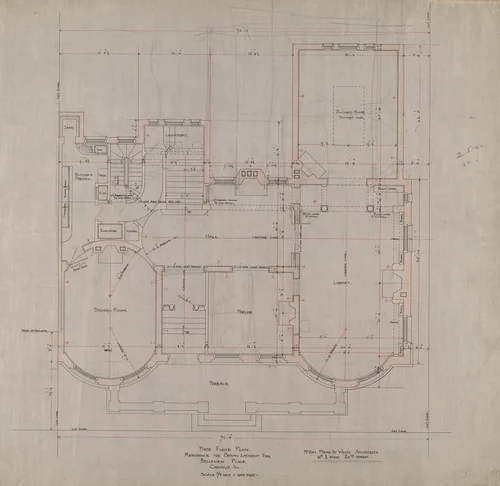
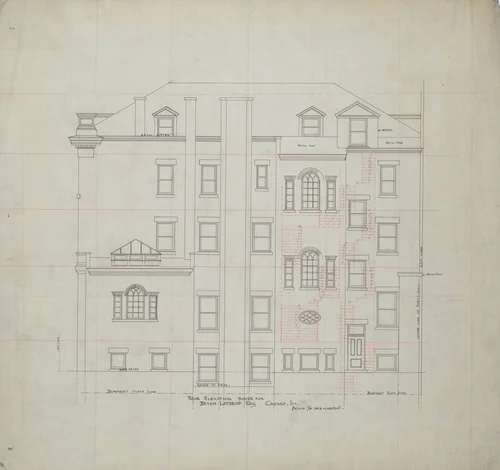
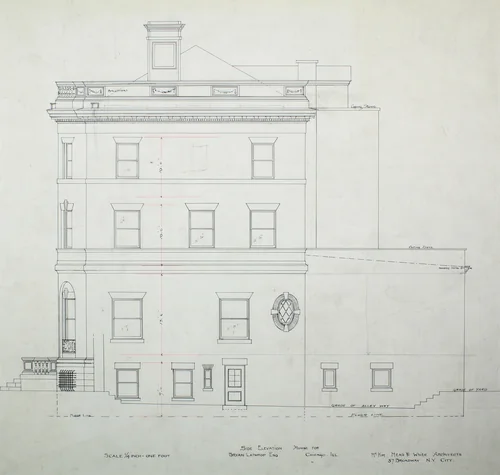
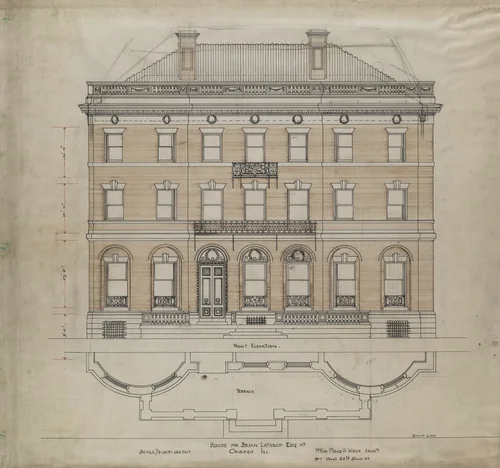
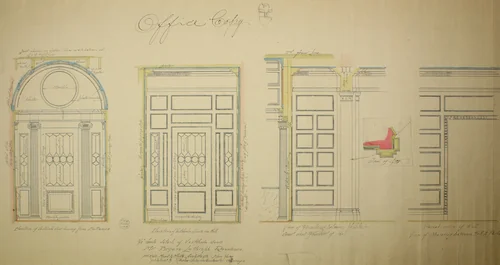
While celebrated for monumental civic commissions like the Boston Public Library and Pennsylvania Station, the firm’s sustained impact is also revealed in its precise residential work. The five surviving drawings for the Bryan Lathrop House in Chicago, executed between 1887 and 1892, provide an exceptional record of McKim, Mead and White’s methodical process. These renderings, including the detailed Bryan Lathrop House, Chicago, Front Elevation and Terrace Plan and the specialized Vestibule Doors, Shop Drawing, reveal the extraordinary precision demanded by the architects. The complexity of these plans confirms that McKim, Mead and White never designed a house; they designed a system.
The inclusion of these works in respected institutions, such as the Art Institute of Chicago, ensures their continued study. Today, thanks to digitization efforts, many of these detailed architectural studies, which hold significant historical value, are available as high-quality prints for researchers and enthusiasts alike. These drawings, now frequently in the public domain, continue to serve as essential resources for understanding the exactitude and formal integrity that made McKim, Mead and White the preeminent architectural voice of their generation.
Source: Wikipedia · CC BY-SA 4.0