Maxime Maufra
Maxime Maufra (1861-1918) holds a significant, if often overlooked, position within the late 19th and early 20th-century French landscape tradition. Primarily known as a marine painter, he worked extensively across mediums, establishing himself as a skilled etcher and lithographer alongside his painting practice. His active period from 1871 to 1903 places him at the critical transition point between established Impressionism and the emerging movements that prized subjective color and structural focus. The lasting institutional respect for his output is evidenced by the inclusion of Maxime Maufra paintings and prints in major North American collections, including the Art Institute of Chicago and the National Gallery of Art.
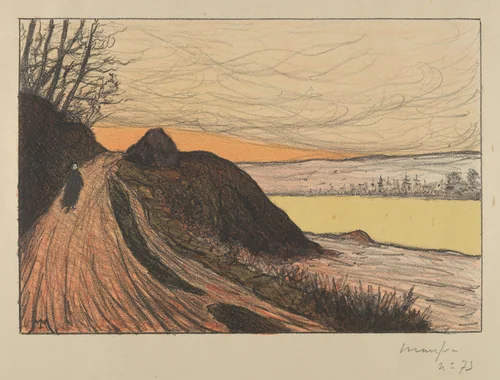
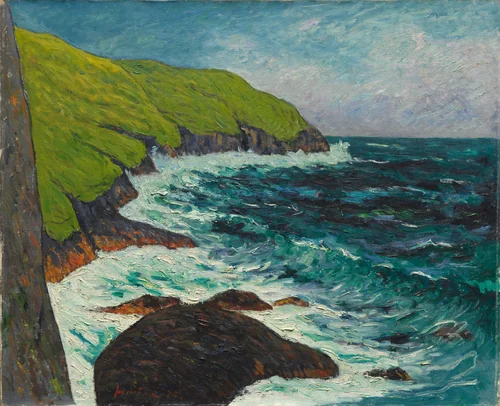
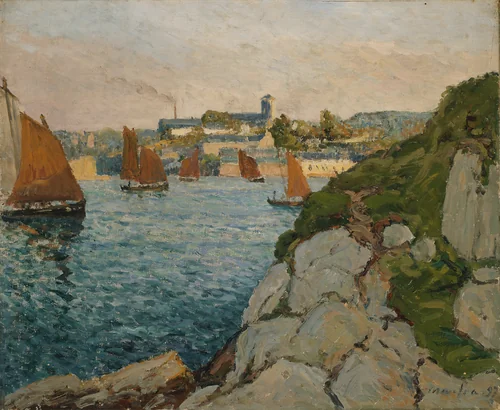
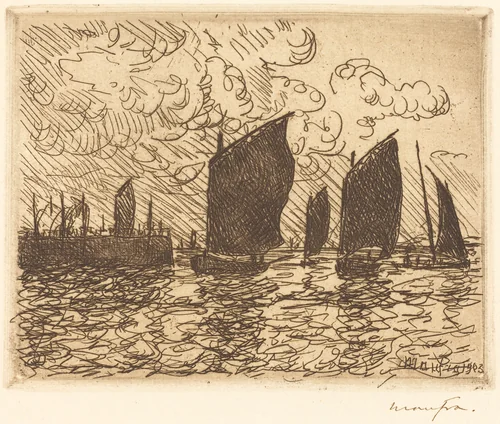
Maufra dedicated much of his career to capturing the volatile conditions of the Breton coastline. His preference for the rugged littoral of Brittany, exemplified by works such as The Cliffs at Beg-ar-Fry, Saint-Jean-du-Doigt and the intensely realized painting Douarnenez in Sunshine, reveals a commitment to observing light and weather effects directly. While his painted compositions retained a vigorous, post-Impressionist approach to brushwork, his graphic output provided a contrasting technical insight. As a contributor to influential portfolios like L’Estampe Originale, Maufra demonstrated a masterful command of printmaking, translating the atmospheric drama of his canvases into sophisticated graphic forms. The lithograph The Road from Gaud (La Route de Gaud) showcases his ability to simplify complex natural forms while maintaining textural richness.
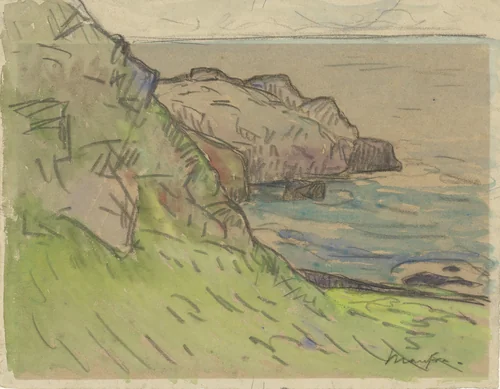
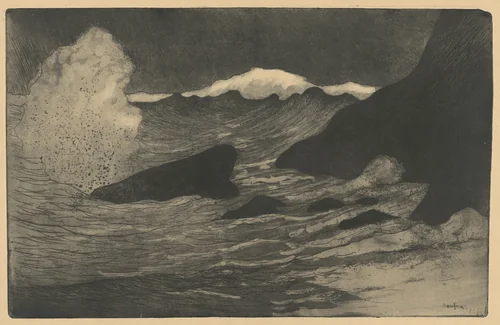
Unlike some of his contemporaries who favored the Parisian milieu, Maufra was an artist resolutely focused on the ocean, often working outdoors in demanding weather. This dedication occasionally resulted in work of striking immediacy, such as The Wave (La Vague) and Côte rocheuse en Bretagne. One enduring observation regarding Maufra's career is how comfortably he bridged the gap between the meticulous detailing demanded by etching and the broad, synthetic strokes necessary for capturing sun-drenched coastal vistas. This duality made him a particularly reliable purveyor of atmosphere, capable of both monumental statement and intimate detail.
Maufra's production ceased relatively early in the modern era, but his achievements remain foundational for understanding regional French landscape art of the fin de siècle. Today, the enduring quality of his draftsmanship ensures that his work continues to be studied. Many of his compelling images are now in the public domain, allowing institutions and researchers access to high-quality prints and downloadable artwork, furthering the appreciation of this dedicated marine artist.
Source: Wikipedia · CC BY-SA 4.0