Max Unger
Max Unger holds a distinguished position within the history of American documentary art, serving as a key renderer for the Index of American Design (IAD), a pivotal New Deal initiative active between 1935 and 1941. Unger’s meticulous work contributed to one of the largest federal arts projects of the Great Depression, tasked with creating a comprehensive visual archive of American decorative arts and material culture from the colonial period through the close of the 19th century. His exacting approach provided the nation with an invaluable record of vanishing craftsmanship and industrial heritage.
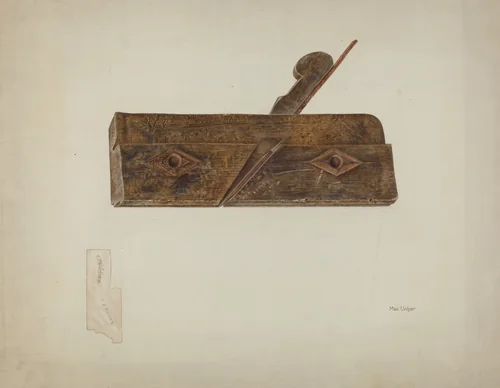
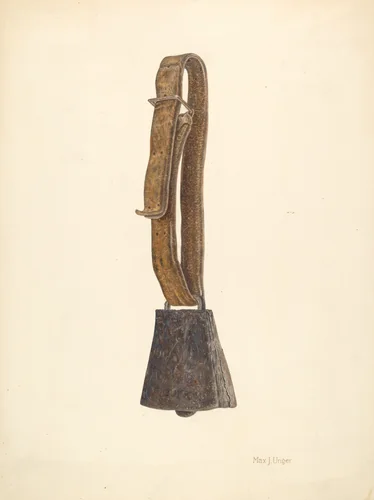
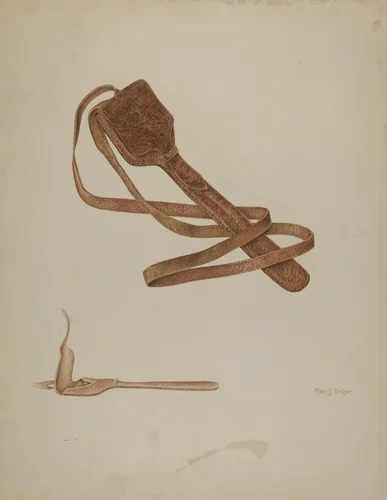
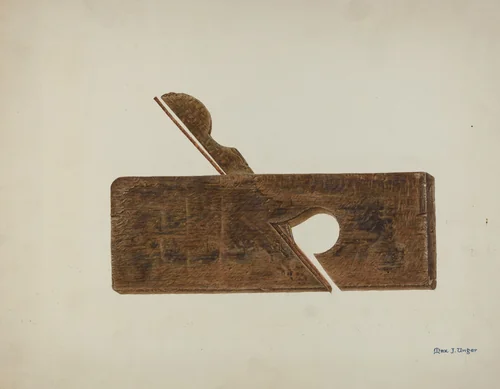
Unger specialized in detailed watercolor renderings and gouache studies, characterized by a commitment to technical accuracy and objective clarity. His extensive portfolio reflects the IAD’s mandate to document utilitarian objects, demonstrating both their inherent aesthetic value and their functional mechanics. Through works such as the precise technical drawing Plane and the highly specialized rendering of the Bead Plane, Unger illustrated implements crucial to early American woodworking and manufacturing. His ability to render reflective surfaces and textural nuance is particularly evident in the documentation of hardware and metalwork, including the detailed study of a Cow Bell and the complex, brass-focused illustration of the Naval Primer Holder. These works required not only artistic skill but a quasi-engineering precision in measurement and form.
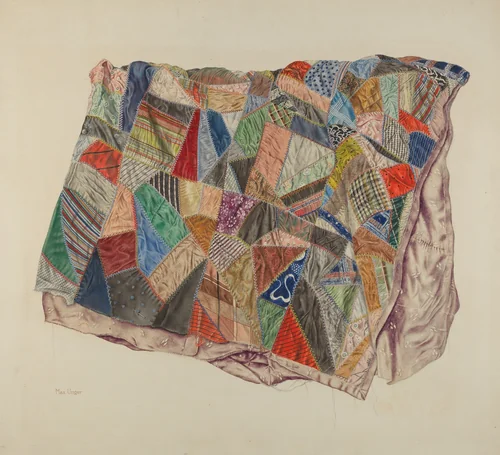
The scope of Unger’s activity during this period was vast, encompassing industrial components alongside domestic items like the geometrically elaborate Patchwork Quilt. These renderings transcend simple illustration; they function as historical blueprints, preserving knowledge of craft techniques that might otherwise have been lost to time. The enduring value of this archive is readily evident today. The National Gallery of Art, which maintains the IAD collection, ensures these historically significant works are widely accessible. Researchers seeking Max Unger prints and related documents benefit from the collection’s public domain status, allowing for royalty-free use and the generation of high-quality prints. It is worth noting that while the Index focused rigorously on preserving history, Unger’s rendering technique possessed a thoroughly modern clarity, offering strikingly sharp visuals that remain relevant for design and historical study today. Many of these documented items are now available as free art prints and downloadable artwork, maintaining the public interest mandate established over eight decades ago.
Source: Wikipedia · CC BY-SA 4.0