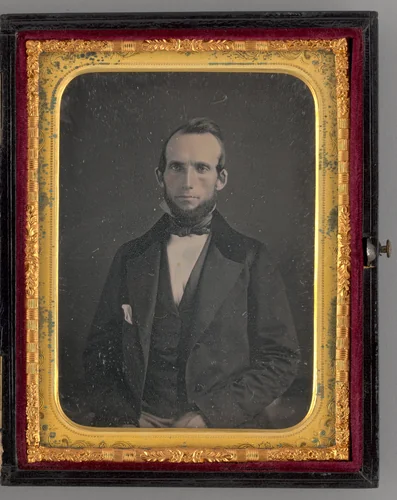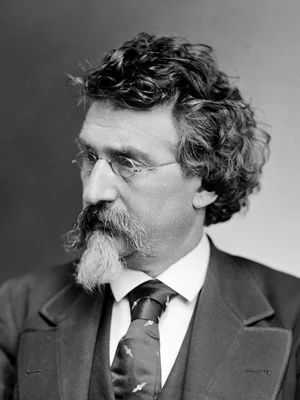
Mathew B. Brady
Mathew B. Brady (1822-1896) stands as one of the most historically significant and technically pioneering figures in nineteenth-century American photography. His career spanned the formative decades of the medium, cementing his reputation through both intimate portraiture and the monumental documentation of the American Civil War. Brady’s work helped shift public perception of photography, demonstrating its capacity not merely for likeness but for objective historical record.
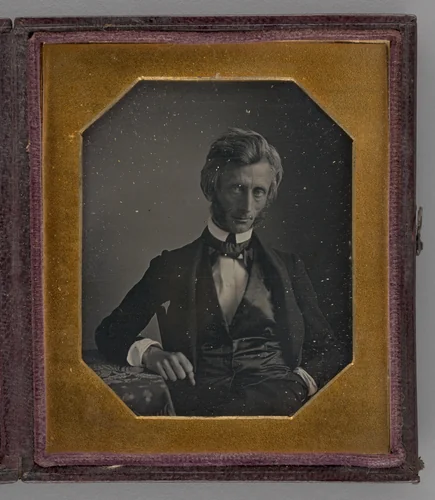
Brady’s initial training under the inventor Samuel Morse was crucial; Morse, having pioneered the daguerreotype technique in America, provided Brady with a direct connection to the rapidly developing technology. This advanced instruction allowed Brady to quickly establish his own professional practice, opening his first successful gallery in New York City in 1844. He soon became the portraitist of choice for the American elite, known for creating meticulous and high-quality prints. His clientele included an array of political titans, such as Presidents John Quincy Adams, Abraham Lincoln, Martin Van Buren, and Millard Fillmore, securing his commercial status and refining his skill in capturing the essence of influential public figures.
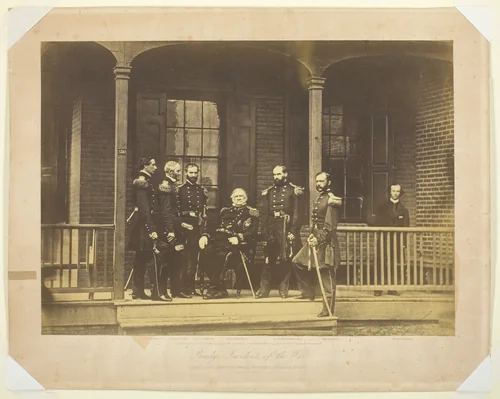
While his studio practice was highly lucrative, Brady's ultimate historical contribution lay in his ambitious, self-funded project to document the Civil War. He understood, perhaps better than any contemporary, the power of photography as historical evidence. Organizing and dispatching teams across battlegrounds and encampments, he sought to create a comprehensive visual narrative of the conflict. The resulting body of work—including the formal composition of Lieutenant General Scott, General-in-Chief, U.S. Army and Staff and countless battlefield scenes—provided the nation with its first unvarnished, emotionally resonant view of modern warfare. This massive undertaking, while financially damaging to Brady personally, preserved an unparalleled record. It is an ironic footnote that the man who chronicled American history so thoroughly ended his career in relative poverty.
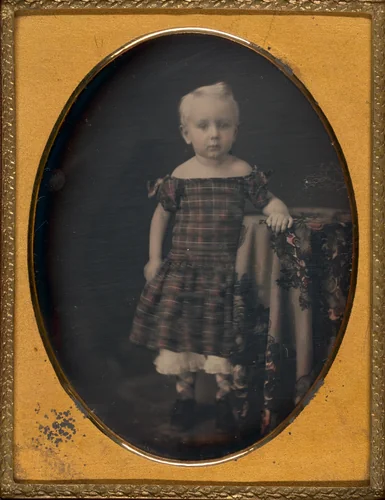
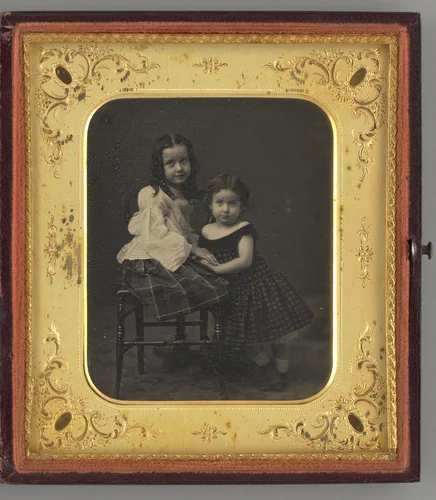
Beyond these landmark military photographs, Brady maintained a thriving business characterized by the earnest directness seen in works such as Untitled (Portrait of a Child) and Untitled (Portrait of Two Girls). His extensive studio output remains a vital resource for studying mid-nineteenth century American culture and costume. Today, much of his enduring photographic catalog resides in the public domain, offering historians and enthusiasts access to museum-quality resources and downloadable artwork, thereby securing his legacy as the defining visual chronicler of an era.
Source: Wikipedia · CC BY-SA 4.0