Master of the Playing Cards
The Master of the Playing Cards holds a singular and foundational position in the history of European graphic arts. Active predominantly in the Upper Rhine region of Southwestern Germany, likely Alsace, between approximately 1420 and 1440, this anonymous German engraver is widely acknowledged as the first major creative personality in the nascent field of printmaking. Before this period, prints were largely the product of anonymous workshops relying on woodcut techniques. The Master introduced a level of technical sophistication and artistic expression previously unseen, effectively transforming the medium from a craft into a powerful vehicle for pictorial representation. While his identity as a painter is often presumed based on the pictorial clarity and volumetric quality of his line work, it is through his distinctive and technically advanced engravings that his historical significance is secured.
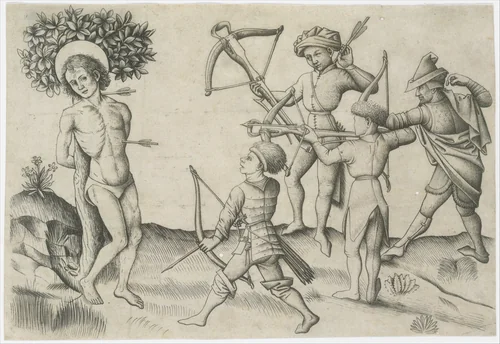
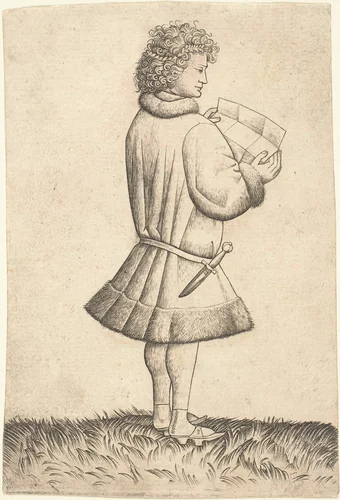
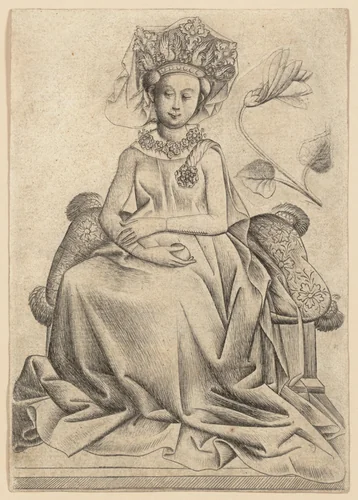
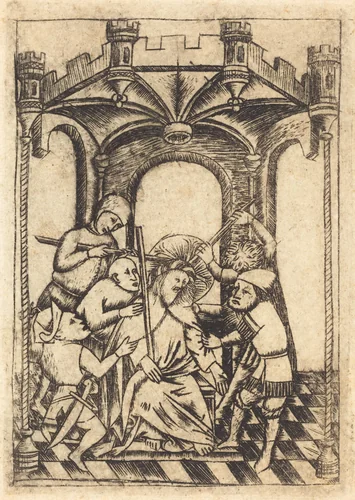
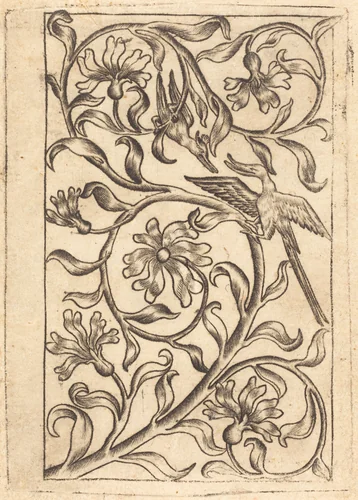
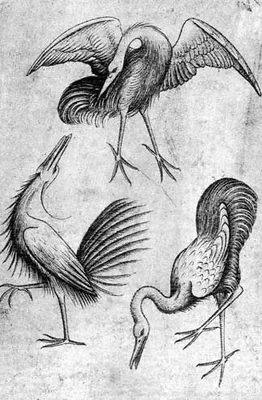
His surviving corpus is small but exceptionally influential, comprising chiefly Master of the Playing Cards prints characterized by exceptionally fine, controlled burin work. His lines are delicate yet firm, achieving subtle variations in tone and texture crucial for indicating volume and depth that prefigure techniques later perfected by Renaissance masters. The subject matter he explored was remarkably diverse, ranging from devotional imagery, such as Saint Sebastian and The Crowning with Thorns, to secular, courtly, and botanical studies like The Queen of Flowers and the elaborate Vine Ornament with Two Birds. His ability to capture narrative tension and nuanced expression in pieces like A Poet Reading suggests an artist capable of profound observation and high artistic ambition. It remains an ironic, yet fitting, historical detail that the individual responsible for establishing printmaking as a serious artistic discipline is known only by the scholarly nomenclature assigned to the set of magnificent, early playing cards that first captured scholarly attention.
The artistry exhibited in these early examples represents a crucial link between the late Gothic aesthetic and the emerging stylistic principles of the Renaissance. Today, these precious engravings are conserved in premier institutions globally, including the Metropolitan Museum of Art and the National Gallery of Art. The strength and precision of his graphic work confirm his status as an early pioneer whose work, though centuries old, remains culturally significant. Fortunately, the artistic achievements of the Master of the Playing Cards endure; foundational examples of his museum-quality work are often available today as high-quality prints for scholarly study and general appreciation.
Source: Wikipedia · CC BY-SA 4.0