Louis Lozowick
Louis Lozowick (1892–1973) stands as a seminal figure in American modernism, recognized particularly for his rigorous contribution to the Precisionist movement. Born in Ukraine, Lozowick immigrated to the United States and dedicated five decades to exploring the mechanized urban environment. His practice, spanning painting and printmaking, was defined by an intellectual approach to form and structure, establishing him as a key interpreter of early twentieth-century architectural ambition.
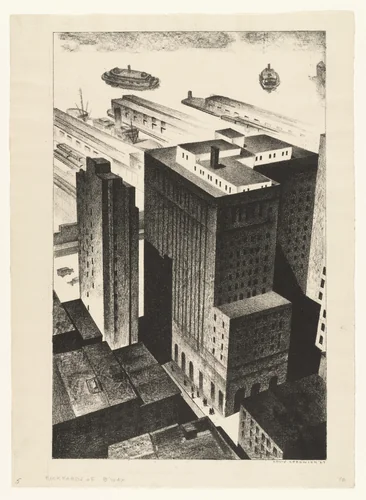
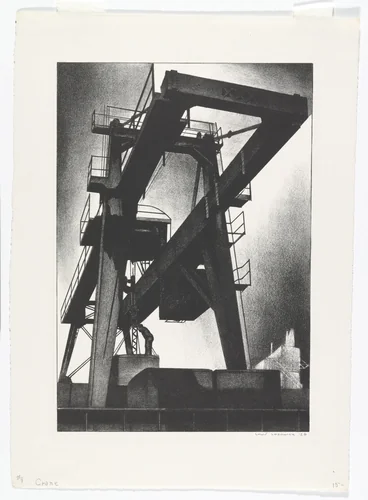
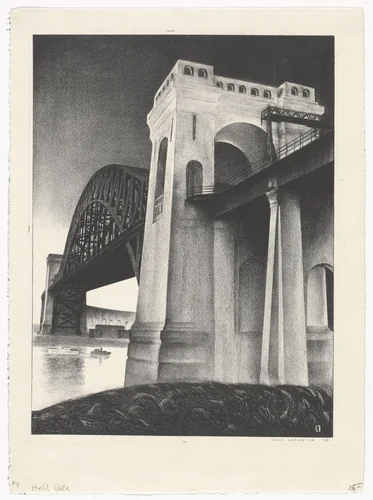
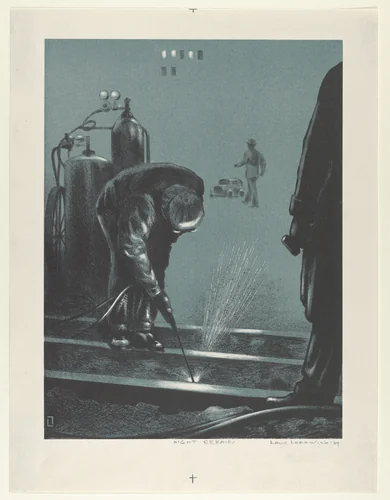
Lozowick embraced the machine age with distinct clarity, choosing the reproducible and graphically stark qualities of lithography as his primary medium. His most impactful period, spanning the mid-1920s to the late 1930s, yielded sophisticated, monochromatic works that capture the functional beauty of industrial infrastructure. Pieces such as Hellgate Bridge and Crane exemplify his Precisionist adherence to geometric clarity and streamline forms, reflecting the principles of both constructivism and the emerging Art Deco aesthetic. He found endless fascination in the density and complexity of metropolitan spaces, turning the mundane utility of a structure, like the elevated perspective seen in Backyards of Broadway, into a powerful, controlled composition.
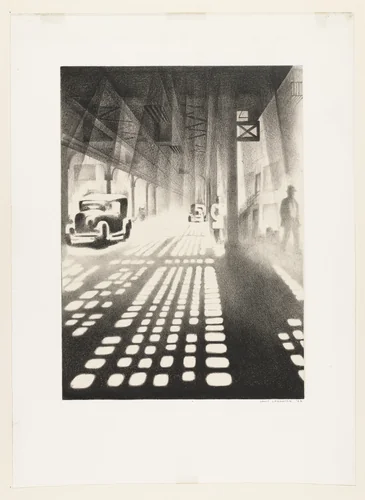
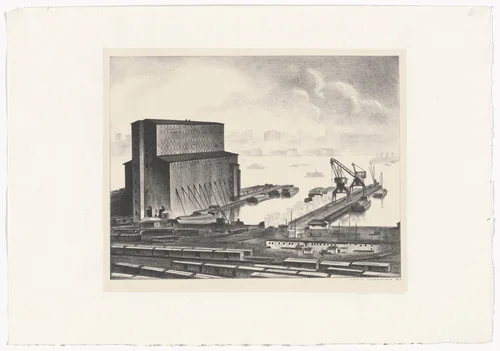
Unlike many European contemporaries who viewed industrialization with suspicion, Lozowick saw the skyscraper and the factory as emblems of American dynamism and possibility. This fundamental optimism lends his Louis Lozowick prints an underlying, albeit controlled, energy. It is perhaps surprising, given the overwhelming geometric dominance in his graphic output, that he spent significant early time studying theology before pivoting entirely to art; a detail suggesting that the search for underlying structure and ordered systems was always central to his worldview. His ability to distill chaotic city grids into organized visual codes is further demonstrated in the tension captured within Checkerboard and the busy dockside activity of Hoboken.
Lozowick’s focused, high-quality prints played a crucial role in documenting and defining the American urban aesthetic during the interwar years. His enduring significance is reflected in his presence within major institutional holdings, including the permanent collections of the Museum of Modern Art and the Metropolitan Museum of Art. Today, many of his defining works have entered the public domain, meaning researchers and enthusiasts can access high-quality prints and related imagery easily.
Source: Wikipedia · CC BY-SA 4.0