Louis Lafitte
Louis Lafitte (active 1790-1815) was a highly versatile French practitioner whose output encompassed painting, illustration, and large-scale mural design. Working across the volatile periods of the late eighteenth and early nineteenth centuries, Lafitte bridged the gap between academic drawing conventions and the practical requirements of liturgical and state commissions. While his recorded output is modest in number, the complexity of his surviving pieces confirms his mastery of narrative draftsmanship. His lasting institutional stature is reflected by the inclusion of his works, including key drawings and Louis Lafitte prints, in major North American collections such as the Metropolitan Museum of Art and the Art Institute of Chicago, confirming their status as museum-quality artifacts.
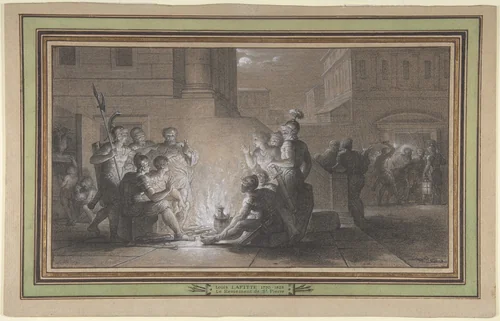
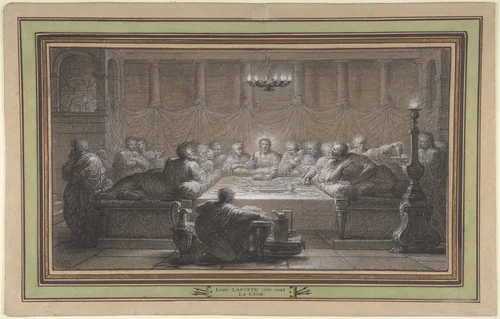
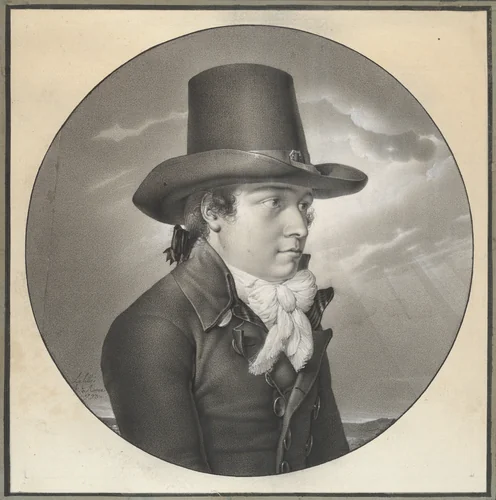
Lafitte’s known works frequently address grand religious themes alongside rigorous exercises in portraiture. His primary surviving medium appears to be drawing, exemplified by detailed compositional studies such as The Denial of Saint Peter and The Last Supper. These pieces reveal the technical precision expected of a designer trained in the demanding French academic system. Lafitte moved fluently between the roles of painter, designer, and illustrator, proving capable of executing both intimate studies, like Portrait of a Man, and complex, multi-figure narrative scenes.
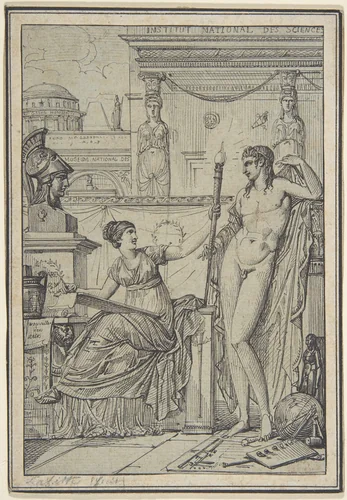
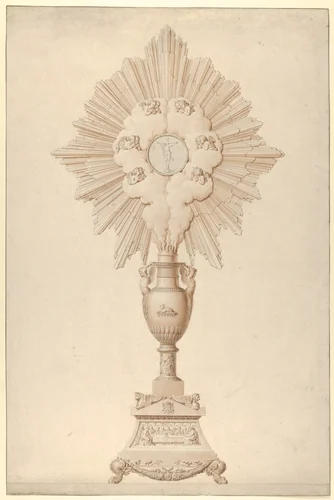
Crucially, Lafitte operated at the intersection of fine art and official patronage, extending his practice into functional design for the church and the state. This is evident in his preparatory drawing, Design for an Allegorical Print, which hints at his work as a commercial illustrator and printmaker. More specifically, the drawing for a Design for a Monstrance (Presented to the City of Trieste by King Louis XVIII) underscores his unique involvement in high-profile royal commissions during the fraught years of the Bourbon Restoration. It is perhaps characteristic of this era that an artist might spend as much time designing sacred vessels for foreign cities as illustrating grand epic narratives. The ultimate destination for such a design, Trieste, speaks volumes about the pan-European reach of French courtly influence following the Napoleonic wars.
Although evidence of large Louis Lafitte paintings is rare, the enduring quality of his draftsmanship ensures his relevance to scholars studying early nineteenth-century French graphic arts. Today, many of his finely executed drawings have entered the public domain. This accessibility allows institutions and enthusiasts globally to obtain downloadable artwork for study, ensuring that his distinct contributions as a designer and muralist remain visible far beyond the original French academies.
Source: Wikipedia · CC BY-SA 4.0