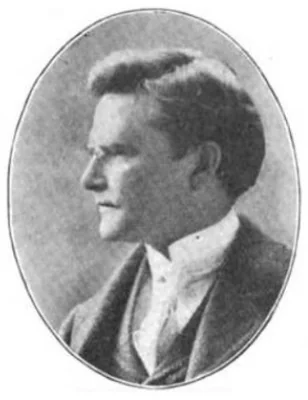
Louis Dalrymple
Louis Dalrymple (1866-1905) holds a significant position among the American political caricaturists whose output defined the visual culture of the late 19th-century Gilded Age. His biting commentary, disseminated through influential weeklies like Puck and Judge, established him as a critical voice in the evolving medium of mass-produced lithographic prints. The enduring institutional weight of his work is confirmed by its inclusion in major American collections, notably the Metropolitan Museum of Art and the Art Institute of Chicago.
Born in Cambridge, Illinois, Dalrymple received a rigorous formal training foundational to his distinctive graphic style. He studied first at the prestigious Pennsylvania Academy of Fine Arts before attending the Art Students League of New York. This comprehensive background in anatomy and composition allowed him to transition smoothly into the demanding world of journalistic cartooning. By 1885, his talent was formally recognized when he was appointed chief cartoonist for the New York Daily Graphic, cementing his role in shaping the nation’s political imagery during a period of intense industrial and political flux.
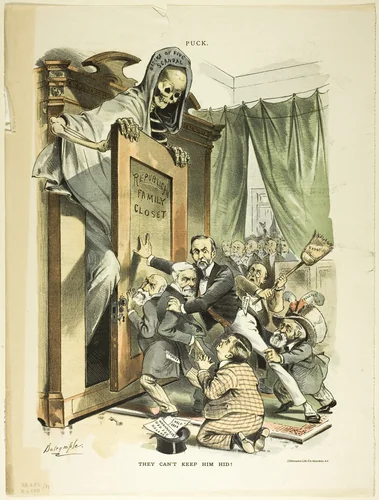
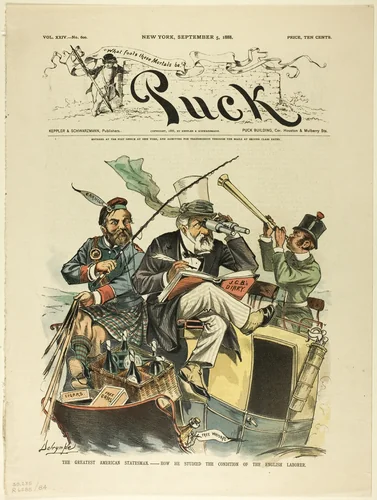
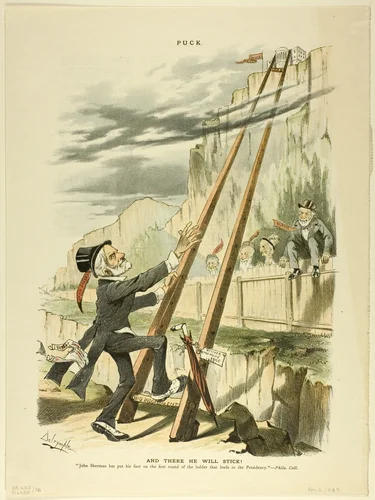
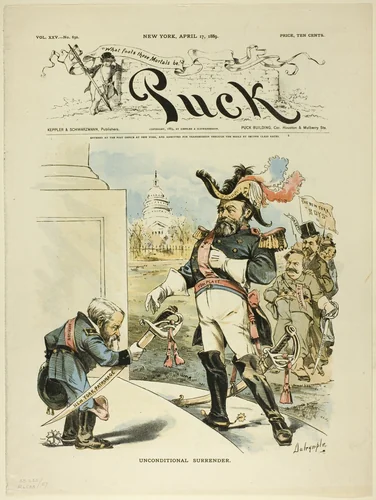
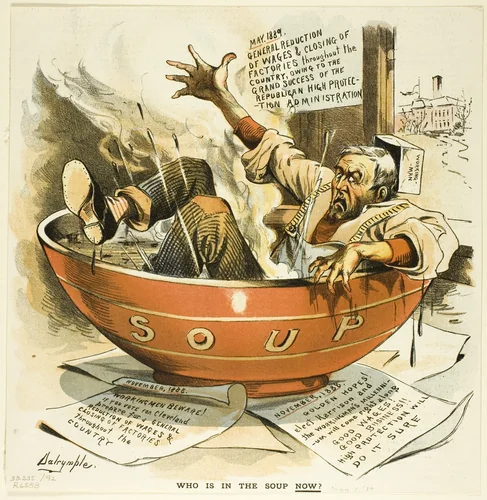
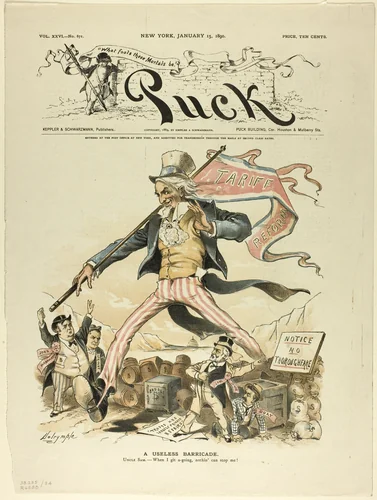
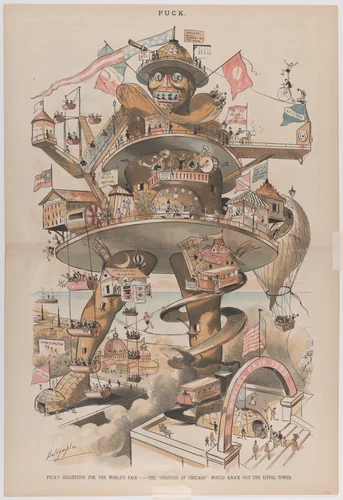
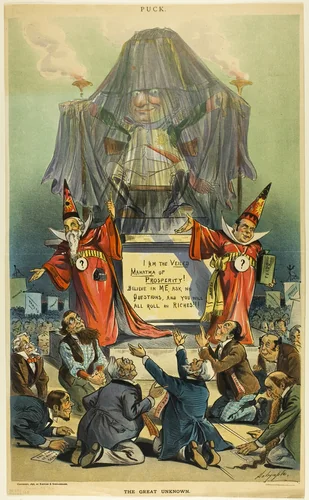
Dalrymple specialized in the often-savage political caricature that characterized the illustrated press of the period. His mastery lay in distilling complex political narratives and personalities into immediate, often humorous, visual metaphors. Pieces such as The Great American Statesman and Unconditional Surrender exemplify his focus on powerful public figures and the high stakes of policy debates. The popularity of these illustrations meant they frequently became the definitive public image of the person or policy under scrutiny. His frequent contributions to Puck, including works like They Can't Keep Him Hid and Who Is in the Soup Now, utilized the emerging color printing techniques of the time to maximum effect, making his Louis Dalrymple prints instantly recognizable.
Unlike some contemporaries who relied solely on pure grotesquery, Dalrymple’s caricatures maintain a certain restrained, if often deeply compromised, humanity. He possessed the rare ability to make powerful men look foolish without stripping them entirely of their gravitas, a subtle wit often prized in museum-quality illustration. Due to the historical scope of his career, much of his original output now falls into the public domain, ensuring that these important contributions to graphic history are available today as high-quality prints and downloadable artwork.
Source: Wikipedia · CC BY-SA 4.0