Louis Chéron
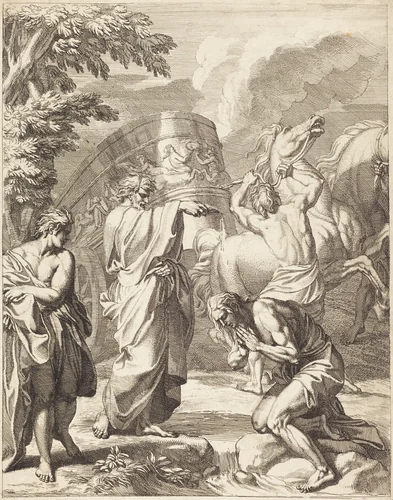
Louis Chéron was a French artistic polymath active between 1660 and 1695, recognized in his era not only as a prolific painter and illustrator but also as an influential art tutor. His professional activity spanned several crucial decades in the development of formalized French academy practice. Chéron’s surviving oeuvre, chiefly represented by superb examples of draftsmanship housed in major American institutions like the National Gallery of Art and the Art Institute of Chicago, provides crucial insight into the demanding academic training of the late Grand Siècle.
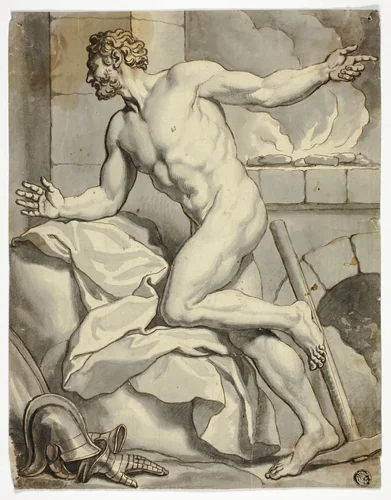
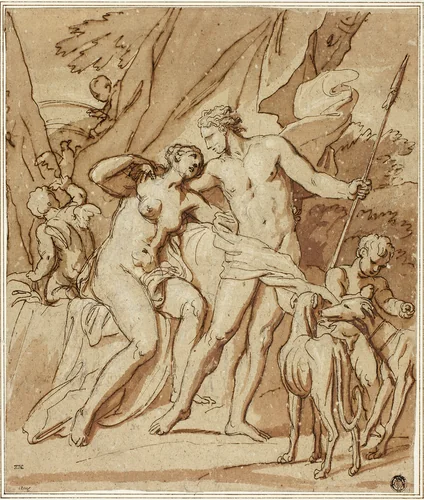
Chéron’s practice consistently prioritized classical and biblical narrative, rendered with an exacting attention to anatomy and dramatic composition, hallmarks of the period's dominant aesthetic. The five known works provide a focused overview of his technical specialties. In the sphere of mythological interpretation, his renderings are particularly strong, evidenced by the sensitive handling of Venus and Adonis and the dynamic figurative study Male Nude Kneeling beside a Furnace (Vulcan?), with Helmet and Metal Gloves on Floor. This latter drawing is a powerful example of Chéron balancing the demands of academic étude with mythological implication, successfully transforming a routine study of the musculature into an engaging narrative vignette.
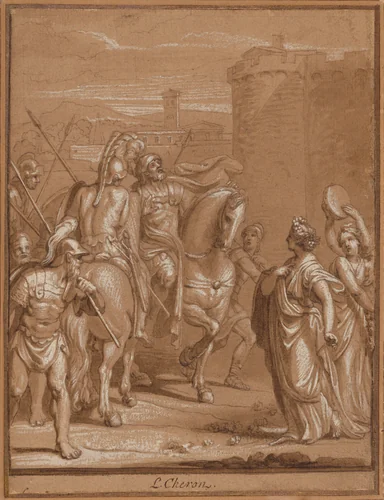
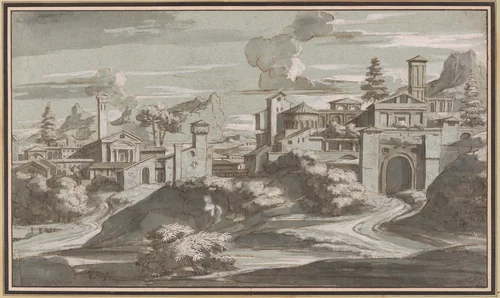
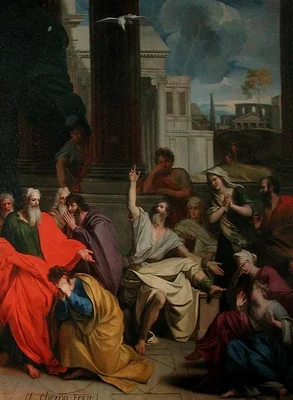
His Biblical subjects display equal narrative depth, from the emotionally fraught composition of Daughter of Jephthah to the devotional clarity found in Baptism of the Eunuch. Although his fame rests primarily on his figurative work and pedagogical skill, Chéron was also an adept practitioner of landscape. It is perhaps a telling detail that the only known print among his documented works is the Imaginary Classical Landscape, suggesting that while painting the figure provided his primary livelihood, the quiet rigor of scenic composition may have been a preferred, if less public, technical pursuit.
Chéron’s importance stems from his capacity to translate complex classical ideas into immediately legible visual forms, thereby establishing a high standard for illustration and instruction. Today, his contributions to 17th-century graphic arts are widely appreciated. Researchers and collectors seeking museum-quality examples of this period’s drawing style benefit greatly from the widespread availability of Louis Chéron prints and downloadable artwork, offering royalty-free access to the meticulous standards he upheld in the classroom and the studio.
Source: Wikipedia · CC BY-SA 4.0