London Stereoscopic Company
The London Stereoscopic Company (LSC) was a highly influential commercial photographic firm active primarily between 1850 and 1875. Operating out of London, the company played a crucial role in popularizing stereography, the technique of creating two slightly differing photographs intended to produce a three-dimensional image when viewed through a specialized device. The LSC specialized in producing and distributing a vast catalog of scenic, architectural, and narrative views to a burgeoning Victorian market.
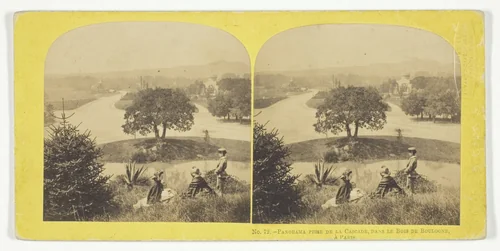
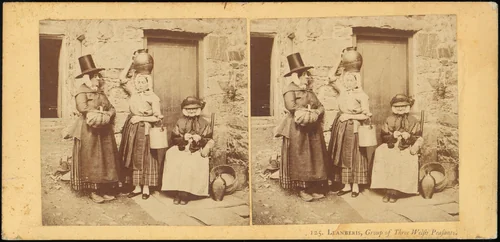
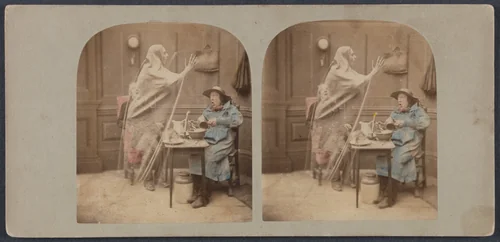
Six stereographs representing the Company’s diverse output are documented in major collections, reflecting the varied interests of the era. Their work encompassed landscape documentation, such as the comprehensive [Group of 13 Early Stereograph Views of British Castles] and Panorama Prise de la Cascade, dans le Bois de Boulogne, A Paris. They also produced important genre scenes and studies of populace, notably the ethnographic photograph Llanberis, Group of Three Welsh Peasants. The LSC was also renowned for novelty photography, including the theatrical narrative piece The Ghost in the Stereoscope.
Today, the work of the London Stereoscopic Company is preserved in major institutions, including the Metropolitan Museum of Art and the Art Institute of Chicago, affirming the firm’s historical importance in the development of commercial photography. Much of the LSC’s extensive body of work is now in the public domain, allowing researchers and collectors access to these historical images. Scholars frequently seek high-quality prints of original London Stereoscopic Company prints to examine early photographic techniques and mass market distribution methods.
Source: Wikipedia · CC BY-SA 4.0
![[Stereograph, Crystal Palace, John Bell's Una and the Lion] by London Stereoscopic Company, photograph, 1854-1862](https://img.artbee.org/86e1bd2d-80b3-4c5a-81fa-13272e435ff3/small.webp)
![[Group of 13 Early Stereograph Views of British Castles] by London Stereoscopic Company, photograph, 1860-1889](https://img.artbee.org/fd46550d-d4d3-4d0b-88e6-fcc94037d544/small.webp)