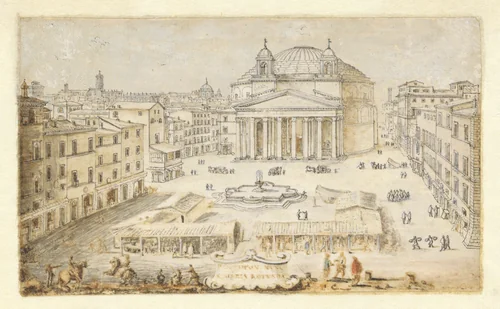
Lievin Cruyl
Lievin Cruyl (c. 1634-c. 1720), a Flemish priest by vocation, secured his artistic legacy through his highly refined skills as a draughtsman and etcher. Active primarily during the key transitional period between 1650 and 1665, Cruyl’s detailed architectural studies, particularly those rendered during extended sojourns in Italy and Paris, were instrumental in shaping the emerging genre of topographical depiction known as veduta.
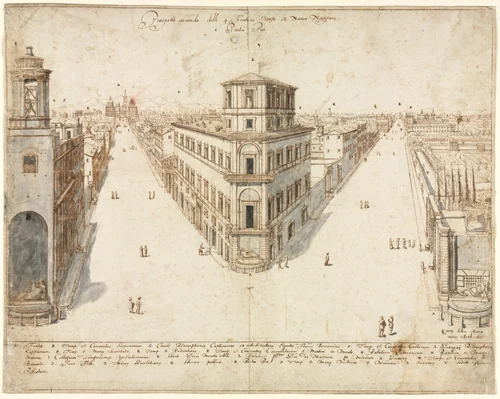
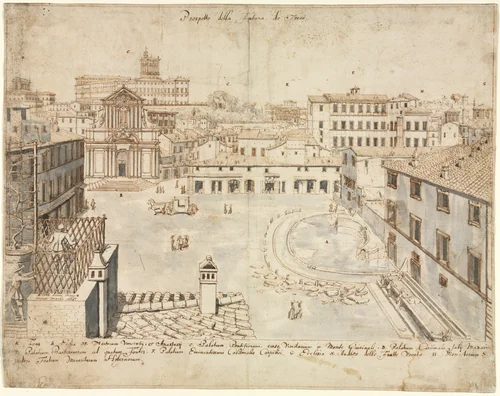
Cruyl specialized in the accurate, meticulously detailed representation of cityscapes, ruins, and significant public spaces. Unlike the idealized or purely schematic landscapes that preceded him, Cruyl’s output sought an aesthetically compelling and reliable documentation of specific locations. He captured both the monumental grandeur of ancient ruins, evidenced by drawings like Romeins landschap met ruïne, and the highly organized urban fabric of 17th-century capitals.
His most widely influential works are found in his celebrated series, the Eighteen Views of Rome, which transformed the preparatory architectural sketch into a finished art form suitable for mass distribution. These etchings, featuring recognizable landmarks such as the Piazza Colonna and the Basilica of Santa Maria Maggiore, demonstrate a keen mastery of perspective and light, providing an essential visual record of the Baroque city before subsequent centuries of modification. It remains a curious, yet fascinating, detail that a man dedicated primarily to ecclesiastical duties spent his most productive artistic years documenting the temporal street life and stone monuments of secular Europe.
Cruyl’s precise renderings served as foundational material for the great vedutisti who followed, establishing a visual language that defined the Grand Tour experience for over a century. Though his active period was brief, the dissemination of his reproducible prints ensured his influence was widespread. Today, the foundational drawings and early prints of Cruyl are preserved in major public collections, notably the Cleveland Museum of Art and the Rijksmuseum. The enduring visual authority of his work ensures that high-quality prints and downloadable artwork derived from these museum-quality holdings are widely available as essential public domain resources for both scholarship and appreciation.
Source: Wikipedia · CC BY-SA 4.0
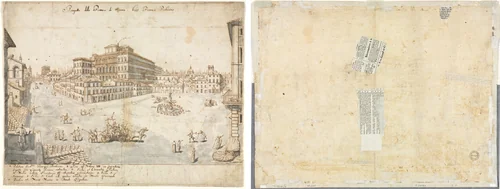
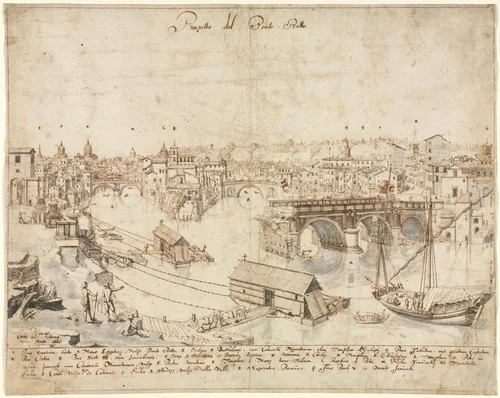
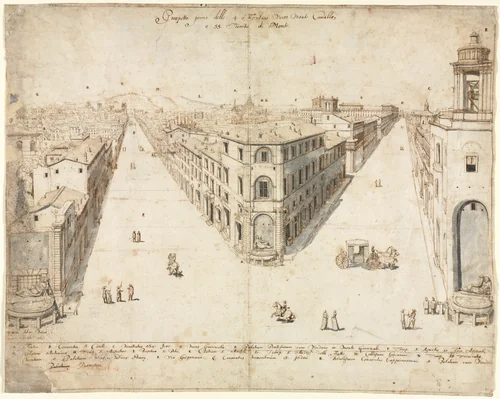
!["Prospectus Locurum Urbis Romae Insign[ium]" by Lievin Cruyl, print, 1666](https://img.artbee.org/763d5dc1-8a4f-48c6-9ac0-476c8bb708ee/small.webp)
![Foro Romano from "Prospectus Locurum Urbis Romae Insign[ium]" by Lievin Cruyl, print, 1666](https://img.artbee.org/710fbcea-7945-4da3-8ab5-1a3b7727232f/small.webp)
![Frontispiece from "Prospectus Locurum Urbis Romae Insign[ium]" by Lievin Cruyl, print, 1666](https://img.artbee.org/16dbcdd3-02cb-4d25-b2ad-27c99668a76a/small.webp)
![Il Colosseo e l'Arco di Costantino from "Prospectus Locurum Urbis Romae Insign[ium]" by Lievin Cruyl, print, 1666](https://img.artbee.org/bbd09d8b-430c-4985-a093-26cef4f3e66f/small.webp)
![Piazza Colonna from "Prospectus Locurum Urbis Romae Insign[ium]" by Lievin Cruyl, print, 1666](https://img.artbee.org/a4e437a3-7fcb-42d5-917c-c6ead7e3a0bb/small.webp)
![Piazza Navona from "Prospectus Locurum Urbis Romae Insign[ium] by Lievin Cruyl, print, 1666](https://img.artbee.org/d05cac85-49ce-4af6-aa52-199cf6687168/small.webp)
![Piazza del Popolo from "Prospectus Locurum Urbis Romae Insign[ium]" by Lievin Cruyl, print, 1666](https://img.artbee.org/ff1d6c22-9504-4bab-be15-036cd68dcc50/small.webp)
![S. Giovanni in Laterano from "Prospectus Locurum Urbis Romae Insign[ium]" by Lievin Cruyl, print, 1666](https://img.artbee.org/c2807af5-d7d8-40a4-85d7-2b8e38da5cc8/small.webp)
![Santa Maria Maggiore from "Prospectus Locurum Urbis Romae Insign[ium]" by Lievin Cruyl, print, 1666](https://img.artbee.org/8de0f52a-cd86-4b92-8791-1a6148c7c389/small.webp)
![St. Angelo from "Prospectus Locurum Urbis Romae Insign[ium] by Lievin Cruyl, print, 1666](https://img.artbee.org/b2234e01-713f-425f-b1c5-2342e81d04e2/small.webp)
![St. Peter's Basilica from "Prospectus Locurum Urbis Romae Insign[ium]" by Lievin Cruyl, print, 1666](https://img.artbee.org/d990445c-c0e9-42e9-8149-35e5642920f7/small.webp)
![Trajan's Column from "Prospectus Locurum Urbis Romae Insign[ium] by Lievin Cruyl, print, 1666](https://img.artbee.org/7b17868a-bacd-44e3-b46f-ef1893be6d3d/small.webp)