Lawrence Phillips
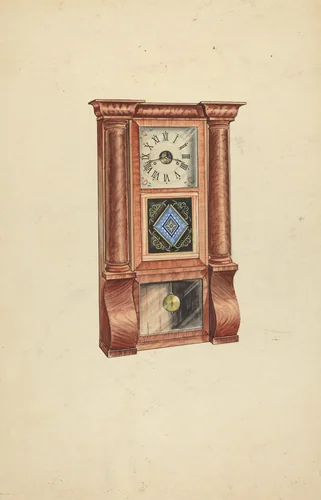
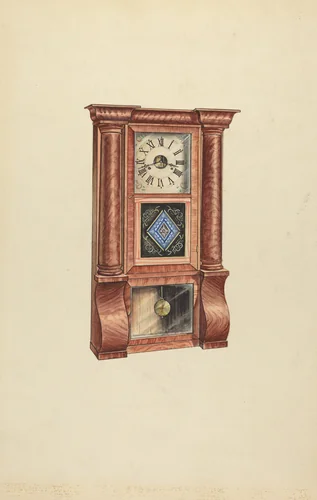
Lawrence Phillips is chiefly recognized for his concentrated output as a contributor to the Index of American Design (IAD), a seminal initiative established during the Federal Art Project of the Works Progress Administration (WPA). Active primarily between 1935 and 1936, Phillips was one of the many skilled draftsmen tasked with documenting the material culture and folk traditions of the United States. His fifteen documented entries provided crucial visual records of domestic objects that predated industrial uniformity, preserving the specific details of early American craftsmanship.
The Index, which aimed to create a comprehensive visual encyclopedia of American decorative arts, relied on exacting rendering skills to capture texture, typology, and construction. Phillips’s assignments focused on vernacular furniture and household utilities, resulting in meticulous plates of items like the robust Court Chest, several variations of the traditional Desk, the specialized thermal accessory known as the Foot Warmer, and a functional Armchair. These drawings served a dual purpose: they provided invaluable source material for contemporary designers seeking inspiration in American heritage, and they established museum-quality documentation of objects often overlooked by academic institutions.
Phillips's contribution, while brief in duration, forms an essential part of this vast preservation effort. The resulting illustrations are today held in the esteemed permanent collections of the National Gallery of Art (NGA) in Washington D.C., and are frequently studied by historians of American design. These important historical records are accessible as royalty-free documentation, forming part of the public domain’s catalogue of downloadable artwork. The precise rendering style of Lawrence Phillips prints allows for the clear study of historical joinery and material finishes.
The historical record indicates a remarkably focused two-year period of artistic endeavor. It is a peculiar circumstance of biography that his subsequent life followed a dramatically different, and much publicized, trajectory, sharply contrasting the quiet dedication evident in his archival work. Nevertheless, his legacy within the Index remains robust—a concentrated period of artistic achievement whose results continue to provide high-quality prints for researchers and enthusiasts worldwide.