Kano Hideyori
Kano Hideyori stands as a significant, though historically elusive, figure within the dominant Kyoto-based Kano School, operating during the pivotal mid-16th century and active around 1525. This placement situates him perfectly at the cusp of the Momoyama period (1573–1603), a time of major artistic transformation in Japan. While the exact dates of his birth and death remain unknown, available records confirm his professional affiliation with the artistic dynasty that held a near-monopoly on official government and temple commissions.
Hideyori’s professional standing is confirmed by his familial link to the school’s greatest organizing force. He is widely accepted by scholars to be either the son or the grandson of the highly influential Kano Motonobu, the master responsible for standardizing the school’s rigorous academic curriculum. This proximity to the center of power helps explain the technical sophistication evident in the few Kano Hideyori paintings that have survived the intervening centuries. Interestingly, the scarcity of detailed personal documentation is not unusual for an artist working within such a powerful, multigenerational enterprise, where the institution often overshadowed the individual.
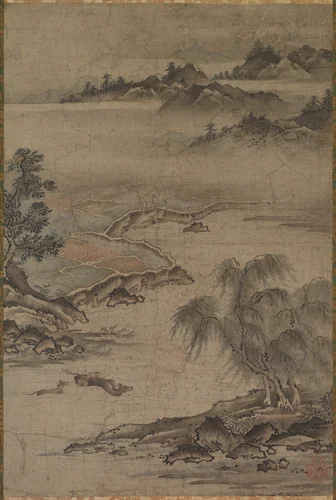
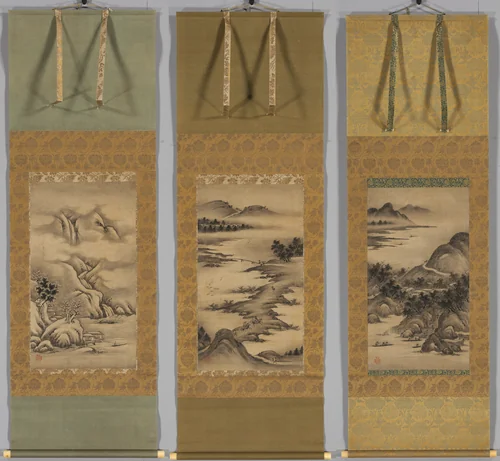
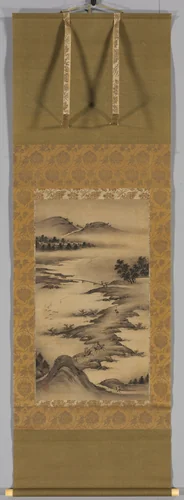
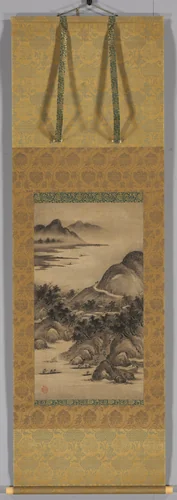
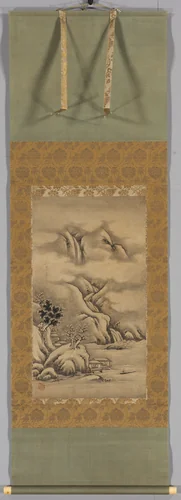
Hideyori’s enduring reputation rests on a small handful of exquisitely rendered compositions, currently preserved primarily within the collection of the Cleveland Museum of Art. These include Farming and Herding Buffalo in Summer and four panels from Seasonal Landscapes (Summer, Autumn, and Winter being the known extant pieces). These works showcase the precise ink outlines and controlled brushwork characteristic of the Kano tradition, skillfully adapting Chinese academic models, known as shin style, while infusing them with a distinctly Japanese atmospheric quality.
The Seasonal Landscapes demonstrate a confident command over complex visual space and tonal variation, while the composition depicting buffalo and farmers provides a unique, understated counterpoint. The quiet humor and keen observation evident in the bustling activity of the farmers offer a subtle personality often masked by the formal demands of the institutional landscape tradition. Today, appreciating such museum-quality artifacts is easier than ever; many historical images, including Kano Hideyori prints, have entered the public domain, making high-quality prints and downloadable artwork accessible worldwide for study and enjoyment. Despite the thin biographical record, the technical and visual excellence of his surviving oeuvre secures Hideyori’s place in the narrative of Momoyama period transition.
Source: Wikipedia · CC BY-SA 4.0