Juste de Juste
Juste de Juste (active c. 1535-1540) is a significant Franco-Italian figure who bridged the artistic languages of the high Renaissance and early Mannerism, playing a critical role in the development of the School of Fontainebleau. Born into the Betti family, a recognized dynasty of sculptors near Florence, he adopted the name 'Juste' after his father Antonio and two brothers emigrated to France, where they spent the majority of their successful careers. This dual heritage provided Juste de Juste with a unique foundation, allowing him to integrate Italianate structural solidity with the dramatic visual elongation favored by French courtly taste.
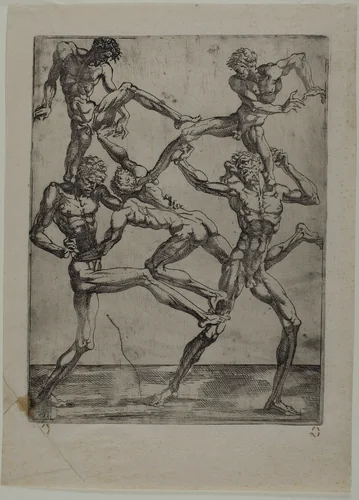
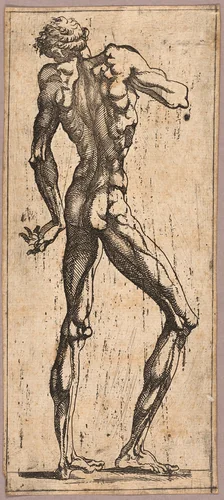
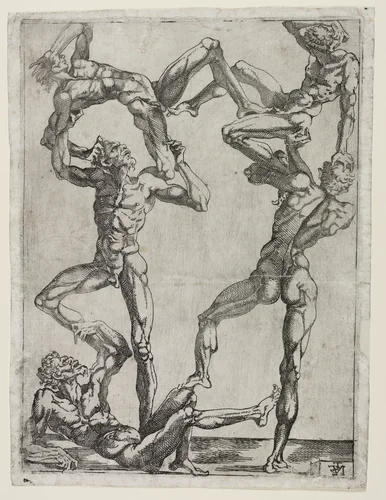
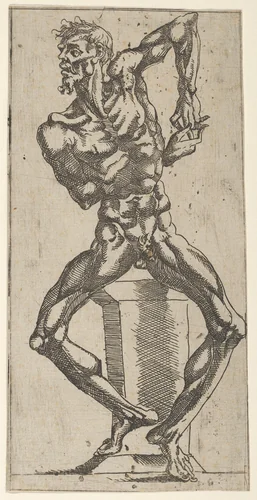
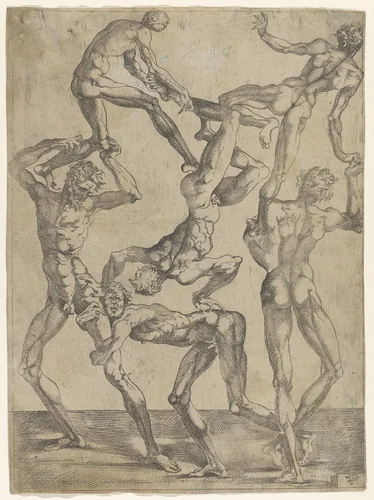
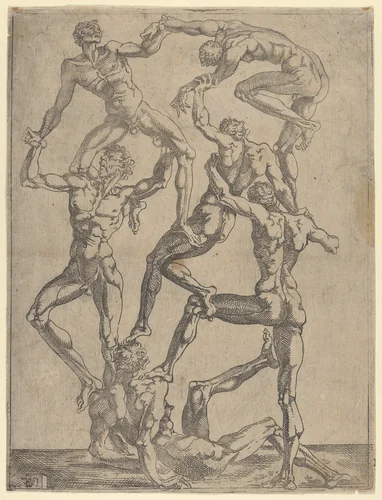
His short, intense period of activity confirms his status not only as a sculptor but as one of the era’s most innovative printmakers working in etching. Juste de Juste is confidently identified as the author of seventeen highly technical etchings focused almost exclusively on the male figure, often presented in challenging, academic poses. Works such as Pyramid of Five Men and Man Turning His Head to the Left demonstrate an obsessive anatomical precision coupled with the expressive dynamism characteristic of the nascent Mannerist movement. These prints served a critical function, circulating studies of musculature and sculptural form that were otherwise difficult to share across geographic boundaries.
The artist also functioned as a skilled stuccoist under the direction of Rosso Fiorentino, placing him at the epicenter of the decorative revolution underway at the royal palace of Fontainebleau. His ability to translate complex three-dimensional forms into repeatable formats, whether in etched copper or molded relief, was highly valued in the court environment. It is perhaps a subtle reflection of his dedication to craft that he signed his etchings with an intricate and rather cryptic monogram, suggesting an artist keen to protect the proprietary nature of his technical methods.
Though his active period was brief, Juste de Juste’s legacy endures through his groundbreaking etchings. Held in major collections globally, including the Metropolitan Museum of Art, these rare Juste de Juste prints are recognized as foundational documents for understanding sixteenth-century artistic theory. Many of his surviving works are now in the public domain, ensuring that museum-quality images and high-quality prints remain accessible for scholarly research and contemporary appreciation.
Source: Wikipedia · CC BY-SA 4.0