Julien Vallou de Villeneuve
Julien Vallou de Villeneuve was a foundational figure in early French photography, recognized today alongside his roles as a painter and lithographer. Active for a relatively brief but critical span, approximately 1848 to 1854, his work bridges the established academic tradition of figure drawing with the revolutionary potential of the camera. His pioneering efforts placed him at the core of nineteenth-century artistic innovation, a significance confirmed by the presence of his photographs in major international institutions, including the Museum of Modern Art and the National Gallery of Art.
Initially known for his skills in lithography, Vallou de Villeneuve’s most enduring legacy stems from his photographic series, Études d’après nature (Studies after Nature). These works, which include titles such as [Reclining Female Nude] and [Standing Female Nude], were conceived not as final artistic declarations but as high-quality preparatory documents. The series was explicitly created to provide artists with detailed, reproducible studies of the human form, free from the constraints of live models. The rigorous, often stark posing inherent in works like Study after Nature reflects the classical academic standards of the period, demonstrating Vallou de Villeneuve’s intent to serve the instructional needs of the fine arts.
This shift from traditional media, following his earlier Julien Vallou de Villeneuve paintings and prints, positioned him as a pragmatic innovator. He successfully navigated the contentious early years of photography by marketing the medium’s efficiency rather than its spiritual or aesthetic claims. There is a subtle irony in the fact that these photographs, originally intended as mere visual utilities for the Parisian studio, are now celebrated as powerful, independent museum-quality artworks that defined the photographic nude in France.
The surviving collection of Julien Vallou de Villeneuve prints offers invaluable insight into mid-century realism and the technical evolution of the medium. Today, recognizing their historical importance and age, many of these pioneering images fall into the public domain, making downloadable artwork and high-quality prints widely accessible for both academic study and appreciation. His concise yet potent output ensured that his technical precision profoundly influenced later generations tackling the complexities of the human figure.
Source: Wikipedia · CC BY-SA 4.0
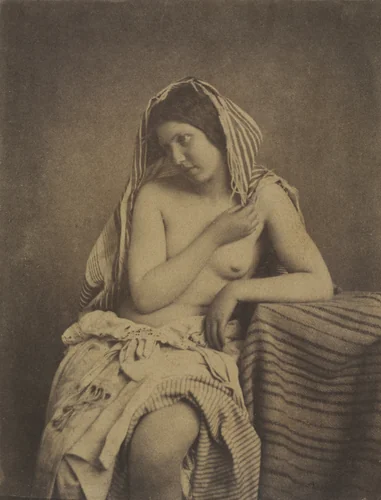
![[Female Nude, Reclining, in Profile] by Julien Vallou de Villeneuve, photograph, 1851-1855](https://img.artbee.org/e741a797-a895-45b9-8c34-9bc300b15f42/small.webp)
![[Reclining Female Nude] by Julien Vallou de Villeneuve, photograph, 1851-1855](https://img.artbee.org/af785a89-7bee-4e72-a6fb-6ac7231a9f3f/small.webp)
![[Reclining Nude] by Julien Vallou de Villeneuve, photograph, 1851-1853](https://img.artbee.org/9c600d67-dd24-40fc-992d-9a1aa1c6731a/small.webp)
![[Standing Female Nude] by Julien Vallou de Villeneuve, photograph, 1851-1855](https://img.artbee.org/49b65888-1c44-49d8-9fda-ca1a24684081/small.webp)
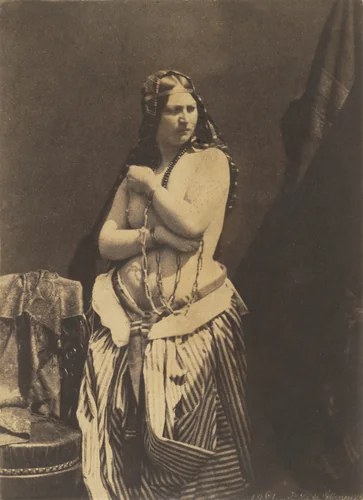
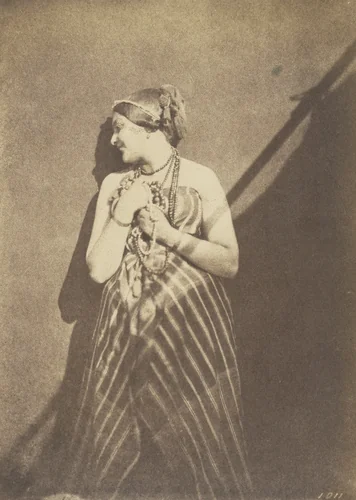
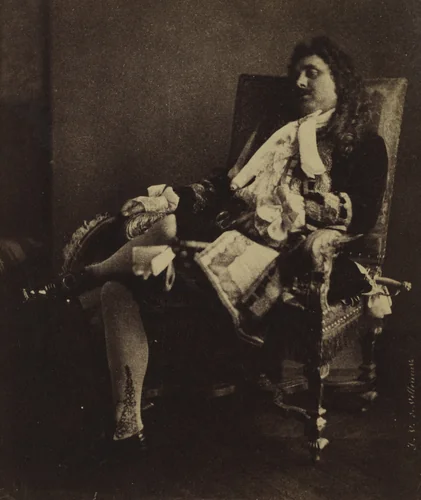
![Étude d'après Nature [nude study] by Julien Vallou de Villeneuve, photograph, 1854](https://img.artbee.org/93e7cf94-9c2f-4ca6-934d-a365b678549e/small.webp)