Joseph von Führich
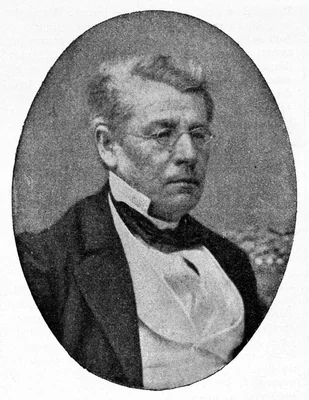
Joseph von Führich (1800-1886) stands as a foundational figure within 19th-century Austrian religious art, celebrated for his profound devotional intensity and his rigorous adherence to sacred narratives. A prominent member of the Nazarenes movement, Führich dedicated his artistic output almost exclusively to reflecting and revitalizing Christian iconography, placing him firmly in opposition to the prevailing academic styles of his era.
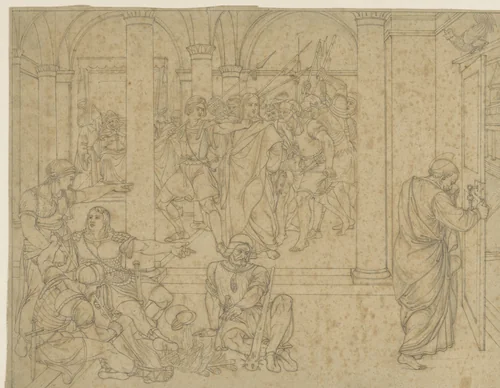
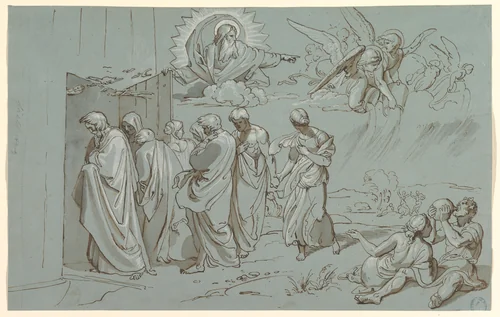
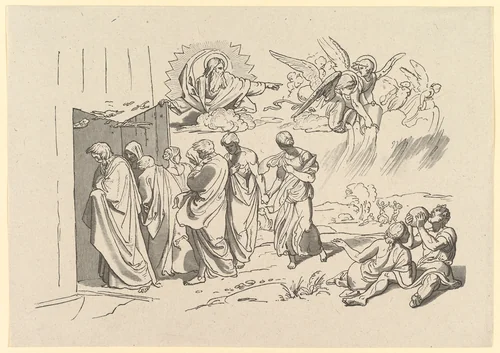
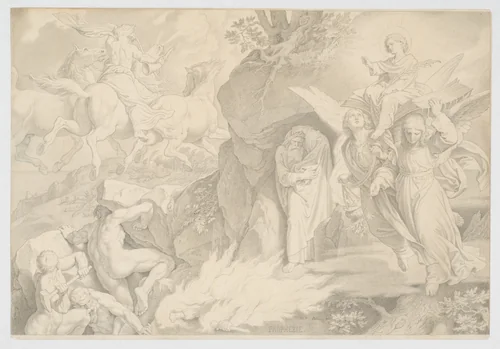
Though he painted large-scale religious commissions, Führich acquired his greatest and most enduring fame as a draughtsman. He perfected an exacting graphic style that translated complex biblical stories, such as the detailed staging seen in Petrus verloochent Christus, voorgesteld in de hal van het gerechtsgebouw and the powerful imagery of God Summons Noah and His Family into the Ark. This mastery of line work cemented his status among his contemporaries. His commitment to the pen allowed him to articulate the spiritual sincerity prioritized by the Nazarenes, a group dedicated to modeling their production after the pure, pre-Raphaelite masters of the Italian Renaissance.
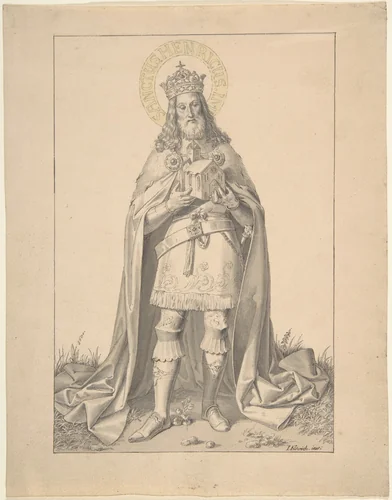
It is perhaps a subtle irony that an artist dedicated to monumental, spiritually resonant themes found his greatest renown not on the canvas, but in the intimate and demanding medium of the drawing. His meticulous study drawings and finished preparatory works, including Saint Henry (Emperor Henry II) and Prophesie, reveal a profound structural clarity that informs the entire corpus of Joseph von Führich paintings and prints.
The clarity and graphic precision of his production ensure that his legacy remains central to understanding the visual culture of piety in Central Europe. Today, original examples of Führich’s work are housed in major international holdings, including the Rijksmuseum and the Metropolitan Museum of Art, testifying to their museum-quality importance. Furthermore, the prolific nature of his drawings means that much of his exceptional draftsmanship is available today within the public domain, ensuring scholars and enthusiasts can access high-quality prints and downloadable artwork for continued study and appreciation.
Source: Wikipedia · CC BY-SA 4.0