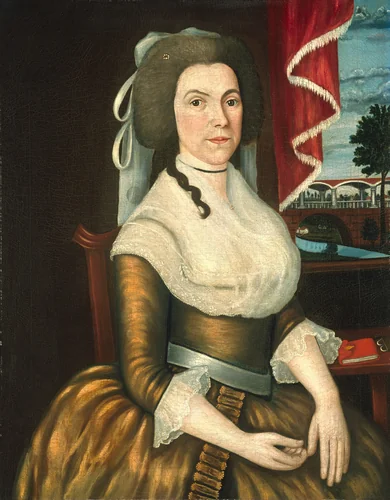
Joseph Steward
Joseph Steward (1753-1822) was a highly unusual figure in early American cultural history, occupying the simultaneous roles of minister, portrait painter, and pioneering museum curator. While his ministerial and institutional efforts defined his later career, Steward’s enduring significance rests on a brief but important period of artistic activity between 1787 and 1790, which yielded a small but distinctive corpus of portraits now housed in prestigious American institutions, including the Metropolitan Museum of Art and the National Gallery of Art.
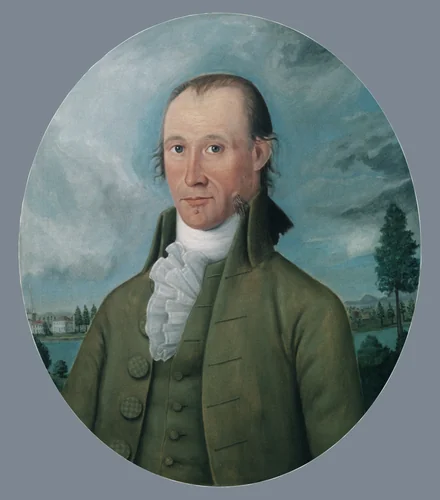
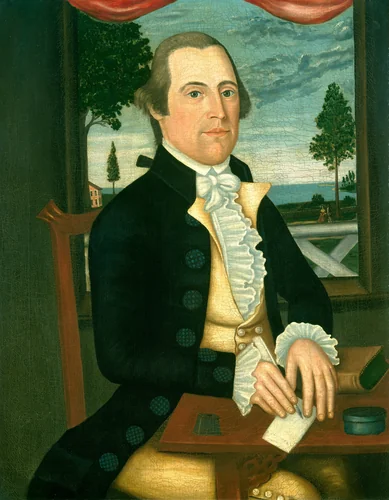
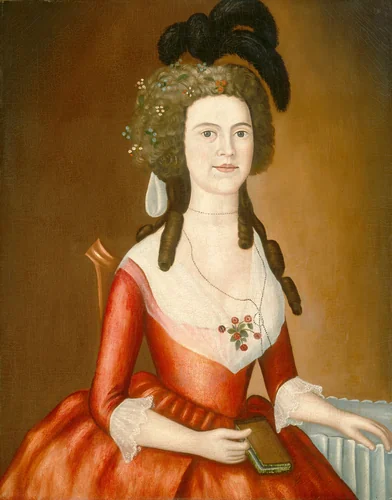
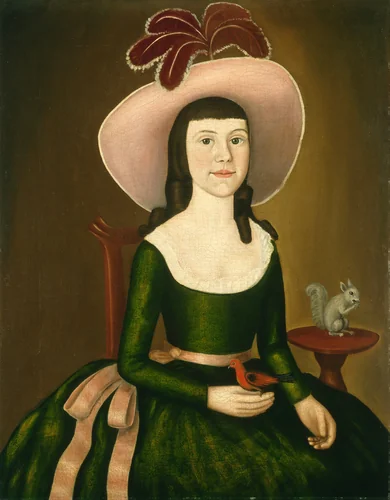
The surviving Joseph Steward paintings reveal a focused clientele drawn from the prosperous merchant and military class of New England, particularly Connecticut. His style is characteristic of the Federalist era: direct, meticulously observed, and reserved. His sitters are presented without undue flourish, emphasizing character and status through carefully rendered attire and accessories. Key works in this period include the detailed study of Jonathan Dwight, alongside a series of intimate portraits depicting the interconnected Denison family of Stonington: Captain Elisha Denison, Elizabeth Denison, and the elegantly composed Mrs. Elizabeth Noyes Denison.
The meticulous nature of these likenesses suggests a painter fully engaged in the professional demands of his craft, yet Steward’s commitment to the canvas proved temporary. It is perhaps telling that, after establishing a visual record of his peers, he shifted his primary focus from the individual subject to the institution itself, becoming one of the nation’s earliest figures dedicated to curatorial practice.
Though few in number, these works provide vital documentation of post-Revolutionary American society and represent an important contribution to late eighteenth-century regional portraiture. Because many of these historic images are now in the public domain, they offer rich resources for art historical scholarship. The ability to access downloadable artwork means that high-quality prints of Steward’s distinct portraits are widely available, ensuring that his visual record remains accessible to a broad, contemporary audience.
Source: Wikipedia · CC BY-SA 4.0