John Sanderson
John Sanderson is recognized primarily for his masterful contribution to mid-eighteenth century English interior design, specifically through his concentrated involvement at Kirtlington Park in Oxfordshire. Active during a concise period between 1742 and 1748, Sanderson executed detailed architectural and decorative plans that exemplify the sophisticated taste of the era-a moment when the strictures of mature Neo-Palladianism were beginning to incorporate more refined, transitional ornamentation. His surviving works, notably five distinct drawings now housed in the collections of the Metropolitan Museum of Art, provide rare and granular insight into the comprehensive process of integrating structure and high-style finishing in a major country house commission.
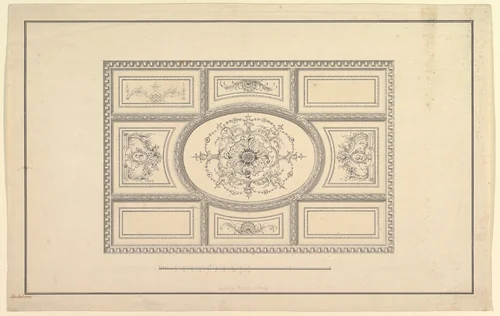
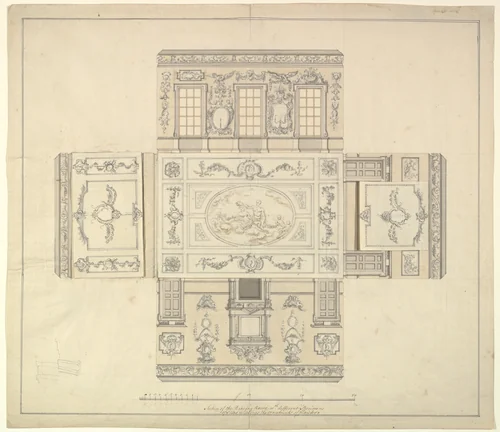
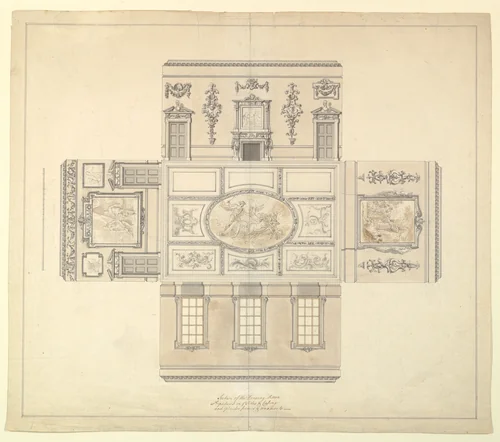
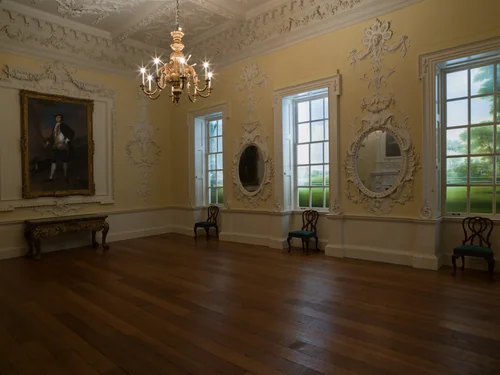
Sanderson’s output reveals a meticulous focus on stylistic coherence and ambitious decorative scale. His primary concern at Kirtlington was the precise articulation of the ceremonial spaces, particularly the Dining Room, which served as a key focal point for aristocratic socializing. The surviving sequence of detailed drawings illuminates this process, beginning with the overall structural framework, seen in the Design for the Dining Room at Kirtlington Park, Oxfordshire, and progressing to the minute decorative decisions, culminating in the Design for Ceiling at Kirtlington Park, Oxfordshire. These plans demonstrate an intimate understanding of proportion and decorative balance, consciously moving away from earlier heavy Baroque flourishes toward controlled, classical motifs.
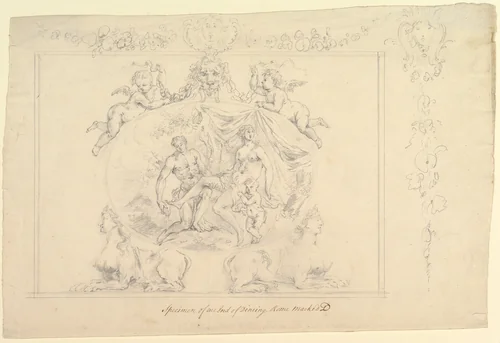
Perhaps his most significant artistic achievement was the perceptive integration of mythological easel painting directly into the architectural framework. This is best illustrated by his preparatory plan, Design for the painting, Mars, Venus & Cupid for the Dining Room at Kirtlington Park, Oxfordshire. Such precise documentation ensured that the final figure painting, surrounding stucco work, and cornice architecture operated in perfect visual harmony, defining the room’s intellectual and social purpose. The work speaks to the demanding environment of mid-century patronage, where a designer needed to coordinate diverse trades-including architects, specialist figure painters, and highly skilled stucco workers-to achieve unified results.
Although the known corpus of Sanderson's designs is necessarily small, reflecting his specialized role within the larger design ecosystem of the time, their high standard ensures their continuing relevance to the study of 18th-century interior architecture. Today, scholars and enthusiasts often seek out John Sanderson prints and related materials, finding these detailed architectural documents available as high-quality prints made accessible through institutionally supported public domain initiatives. It is a subtle historical curiosity that, centuries later, the name John Sanderson would be associated with a high-ranking military officer and vice-regal representative, the former Governor of Western Australia-a strange, modern echo of a forgotten designer's precision.